In This Article
Shared Roots and the Great Divergence
To speak of Carnatic and Hindustani music as entirely separate traditions would be misleading. Both systems trace their theoretical foundations to common ancient sources — the Natyashastra of Bharata Muni (circa 2nd century BCE to 2nd century CE) and the Sangita Ratnakara of Sarngadeva (13th century CE), the latter often described as the last major treatise before the two traditions began to crystallise into distinct identities. Sarngadeva, a Kashmiri scholar working in the Yadava court of Devagiri (modern-day Daulatabad, Maharashtra), synthesised concepts that both systems would later claim as foundational.
The divergence is generally placed between the 13th and 16th centuries, catalysed by the establishment of Islamic courts in northern India. The Delhi Sultanate and later the Mughal Empire created fertile ground for Persian and Central Asian musical influences to intermingle with the existing Sanskritic tradition. Figures like Amir Khusrau (1253–1325), the polymath poet-musician of the Delhi court, are credited — sometimes apocryphally — with introducing new ragas, talas, and instruments that would come to define the Hindustani idiom. Meanwhile, in the southern kingdoms — the Vijayanagara Empire and later the Nayak courts of Thanjavur and Madurai — the older Sanskritic framework was preserved, refined, and enriched by towering composer-saints.
The result is two systems that share a common DNA — the concepts of raga (melodic framework), tala (rhythmic cycle), shruti (microtonal pitch), and swara (musical note) — yet express these concepts through markedly different aesthetic philosophies, performance practices, and repertoires.
Composition Versus Improvisation: Where the Emphasis Falls
Perhaps the most fundamental difference between the two traditions lies in the balance between pre-composed material and spontaneous elaboration.
Carnatic music is composition-centric. The tradition is anchored by the monumental works of the Trinity — Tyagaraja (1767–1847), Muthuswami Dikshitar (1775–1835), and Syama Sastri (1762–1827) — whose kritis form the bedrock of virtually every concert. A Carnatic performer's artistry is measured not only by improvisational skill but by fidelity to the sahitya (lyrical text) and the melodic and rhythmic architecture of the composition. Improvisation exists in abundance — through alapana, niraval, kalpanaswaram, and the elaborate ragam-tanam-pallavi — but it orbits around and serves the composition.
Hindustani music is improvisation-centric. A typical Hindustani performance begins with an extended alap — a slow, meditative, unmetered exploration of the raga — that can last thirty minutes or more before any composition is introduced. The bandish (composition) in a khayal performance, while essential, often serves as a launchpad for elaborate improvisatory passages (badhat, taan, bol-taan). The performer's individual expression and spontaneous creativity are paramount. This is why two renderings of the same raga by the same Hindustani musician can sound vastly different, while a Carnatic musician's rendering of a particular kriti will retain recognisable structural identity across performances.
"In Carnatic music, the composition is the temple and improvisation is the worship within it. In Hindustani music, the raga itself is the temple, and the musician builds it anew each time."
Raga, Tala, and the Question of Time
While both systems use the concept of raga, their classification schemes and nomenclature differ considerably. Carnatic music organises its ragas under the 72 melakarta scheme, a comprehensive, mathematically derived system of parent scales formalised by Venkatamakhin in his Chaturdandi Prakashika (1660). Every raga is either a melakarta (parent, with a complete ascending and descending scale) or a janya (derived) raga. This system is exhaustive and logically elegant.
Hindustani music employs the thaat system, codified by Vishnu Narayan Bhatkhande (1860–1936) in the early 20th century, which groups ragas under ten parent scales. Bhatkhande's classification, while practical, is acknowledged as less comprehensive than the melakarta framework — many ragas do not fit neatly into any single thaat.
Nomenclature diverges strikingly. Ragas that are melodically identical or nearly so bear different names in the two systems. The Hindustani raga Yaman corresponds closely to the Carnatic Kalyani; Bhairavi in the north is broadly equivalent to Sindhu Bhairavi or Todi in the south (depending on context); the Hindustani Todi maps more closely to the Carnatic Shubhapantuvarali. These cross-references are a source of enduring fascination — and occasional confusion — for rasikas exploring both traditions.
Time theory (samay) is a distinctive feature of Hindustani music, largely absent in Carnatic practice. Hindustani ragas are traditionally assigned to specific times of day or night, or to particular seasons — Bhairav and Lalit for the early morning, Malkauns and Darbari Kanada for the late night, Megh for the monsoon season. This time theory, rooted in the belief that each raga's emotional resonance (rasa) aligns with natural temporal rhythms, governs concert programming and recording conventions. In Carnatic music, no such rigid time association exists; a musician may perform Bhairavi or Todi at any hour without breach of convention.
The tala systems, while sharing underlying principles, differ in practice:
- Carnatic music employs a vast and intricate system of 35 talas (under the suladi sapta tala framework) expandable to 175 through five jati variations, with complex patterns of laghu, drutam, and anudrutam. Rhythmic complexity — including advanced calculations in kalpanaswaram and the tani avartanam (percussion solo) — is a celebrated hallmark.
- Hindustani music uses a more streamlined set of talas — Teental (16 beats), Jhaptaal (10 beats), Ektaal (12 beats), Rupak (7 beats) — with the rhythmic cycle defined by vibhag (sections), tali (clap), and khali (wave). The interplay between vocalist and tabla player through layakari (rhythmic play) is a highlight of khayal and, especially, dhrupad performances.
Instruments, Performance Conventions, and Living Traditions
The instrumental ecosystems of the two traditions have diverged substantially, shaped by historical circumstances and aesthetic priorities.
Carnatic music's core instruments include the veena (Saraswati veena), violin (adapted brilliantly into the tradition since Baluswami Dikshitar introduced it in the late 18th century), flute (in the transverse bamboo form championed by T. R. Mahalingam and later Mali), the mridangam (the principal percussion instrument), ghatam, kanjira, and morsing. The violin is unique in serving as both a solo and an accompanying instrument — the latter role being indispensable in Carnatic concerts.
Hindustani music's instrumental palette reflects its historical absorption of Persian influences: the sitar (associated with Ravi Shankar and Vilayat Khan), sarod (championed by Amjad Ali Khan and Ali Akbar Khan), sarangi, santoor (popularised by Shivkumar Sharma), the bansuri flute (redefined by Pannalal Ghosh and Hariprasad Chaurasia), the tabla (the rhythmic cornerstone), and the tanpura as the drone instrument — a role shared with Carnatic practice, where the tambura and now the electronic shruti box serve the same purpose.
Performance conventions also differ markedly:
- A typical Carnatic concert (kutcheri) follows a well-established format codified largely by Ariyakudi Ramanuja Iyengar in the 1930s: an opening varnam, a progression of kritis in increasing complexity, a centrepiece ragam-tanam-pallavi or a weighty main item, lighter devotional pieces, and a concluding mangalam.
- A Hindustani concert is far less rigidly structured. A vocalist or instrumentalist may present two or three ragas across an evening, each receiving extended treatment. A dhrupad recital might feature just one or two ragas over ninety minutes. The focus is on depth of exploration rather than breadth of repertoire.
- Carnatic concerts typically feature a co-artist model, with a violinist and percussionists sharing the stage as essential collaborators. Hindustani performances tend to foreground the soloist, with the tabla player and, increasingly rarely, the sarangi player in an accompanying role.
Both traditions remain vibrantly alive and continue to evolve. The Carnatic world sustains itself through an extraordinarily robust sabha (concert organisation) culture, epitomised by the annual Madras Music Season — the world's largest cultural festival, spanning December and January each year with thousands of concerts across Chennai. Hindustani music thrives through festivals such as the Sawai Gandharva Bhimsen Mahotsav in Pune, the Dover Lane Music Conference in Kolkata, and the Saptak Festival in Ahmedabad, alongside a growing global circuit.
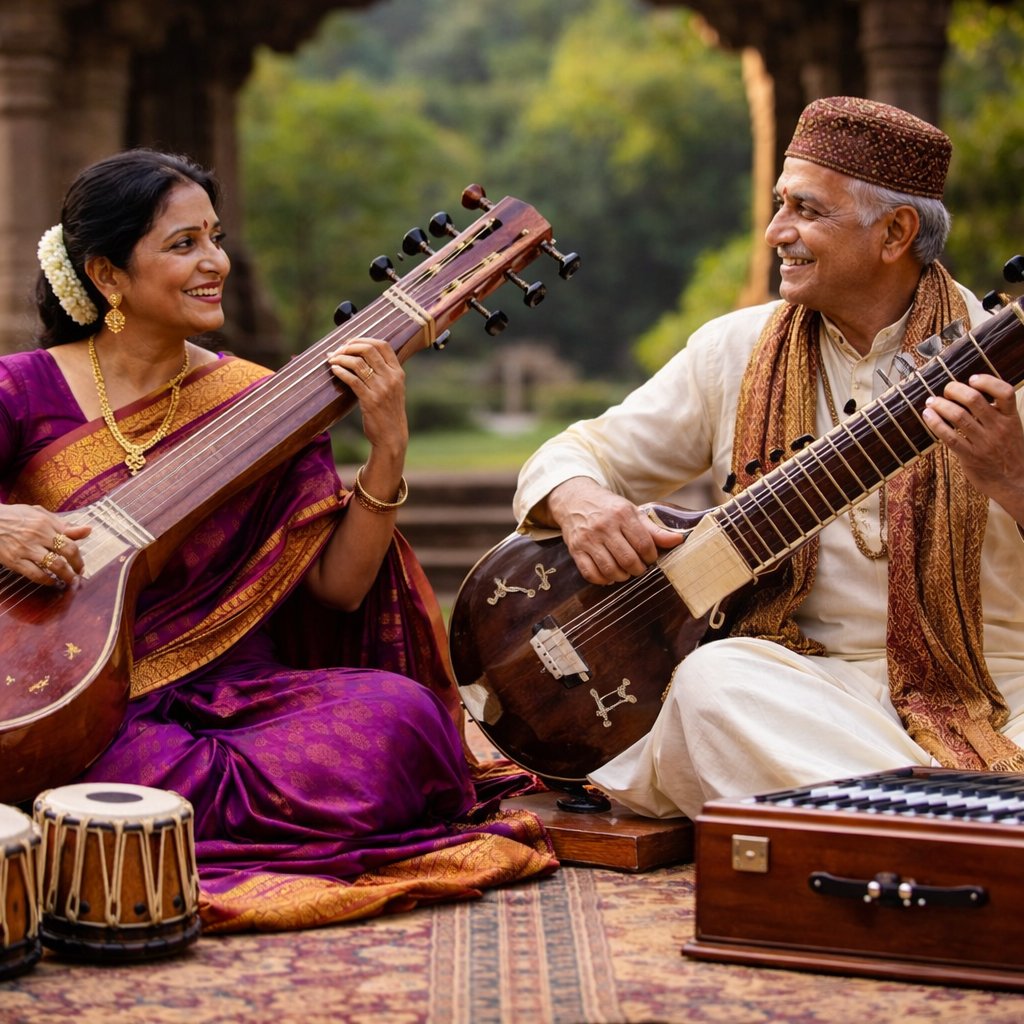
Cross-pollination between the two systems — once rare — has become more frequent. The jugalbandi tradition, pairing a Hindustani and a Carnatic musician, has produced memorable collaborations, and contemporary artists increasingly draw from both wells. Yet each tradition retains its unmistakable identity: the Carnatic's devotional intensity, mathematical precision, and compositional richness; the Hindustani's meditative depth, atmospheric grandeur, and improvisatory freedom. Together, they represent one of humanity's most sophisticated and enduring artistic achievements.