
In This Article
Origins and a Founding Vision
In the early decades of the twentieth century, Bharatanatyam — then still widely referred to as sadir or dasi attam — occupied a deeply contested cultural space. The anti-nautch movement, driven by social reformers and colonial morality alike, had pushed the art form to the margins of respectability. It was into this fraught environment that Rukmini Devi Arundale (1904–1986) stepped, not merely as a dancer but as a cultural revolutionary determined to reclaim an ancient heritage.
Rukmini Devi's own journey was itself extraordinary. Born into a Brahmin family in Madurai, she married Dr. George Arundale, a British Theosophist and later president of the Theosophical Society, whose headquarters at Adyar in Madras would prove pivotal to her mission. Her exposure to Anna Pavlova, the legendary Russian ballerina, during a voyage in 1928 is often cited as the catalyst that awakened her passion for dance. Yet it was her subsequent training under the great nattuvanar Meenakshi Sundaram Pillai of the Pandanallur tradition — a decision that scandalised conservative society — that gave her the artistic authority to reimagine the form.
On 6 January 1936, Rukmini Devi founded the International Academy of Arts, soon rechristened Kalakshetra — literally, "the sacred ground of art" (kala + kshetra). The institution began modestly on the grounds of the Theosophical Society in Adyar, Madras (now Chennai), with just a handful of students. But its aspirations were nothing less than monumental: to create a gurukula environment where Bharatanatyam, Carnatic music, and the allied arts could be taught, practised, and elevated as integrated expressions of India's spiritual and aesthetic heritage.
The Revival of Bharatanatyam and Carnatic Music
Rukmini Devi's contribution to the revival of Bharatanatyam cannot be overstated, though it must be understood alongside the parallel efforts of figures such as E. Krishna Iyer and the hereditary practitioners of the devadasi tradition. What distinguished Rukmini Devi's approach was her insistence on aesthetic refinement, spiritual dignity, and the removal of elements she considered overly sringara (erotic) in favour of a more devotional (bhakti-centred) presentation.
Her landmark public performance at the Madras Music Academy in 1935 — a year before Kalakshetra's founding — was a watershed moment. A Brahmin woman of social standing dancing on a public stage challenged both caste orthodoxy and colonial prudishness. The performance, and the debates it ignited, effectively accelerated the re-legitimisation of Bharatanatyam as a classical art form worthy of the concert stage.
At Kalakshetra, Rukmini Devi assembled an extraordinary faculty. Meenakshi Sundaram Pillai continued as the principal dance guru, ensuring that the Pandanallur bani (style) formed the institution's choreographic backbone. For Carnatic music, she recruited masters of the highest calibre, including the legendary vocalist Tiger Varadachariar and later Mysore Vasudevachariar, both of whom brought rigorous musicological knowledge and deep repertoire traditions to the academy. The veena maestro S. Balachander and mridangam vidwan Palani Subramania Pillai also had associations with the institution in its formative years.
Kalakshetra's dance-dramas, or nritya natakams, became its most celebrated artistic contribution. Drawing on themes from the Ramayana, Mahabharata, and the Silappadikaram, these productions — choreographed primarily by Rukmini Devi herself — synthesised Bharatanatyam, Carnatic music, elaborate costuming, and stagecraft into a unified theatrical experience. Works such as Kutrala Kuravanji, Ramayana series, and Silappadikaram became signature productions, performed across India and internationally, bringing a new grandeur to South Indian performing arts.
"Art should be like a temple — pure, beautiful, and uplifting. That is the ideal of Kalakshetra."
— Rukmini Devi Arundale
A Distinctive Pedagogical Approach
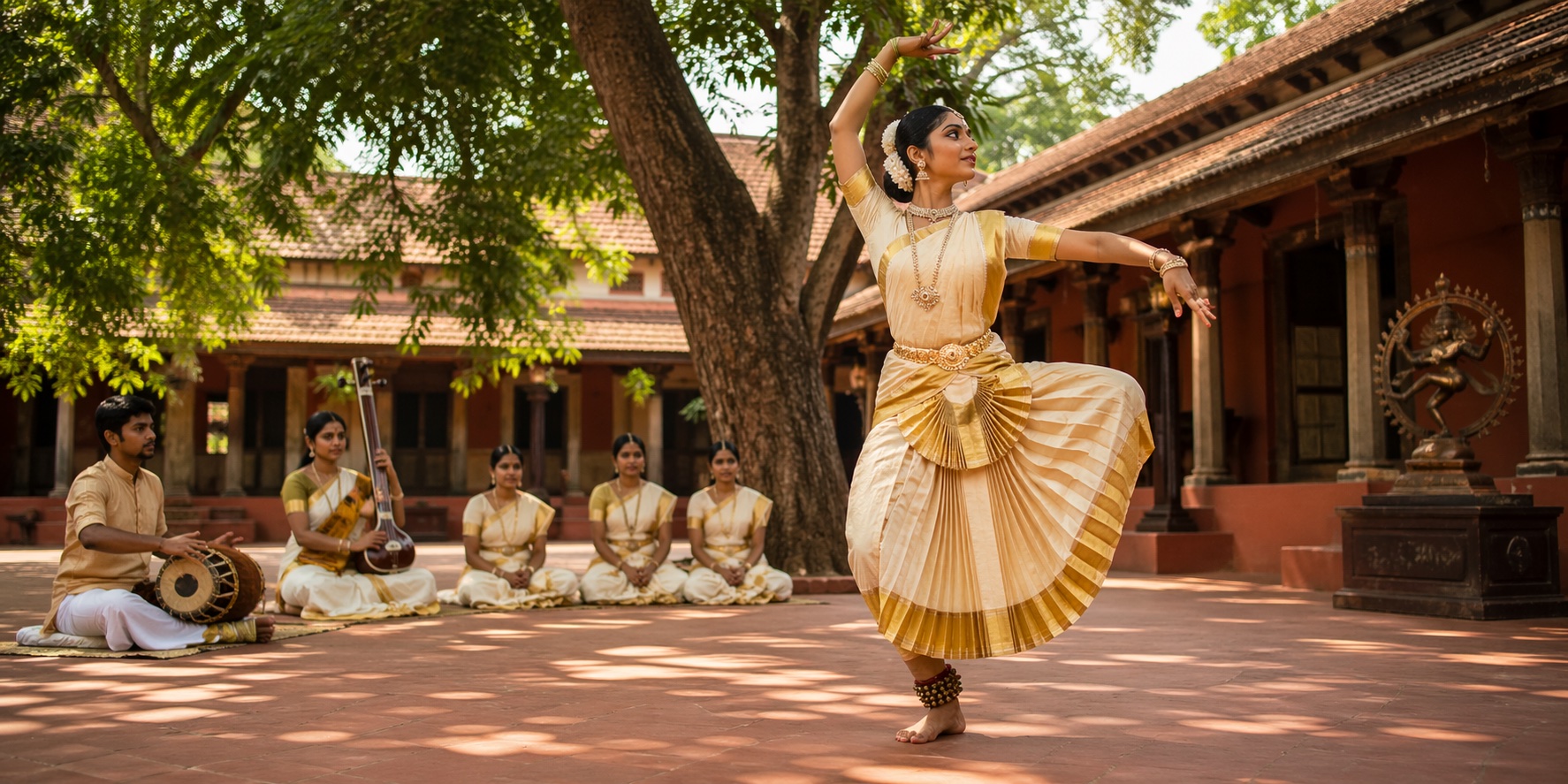
What has always set Kalakshetra apart from conventional arts institutions is its commitment to the gurukula model — the ancient teacher-student residential system — adapted for the modern age. Students live and learn on a verdant, hundred-acre campus (the institution moved to its present location in Thiruvanmiyur in 1962) under sprawling banyan trees, in open-air classrooms where the rustle of leaves accompanies the sound of the nattuvangam and the tambura.
The pedagogical philosophy rests on several distinctive pillars:
- Integration of music and dance: Kalakshetra insists that its dance students receive thorough Carnatic music training and vice versa. This integration ensures that dancers understand the raga, tala, and sahitya of the compositions they perform, while musicians develop sensitivity to movement and expression.
- Fidelity to tradition with aesthetic refinement: The Pandanallur style as codified at Kalakshetra — sometimes called the "Kalakshetra bani" — is characterised by geometric precision, clean lines, restrained abhinaya, and an emphasis on angasuddha (purity of body positions). Critics have sometimes called this approach austere; admirers consider it the very definition of classical rigour.
- Holistic arts education: Beyond dance and music, Kalakshetra offers programmes in visual arts and textile design, the latter being particularly renowned. The institution's handloom and kalamkari textiles — created in its own weaving centre — have earned national recognition and sustain traditional craft practices.
- Spiritual and ethical grounding: Reflecting Rukmini Devi's Theosophical convictions and her deep Hindu devotionalism, Kalakshetra has always emphasised the spiritual dimension of art. Students are expected to approach their training not merely as professional preparation but as sadhana — a form of disciplined spiritual practice.
The institution was declared an "Institution of National Importance" by an Act of Parliament in 1994 (the Kalakshetra Foundation Act), placing it under the Ministry of Culture, Government of India. It offers diploma programmes in Bharatanatyam, Carnatic music (both vocal and instrumental), and visual arts, with its diplomas recognised as equivalent to university degrees.
Ongoing Influence and Legacy
The list of artists who have emerged from Kalakshetra reads like a Who's Who of South Indian performing arts. Leela Samson, who also served as the institution's director from 2005 to 2012, carried the Kalakshetra aesthetic to international stages. C.V. Chandrasekhar and Shanta Dhananjayan and V.P. Dhananjayan — the celebrated Dhananjayan couple — became powerful ambassadors of the Kalakshetra bani, training generations of students in their own academies. The vocalist A. Kanyakumari (the violinist) and numerous instrumentalists further testify to the strength of the institution's music programme.
Yet Kalakshetra's influence extends beyond individual alumni. It has fundamentally shaped the grammar of modern Bharatanatyam pedagogy. The structured adavu system taught at Kalakshetra, the standardised margam (concert repertoire sequence), and the institution's approach to nritya natakam production have been adopted and adapted by dance schools across the world. When a Bharatanatyam student in London, Singapore, or San Francisco practises tattadavu or nattadavu in a systematic progression, she is, in many cases, following a pedagogical lineage that traces back to Kalakshetra's codification of the Pandanallur tradition.
The institution has not been without controversy. Debates about whether Rukmini Devi's sanitisation of Bharatanatyam marginalised the hereditary devadasi communities and their distinctive artistic contributions remain vital and necessary conversations within the dance world. Scholars such as Avanthi Meduri and Matthew Harp Allen have written extensively on these complexities, and contemporary practitioners increasingly seek to honour both the Kalakshetra legacy and the older, hereditary lineages.
Today, the Kalakshetra Foundation continues to function on its serene Thiruvanmiyur campus, conducting annual arts festivals, hosting the renowned Kalakshetra Repertory Company, and training new cohorts of dancers and musicians. Its annual nritya natakam productions during the December music and dance season in Chennai remain pilgrimage events for serious rasikas. The banyan trees still stand, the open-air stages still ring with the sound of jathis and kritis, and Rukmini Devi's vision — however debated, however refined by successive generations — endures as one of the most consequential cultural experiments of modern India.
For the rasika who seeks to understand how Bharatanatyam and Carnatic music arrived at their present forms, a reckoning with Kalakshetra is not optional. It is essential.