
In This Article
Origins and Spiritual Foundations: From the Chishti Khanqahs to the Dargah
Qawwali — derived from the Arabic qaul, meaning "utterance" or "axiom" — is among the most viscerally powerful musical traditions to emerge from the Indian subcontinent. Its roots lie in the 13th-century Chishti Sufi order, and its founding is traditionally attributed to Amir Khusrau (1253–1325), the polymath poet, musician, and devoted disciple of the great Sufi saint Hazrat Nizamuddin Auliya of Delhi. While the precise historical details of Khusrau's musical innovations remain a matter of scholarly debate, there is broad consensus that he played a seminal role in synthesising Persian poetic forms, Indian melodic structures, and the rhythmic vitality of local musical practice into a devotional genre that could induce wajd — a state of spiritual ecstasy and mystical union with the Divine.
The Chishti order, more than any other Sufi silsila on the subcontinent, embraced sama — the practice of spiritual audition through music — as a legitimate and indeed essential path to God. While orthodox theologians often viewed music with suspicion, the Chishti saints argued that when the listener's heart was oriented towards the Divine, music became a vehicle for fana (annihilation of the ego) and baqa (subsistence in God). The mahfil-e-sama — the formal assembly of spiritual listening — became the institutional setting in which Qawwali flourished, typically held at the dargahs (shrines) of Sufi saints, most notably at the shrine of Hazrat Nizamuddin Auliya in Delhi and that of Hazrat Moinuddin Chishti in Ajmer, Rajasthan.
The textual repertoire of Qawwali draws upon an extraordinarily rich literary heritage. Compositions may be set to verses in Persian, Urdu, Hindi, Punjabi, or Braj Bhasha, and the poetry ranges from the ghazals of Amir Khusrau and Rumi to the kafi of Bulleh Shah and the kalaam of later Sufi poets. A characteristic feature is the strategic use of girah — the spontaneous interpolation of a verse from a different poem that amplifies or recontextualises the meaning of the primary text. This technique, requiring formidable literary knowledge and improvisatory skill, transforms a Qawwali performance into a dynamic, multi-layered act of poetic interpretation.
The Qawwali Ensemble: Architecture of Ecstasy
The structure of the Qawwali ensemble, or hamnawa, is remarkably consistent across the tradition and is itself a reflection of Sufi communal values. At its centre stands the lead qawwal, who is both the principal vocalist and the spiritual director of the performance. He is supported by one or more secondary vocalists, and the entire group participates in a chorus that provides the characteristic waves of collective vocal power. The ensemble typically comprises:
- Lead qawwal(s): One or two principal singers who carry the melodic and textual narrative, executing improvisations and girah insertions.
- Chorus (hamnawa): A group of supporting vocalists, usually numbering between four and ten, who sing refrains, provide harmonic reinforcement, and punctuate the lead singer's phrases with rhythmic handclapping (taali).
- Harmonium: The primary melodic accompaniment, introduced in the 19th century and now indispensable to the genre, providing a sustained tonal foundation.
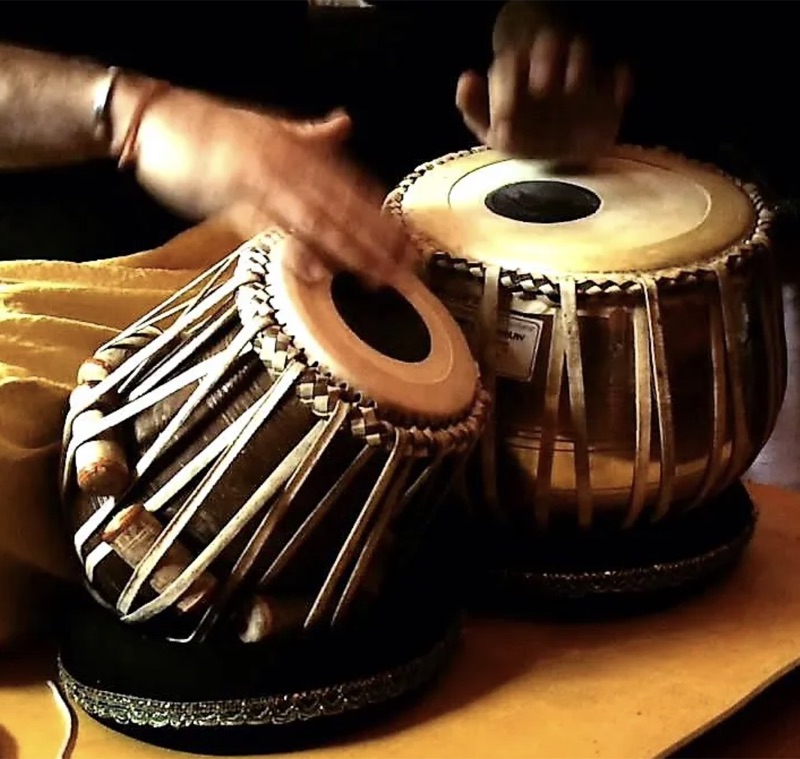
- Dholak or tabla: Percussion instruments that drive the rhythmic cycle. The dholak is more traditional to Qawwali, though tabla is also frequently employed.
- Handclapping (taali): Perhaps the most distinctive sonic signature of Qawwali, the synchronised clapping of the ensemble functions both as a rhythmic anchor and as a means of building collective intensity.
A Qawwali performance follows a broadly recognisable formal arc. It typically opens with a hamd (praise of God), followed by a naat (eulogy of the Prophet Muhammad), before proceeding to the main kalaam. The performance begins at a measured, contemplative pace, with the lead qawwal unfolding the raga and the poetic text with deliberation. As the performance progresses, tempo and intensity escalate through techniques of melodic repetition, rhythmic acceleration, and vocal ornamentation. The lead singer may repeat a particularly potent verse — sometimes dozens of times — each iteration layered with new melodic inflection or dynamic intensity, creating a cumulative effect designed to overwhelm rational consciousness and open the heart to divine grace.
"Man kunto maula, fa haza Ali maula" — this celebrated qaul, attributed to Amir Khusrau and still performed as one of the foundational pieces of the Qawwali repertoire, exemplifies the tradition's fusion of Arabic theological statement with Hindustani melodic expression.
Legendary Qawwals: Voices That Defined the Tradition
No discussion of Qawwali can proceed without acknowledging the towering figure of Nusrat Fateh Ali Khan (1948–1997). Born in Faisalabad, Pakistan, into a family of qawwals whose lineage stretched back over six hundred years, Nusrat possessed a voice of extraordinary range, power, and emotional depth. Under the initial tutelage of his uncle Mubarak Ali Khan and later as the leader of his own party, Nusrat transformed Qawwali from a largely devotional, shrine-based tradition into a global phenomenon. His performances at festivals such as WOMAD (from 1985 onwards) and his collaborations with Western artists including Peter Gabriel, Eddie Vedder, and Michael Brook — most notably on the landmark album Mustt Mustt (1990) — introduced Qawwali to audiences who had never encountered Sufi music. Yet Nusrat never sacrificed classical substance for accessibility; his improvisations revealed a profound command of ragas such as Yaman, Bhairavi, and Darbari Kanada, and his performances at the shrines of Ajmer and Nizamuddin remained anchored in deep devotional sincerity.
The Sabri Brothers, led by Haji Ghulam Farid Sabri (1930–1994) and Maqbool Ahmed Sabri (1945–2011), represent another monumental lineage. Based in Karachi but tracing their musical ancestry to the qawwal bachche tradition of Delhi, the Sabri Brothers were renowned for their impeccable ensemble discipline and their ability to sustain extended compositions of breathtaking structural integrity. Their rendition of "Tajdar-e-Haram" remains one of the most widely recognised Qawwali recordings in history, a piece of such devotional grandeur that it continues to move listeners across religious and cultural boundaries.
Other significant figures include the Nizami Brothers of the Nizamuddin Dargah in Delhi, hereditary qawwals who have maintained the shrine-based tradition with remarkable fidelity; Aziz Mian Qawwal (1942–2000), celebrated for his intense, almost confrontational performance style and his extended philosophical compositions; and in more recent times, Rahat Fateh Ali Khan, Nusrat's nephew, who has carried the family tradition into the 21st century, albeit with a more pronounced orientation towards film music and popular forms.
Bridging Classical Rigour and Devotional Expression
Qawwali occupies a fascinating and somewhat paradoxical position within the taxonomy of Hindustani music. Classified under "light classical" alongside ghazal, thumri, and bhajan, it is in practice a genre of formidable musical sophistication. A skilled qawwal must possess a thorough grounding in raga — not merely the ability to reproduce melodic patterns, but the capacity to improvise within a raga's grammar for extended durations, sometimes sustaining a single raga across a performance lasting well over an hour. The rhythmic dimension is equally demanding: Qawwali employs taals such as kaherwa (8 beats) and dadra (6 beats), but the interplay between the rhythmic cycle, the handclapping patterns, and the vocal improvisation requires an ensemble coordination that rivals any classical form.
What distinguishes Qawwali from the "pure" classical forms of khayal or dhrupad is not a deficit of musical skill but a difference of intentionality. In Qawwali, every musical device — every taan, every melodic ascent, every acceleration of rhythm — is subordinated to a spiritual purpose. The raga is not explored for its own aesthetic sake but is deployed as a means of intensifying the emotional and devotional impact of the poetic text. The repetition of a single line is not a structural conceit but a technique for deepening the listener's absorption until the boundary between the self and the Divine dissolves.
This synthesis of classical craft and devotional purpose has ensured Qawwali's enduring vitality. At the great urs celebrations at Ajmer and Nizamuddin, in concert halls from London to Lahore, and in the recorded legacy of its greatest practitioners, Qawwali continues to demonstrate that the most profound musical expression arises not from technical virtuosity alone, but from the marriage of disciplined artistry with an unwavering orientation towards the transcendent. For the serious rasika, engaging with Qawwali is an invitation to experience Hindustani music at its most elemental — a music that refuses to separate the beautiful from the sacred.