
In This Article
Diversifying Income Streams: Beyond the Concert Stage
The romantic notion that a classical musician need only practise and perform is, regrettably, a relic of the court patronage era. When Tansen served in Akbar's court or when the Travancore kings sustained generations of Carnatic musicians, artists could dedicate themselves entirely to sadhana. Today, even accomplished performers — artists who have received the Padma Shri or hold top grades at All India Radio — must think strategically about how they earn a living.
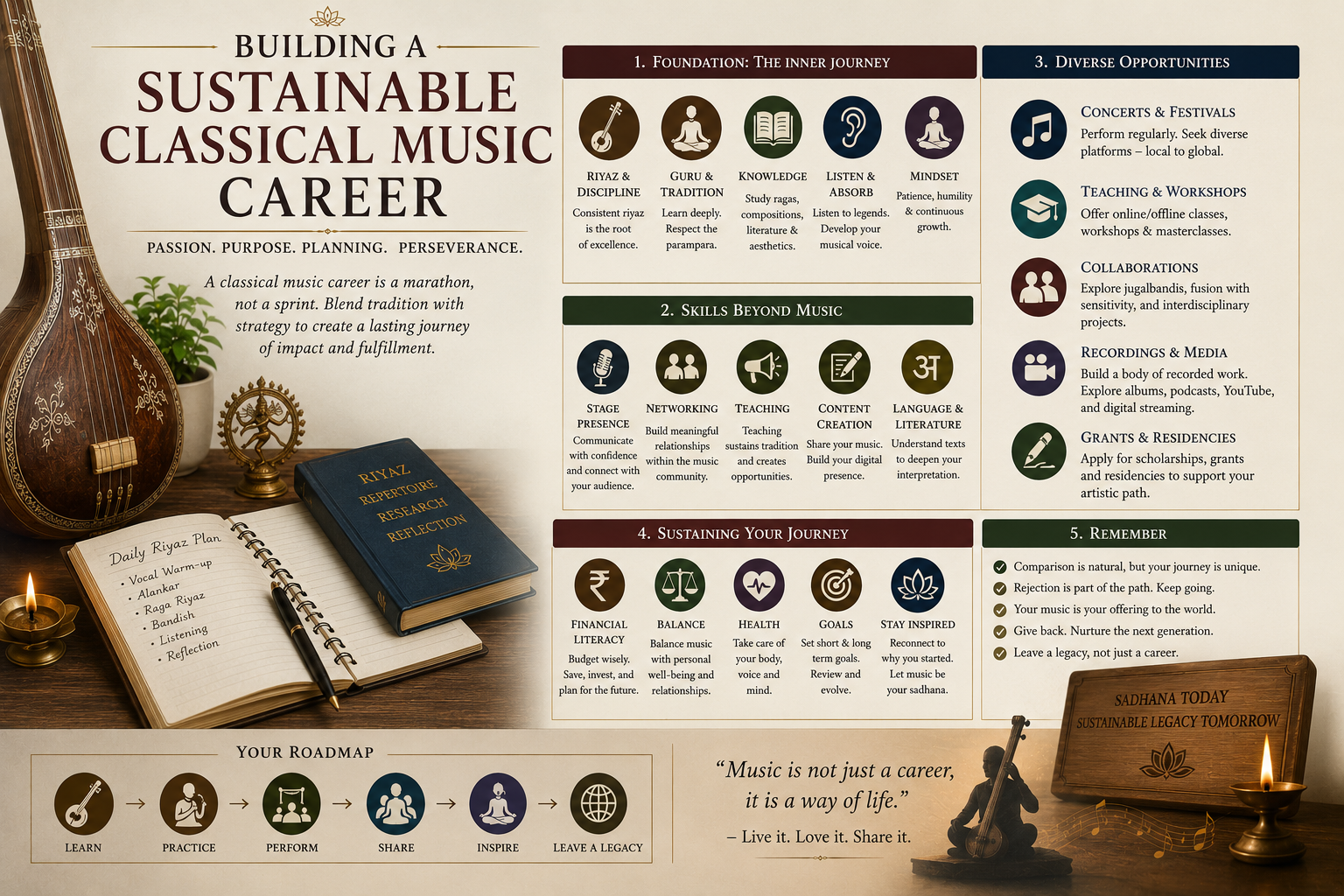
The most resilient classical music careers are built on multiple, complementary income streams. Consider these pillars:
- Concert performances: This remains the centrepiece, but it is rarely sufficient alone. The fee structure varies enormously — from ₹5,000 for a local sabha concert to several lakhs for a headline slot at Sawai Gandharva Bhimsen Mahotsav in Pune or the December Season in Chennai. Emerging artists should aim for 40–60 concerts per year while building their reputation, recognising that travel and accompanist costs often consume a significant portion of fees.
- Teaching and mentorship: Far from being a fallback, teaching is a deeply respected tradition — the guru-shishya parampara is the very backbone of our music. Pandit Jasraj ran his school in Mumbai and later New Jersey; Smt. Veena Sahasrabuddhe taught at the ITC Sangeet Research Academy in Kolkata while maintaining a vigorous performance schedule. Today, online platforms have expanded the teaching market globally. A structured programme of private lessons, masterclasses, and institutional teaching (at universities such as the Faculty of Music at the University of Delhi or SASTRA in Thanjavur) can provide stable monthly income.
- Recordings and digital content: Album royalties from labels like Sense World Music, Underscore Records, or Saregama may be modest, but recordings serve a dual purpose — they generate passive income and function as artistic calling cards. YouTube channels, Spotify releases, and curated content on platforms like Darbar or Raaga can build discoverability. The sitar player Purbayan Chatterjee and vocalist Kaushiki Chakraborty have leveraged digital platforms effectively to reach younger audiences worldwide.
- Festivals, residencies, and commissions: International opportunities — from the Darbar Festival in London to residencies offered by the Ravi Shankar Foundation or collaborations at WOMAD — provide both income and exposure. Artists should also explore commissions for cross-genre projects, film scoring, and corporate events, provided these engagements do not compromise their core artistic identity.
- Lecture-demonstrations and workshops: Institutions such as NCPA Mumbai, SPIC MACAY chapters, and universities regularly commission artist talks. These engagements pay reasonably and position the musician as an authority, opening further doors.
Financial Management for Musicians
Indian classical musicians have historically been reluctant to discuss money — a cultural reticence that has, unfortunately, left many great artists in precarious financial positions in their later years. The struggles faced even by towering figures should serve as cautionary reminders.
Treat your music practice as a professional enterprise. This means:
- Maintain separate accounts for personal and professional finances. Track every concert fee, teaching income, and royalty payment. Use accounting software or, at minimum, a disciplined spreadsheet.
- Budget for irregular income. Concert fees are seasonal — the October-to-March season is typically flush, while summer months can be lean. A prudent approach is to save 25–30% of peak-season earnings to cover quieter periods.
- Invest in your career infrastructure. Quality instruments, a reliable tanpura (or an electronic substitute for practice), recording equipment for home sessions, and a professional website are not luxuries — they are tools of the trade. Budget for them accordingly.
- Plan for retirement and health. Unlike salaried professionals, most performing artists lack employer-provided insurance or pension. The Sangeet Natak Akademi and state-level kulturakademis offer some fellowships and pensions, but these are competitive and limited. Independent health insurance and systematic investment plans (SIPs) should begin early in one's career.
- Understand taxation. Income from performances and teaching is taxable under Indian law. Expenses related to instruments, travel, accompanists, and venue hire are deductible. A chartered accountant familiar with the arts sector is a worthwhile investment.
"An artist who cannot sustain himself cannot sustain his art. There is no dishonour in understanding the economics of what we do." — a sentiment echoed by many senior musicians in private, even if rarely stated publicly.
Cultivating and Retaining Your Audience
A classical musician's audience is not merely a market — it is a community of rasikas whose deep listening sustains the art form. Building this community requires patience, consistency, and genuine engagement.
Start local, expand gradually. The legendary vocalist Kishori Amonkar built an unshakeable base in Maharashtra before her reputation radiated nationally. Young Carnatic musicians in Chennai often perform extensively at smaller sabhas — the Krishna Gana Sabha, Narada Gana Sabha, and the Music Academy's regular slots — before graduating to headline concerts. Each performance is an audition for future invitations.
Leverage social media with integrity. Platforms like Instagram and YouTube allow artists to share practice snippets, explain raga nuances, and announce concerts. The key is authenticity — rasikas can distinguish genuine artistic sharing from hollow self-promotion. Vocalist T.M. Krishna's use of social media to discuss both music and broader cultural questions has deepened his connection with a thinking audience. Flautist Rakesh Chaurasia regularly shares rehearsal moments that draw listeners into the creative process.
Build relationships with organisers and sabhas. A single outstanding performance at a prestigious festival can generate invitations for years. Respond to organisers promptly, arrive prepared, treat co-artists and accompanists with respect, and honour commitments. The classical music world is small; reputation travels faster than any social media post.
Engage with the next generation. SPIC MACAY concerts in schools and colleges may not pay lavishly, but they plant seeds. Many of today's most devoted rasikas trace their love of classical music to a single school assembly performance by a visiting artist. Pandit Shivkumar Sharma and Pandit Hariprasad Chaurasia's participation in such outreach over decades created audiences that endure.
Navigating Career Ups and Downs
Every classical music career encounters fallow periods — seasons with fewer invitations, creative blocks, health challenges, or the simple reality that younger artists are capturing attention. How one navigates these phases often determines long-term sustainability.
Creative renewal is essential. When Pandit Bhimsen Joshi faced a vocal crisis in the 1950s, he retreated into intensive riyaaz and emerged with a transformed, even more powerful voice. Periods of reduced public performance can be redirected into deeper exploration of neglected ragas, study of allied traditions, or collaborative experimentation. The Carnatic vocalist Bombay Jayashri's foray into film music — including her Academy Award-nominated song "Pi's Lullaby" for Life of Pi (2012) — demonstrated how diversification can revitalise an artist without diminishing their classical credentials.
Seek institutional support during transitions. Fellowships from the Ministry of Culture's Centre for Cultural Resources and Training (CCRT), the Sangeet Natak Akademi, or the ITC Sangeet Research Academy can provide financial breathing room and artistic legitimacy during lean periods. State-level awards and grants — such as those from the Maharashtra government's cultural department — are also worth pursuing.
Guard your mental health. The pressure of comparison, social media metrics, and inconsistent income can erode even a deeply committed musician's wellbeing. Cultivating a supportive peer network, maintaining interests outside music, and seeking professional help when needed are not signs of weakness — they are acts of professional maturity.
Play the long game. Indian classical music rewards longevity. Many of the greatest artists — Pandit Ravi Shankar performing into his nineties, M.S. Subbulakshmi's enduring relevance decades after her passing, Ustad Zakir Hussain's ever-expanding artistry until his final years — achieved their deepest impact in the later stages of their careers. A sustainable career is not built on a single viral moment but on decades of consistent, evolving artistry anchored by sound professional practices.
The path is demanding, but for those who approach it with both artistic sincerity and practical wisdom, a life in Indian classical music remains one of the most profoundly fulfilling vocations imaginable.