
In This Article
The Body as Instrument: Posture, Stillness, and Movement
When Pandit Jasraj settled into his characteristic upright posture on stage, spine erect yet shoulders relaxed, he was doing far more than finding physical comfort. He was establishing a visual shruti — a foundational note of authority and calm from which every musical phrase would emerge. For the classical musician, the body is the first thing an audience reads, often before a single note is sounded.
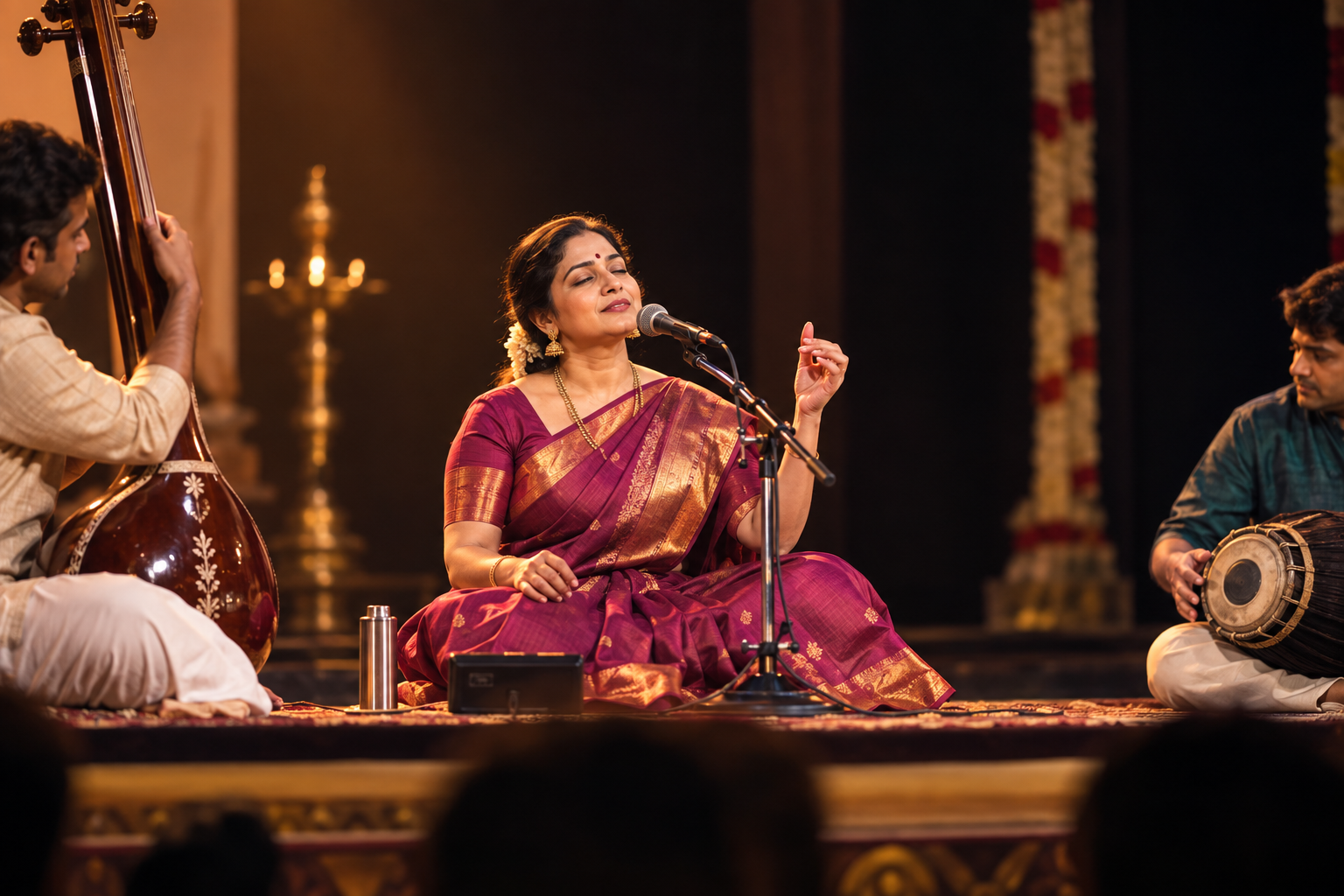
Posture is the architecture of presence. Whether you are a vocalist seated cross-legged or a sitarist positioned with the instrument cradled at an angle, your spine should be aligned and your shoulders free of tension. A collapsed posture restricts breath support for vocalists and limits the fluidity of movement for instrumentalists. More subtly, it communicates fatigue or disengagement to the audience, undermining the very bhava you seek to convey.
- Vocalists: Sit on a firm cushion that elevates the hips slightly above the knees. This tilts the pelvis forward and naturally straightens the lumbar curve, allowing the diaphragm to move freely. Ustad Rashid Khan was known for his remarkably still upper body, which allowed his breath to do extraordinary work.
- Instrumentalists: Ensure your instrument position does not force you into asymmetric tension. Sarod maestro Ustad Ali Akbar Khan would often adjust his posture minutely between compositions, never allowing physical strain to accumulate across a long recital.
- Percussionists: Tabla players and mridangam artists face unique challenges — the forward lean required for striking can compress the abdomen. Practise maintaining an open chest even during intense tihais and chakkardars.
A note on movement: Indian classical music naturally invites expressive gestures — the sweep of a hand tracing a melodic arc, the gentle swaying that accompanies a vilambit passage. These movements should arise organically from the music, never performed for visual effect. Audiences at the Sawai Gandharva Bhimsen Mahotsav in Pune or the Dover Lane Music Conference in Kolkata are astute enough to distinguish genuine musical transport from theatrical affectation.
The Silent Dialogue: Engaging with Accompanists
A classical music concert is never a solo act. The interplay between the main artist and accompanists — the tabla player, the harmonium or sarangi artist providing sangat, the tanpura player anchoring the drone — constitutes a living, breathing conversation. How a lead musician manages this dialogue on stage speaks volumes about their artistry and character.
Eye contact is the primary currency of this exchange. When Kishori Amonkar would lock eyes with her tabla accompanist before launching into a drut composition, she was establishing tempo, mood, and mutual trust in a single glance. This silent communication — a raised eyebrow to signal an approaching sam, a slight nod to invite a tabla solo, a smile of acknowledgement after a well-placed theka variation — is what transforms competent musicians sharing a stage into an ensemble creating something transcendent.
"The greatest compliment I ever received on stage was not from the audience but from Abbaji's eyes when I caught the sam perfectly after a complex layakari passage." — Ustad Zakir Hussain, speaking of performing with his father, Ustad Alla Rakha
Practical guidelines for onstage accompanist interaction:
- Acknowledge introductions. When the compère introduces your accompanists, turn towards them and offer a visible gesture of respect. This sets a collaborative tone from the outset.
- Signal clearly. Develop a shared vocabulary of cues with your regular accompanists during rehearsal. Ambiguity on stage leads to musical accidents; clarity breeds confidence.
- Give space generously. When you invite a tabla or violin solo, listen visibly. Lean in. React. Pandit Ravi Shankar was masterful at this — during Ustad Alla Rakha's tabla solos, his face would register genuine delight, drawing the audience's attention to his partner.
- Never display displeasure publicly. If an accompanist makes an error, absorb it gracefully. The audience may not have noticed; your visible irritation will ensure they do.
Reaching the Last Row: Audience Connection
The relationship between a Hindustani or Carnatic musician and their audience is uniquely intimate. Unlike Western classical concerts, where applause is typically reserved for movement endings, Indian classical performances thrive on real-time feedback — the murmured "wah wah", the sharp intake of breath at a perfectly rendered andolan, the spontaneous applause after a taan that catches the sam with devastating precision. The musician who learns to harness this energy without becoming dependent on it has mastered a crucial dimension of stage presence.
Begin with the eyes. In smaller, traditional baithak-style settings — the kind of intimate gathering still hosted at venues like the ITC Sangeet Research Academy in Kolkata or the Saptak festival's morning sessions in Ahmedabad — direct eye contact with listeners creates an almost conversational bond. In larger auditoria, let your gaze sweep the hall in slow arcs rather than fixing on the middle distance. Vidushi M.S. Subbulakshmi, even when performing to thousands at the United Nations General Assembly in 1966, had the extraordinary ability to make every listener feel personally addressed.
Consider also the pacing of your programme as a tool of audience engagement:
- Open with a composition that establishes your musical identity without demanding too much of an audience still settling in. A well-chosen madhyalaya bandish or a kriti in a familiar raga can serve as a welcoming gesture.
- Reserve your most demanding and exploratory music — an extended alap in a rare raga, perhaps, or a complex tala exploration — for the middle of your recital, when attention is at its peak.
- Close with something that sends the audience home with music ringing in their ears. Pandit Bhimsen Joshi's practice of ending concerts with an exuberant bhajan or abhang was not mere crowd-pleasing; it was a masterclass in emotional architecture.
Verbal communication, used sparingly, can deepen connection. A brief note about the raga's history, the composition's lineage, or the tala structure helps less experienced listeners without patronising knowledgeable rasikas. Bombay Jayashri, in her Carnatic recitals, often offers elegant contextual remarks that enhance appreciation without disrupting musical flow.
Grace Under Pressure: Handling the Unexpected
No performing career of any length is free from onstage mishaps — a tanpura string that snaps mid-alap, a microphone that feeds back during a pianissimo passage, an electronic tanpura that suddenly shifts pitch, or the dreaded moment when stage monitors fail entirely. How a musician handles these moments often defines their reputation as decisively as their finest musical passages.
The first principle is composure. An audience takes its emotional cues from the performer. If you remain calm, they remain calm. Pandit Shivkumar Sharma once had a javari buzz develop on his santoor mid-concert at the Tansen Samaroh in Gwalior. Rather than stopping, he subtly adjusted his striking angle, incorporated the altered timbre into his improvisation, and addressed the issue during the applause break. Most listeners never realised anything had gone wrong.
Practical strategies for managing technical difficulties:
- Carry spares of everything within your control — strings, plectra, reeds, batteries for electronic tanpuras. Arrive early enough for a thorough sound check, and identify the sound engineer by name.
- Develop a rehearsed response for common failures. If your microphone cuts out, project acoustically and signal the sound engineer with a calm gesture. If the tanpura drone is disrupted, your accompanists should be prepared to sustain the tonal centre on harmonium or voice while the issue is resolved.
- Use humour judiciously. A light, self-deprecating remark can defuse tension — but forced jocularity undermines gravitas. Read the room.
- Never blame organisers or technicians publicly. Even if the sound system is genuinely inadequate, professional grace demands that grievances be addressed privately, after the performance.
Beyond technical failures, there are subtler challenges: the restless audience member whose phone rings during your alap, the photographer whose flash disrupts your concentration, the poorly timed interval that breaks the mood of a raga you have spent forty minutes building. In every case, the answer is the same — return to the music. The raga is larger than the disruption. Your absorption in it will re-centre both you and your listeners.
Ultimately, stage presence for the Indian classical musician is not a costume to be donned at the green room door. It is an extension of sadhana — of the thousands of hours spent in riyaz, of the deep respect for guru and tradition, of the genuine love for the raga and its capacity to move the human spirit. When that inner conviction is authentic, the outer presence takes care of itself. The stage, after all, is simply the place where your private devotion becomes a shared experience.