
In This Article
Ancient Claims, Modern Validation
The idea that music heals is not new to the Indian tradition. The Sangita Ratnakara of Sharngadeva (13th century) dedicates passages to the physiological and psychological effects of specific ragas. The Raga Chikitsa tradition — a systematic approach to raga-based healing — finds mention in texts spanning centuries, from the writings of Sarangadeva to the later compilations of the Thanjavur court. Yet for much of the modern era, these claims remained in the realm of faith and anecdotal experience, lacking the rigorous empirical framework that contemporary science demands.
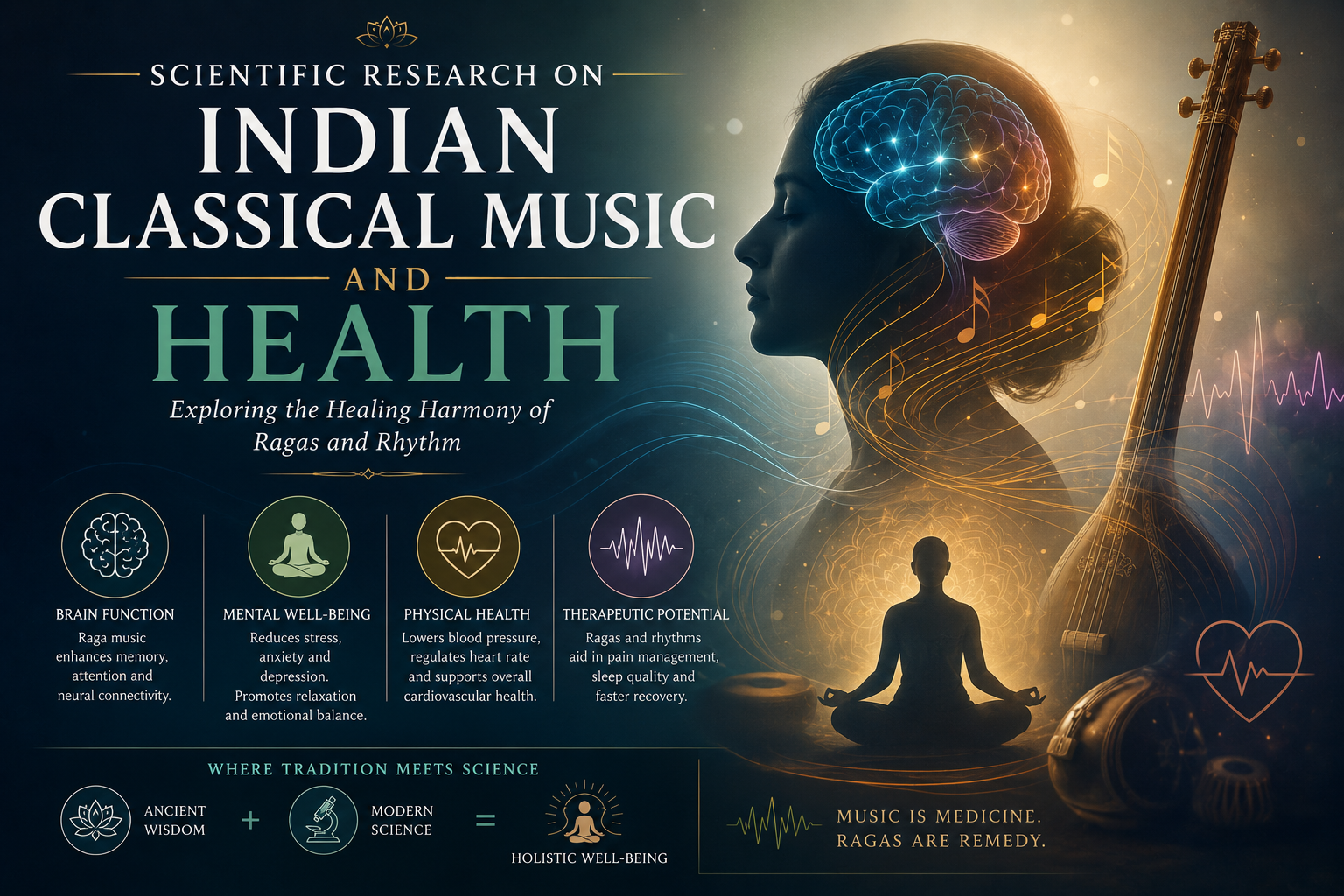
That landscape has shifted dramatically over the past two decades. Researchers across India and the world — from the All India Institute of Medical Sciences (AIIMS) in New Delhi to institutions in the United States and Europe — have begun subjecting Indian classical music to controlled scientific study. The results have been striking, not merely confirming broad claims about music's soothing qualities, but identifying specific, measurable physiological responses tied to particular ragas, tala structures, and performance contexts.
What makes this research particularly compelling for the rasika is that it does not reduce raga to mere acoustic stimulus. The best studies acknowledge the complex interplay of melodic structure, microtonal ornamentation (gamaka), temporal framework (laya), and emotional resonance (rasa) — the very elements that distinguish a raga performance from generic relaxation music.
Stress, Cortisol, and the Nervous System
One of the most extensively studied areas is the effect of Indian classical music on the human stress response. A landmark 2015 study published in the International Journal of Brain and Cognitive Sciences by researchers at Bengaluru's National Institute of Mental Health and Neurosciences (NIMHANS) demonstrated that listening to Raga Darbari Kanada for just 20 minutes produced a statistically significant reduction in salivary cortisol levels — the primary biomarker for physiological stress — compared to a control group exposed to silence.
This finding resonated with earlier work by Dr. Burnell of the Rajan Hospital, Chennai, and a 2004 study by Padmasani and Vijayalakshmi at SRM University, which measured autonomic nervous system responses to raga music using heart rate variability (HRV) analysis. Their findings showed that:
- Pentatonic ragas with a predominance of komal (flat) swaras — such as Raga Yaman Kalyan and certain renditions of Bhimpalasi — shifted the autonomic balance towards parasympathetic dominance, indicating a relaxation response.
- The tempo and rhythmic density of the performance mattered significantly; vilambit (slow tempo) alaap sections produced greater parasympathetic activation than drut (fast) compositions.
- Listeners with prior familiarity with Hindustani or Carnatic music showed stronger and more rapid physiological responses, suggesting that cultural and aesthetic engagement amplifies the therapeutic effect.
A 2018 study conducted at AIIMS, New Delhi, under Dr. Sheffali Gulati, examined the effects of structured raga-listening sessions on patients with clinical anxiety disorders. Over an eight-week programme, patients exposed to curated recordings of Ragas Bageshree, Puriya Dhanashree, and Todi showed meaningful improvements on the Hamilton Anxiety Rating Scale, with effects comparable to certain first-line pharmacological interventions — though researchers were careful to note that music was studied as a complementary, not replacement, therapy.
Shankarabharanam and Cardiac Health
Perhaps no single finding has captured the imagination of the music therapy community as much as the research linking Raga Shankarabharanam (the Carnatic equivalent of Bilawal in the Hindustani system, corresponding to the Western major scale) to measurable improvements in cardiac function.
The most widely cited study in this area was conducted by Dr. Rajam Shanker and colleagues at the Madras Medical College and Government General Hospital, published in findings presented at cardiology conferences between 2012 and 2016. In their controlled study, patients recovering from acute myocardial infarction were divided into groups: one received standard post-operative care, while the other received the same care supplemented by 30-minute daily listening sessions of Shankarabharanam compositions — including Thyagaraja's Endaro Mahanubhavulu and Shyama Shastri's O Jagadamba.
"The group exposed to Shankarabharanam demonstrated a statistically significant reduction in systolic blood pressure, improved heart rate variability indices, and lower levels of post-operative anxiety compared to the control group. The raga's symmetrical, consonant intervallic structure appears to promote cardiovascular homeostasis."
Subsequent research has attempted to explain why Shankarabharanam might exert these effects. Dr. T. M. Srinivasan of the Swami Vivekananda Yoga Anusandhana Samsthana (S-VYASA), Bengaluru, has proposed that the raga's symmetrical ascending and descending structure — Sa Ri Ga Ma Pa Da Ni Sa — creates a predictable, consonant acoustic pattern that the brain processes with minimal cognitive load, triggering a relaxation cascade through the vagus nerve. The absence of vakra (zigzag) phrases and the prevalence of samvadi (consonant) swara relationships in Shankarabharanam may contribute to what researchers describe as "acoustic coherence" — a quality that aligns brainwave patterns towards alpha-wave dominance, the neural signature of calm alertness.
It is worth noting that the therapeutic potential of Shankarabharanam was recognised in traditional Carnatic pedagogy long before modern cardiology took an interest. The raga has been historically associated with feelings of devotion, serenity, and emotional equilibrium — qualities enshrined in its very name, which invokes Lord Shankara (Shiva) as the bestower (abharana) of auspiciousness.
Cognitive Function and Future Directions
Beyond stress and cardiac health, a growing body of research examines Indian classical music's effects on cognitive function, memory, and neuroplasticity. A 2019 study by Dr. Shantala Hegde at NIMHANS demonstrated that trained Carnatic musicians exhibited enhanced verbal memory, executive function, and auditory processing compared to non-musicians — findings that parallel Western research on the "musician's brain" but with specific markers tied to the demands of raga improvisation and complex tala computation.
Research at the University of Hyderabad's Centre for Neural and Cognitive Sciences, led by Dr. Ramesh Kumar Mishra, has explored how raga-listening activates bilateral brain networks — engaging not only the auditory cortex but also regions associated with emotion (amygdala), memory (hippocampus), and reward (nucleus accumbens). Functional MRI studies suggest that the improvisatory, non-repetitive structure of an alaap engages the brain differently from composed, repetitive Western music, potentially offering superior neuroprotective benefits for ageing populations.
Several institutions are now working to formalise these findings into clinical protocols:
- The Chennai-based Raga Research Centre, founded by the late Dr. T. V. Sairam, has compiled decades of case studies and therapeutic applications into structured raga therapy curricula.
- S-VYASA University in Bengaluru is integrating raga-listening into yoga therapy programmes for patients with hypertension, insomnia, and post-traumatic stress disorder.
- The Indian Council of Medical Research (ICMR) has, in recent years, funded pilot studies exploring music therapy as a complementary intervention in palliative care settings.
Yet challenges remain. Much of the existing research suffers from small sample sizes, methodological inconsistencies, and the inherent difficulty of standardising a living art form for clinical trials. A 20-minute rendition of Shankarabharanam by Semmangudi Srinivasa Iyer is a profoundly different acoustic and emotional experience from a student's practice piece in the same raga — and current research protocols do not always account for the role of artistry, bhava, and interpretive depth.
The most promising path forward lies in interdisciplinary collaboration — bringing together musicologists who understand the grammar and aesthetics of raga, neuroscientists equipped with functional imaging and biomarker analysis, and clinicians who can design rigorous therapeutic protocols. The ancient rishis intuited what modern instruments are beginning to measure: that the structured, intentional deployment of sound — refined over millennia into the sophisticated system of raga — possesses the capacity to heal. The task before us now is to honour that inheritance with the same rigour and devotion that a great musician brings to their art.