
In This Article
Ancient and Medieval Patronage: Temple, Court, and Sacred Duty
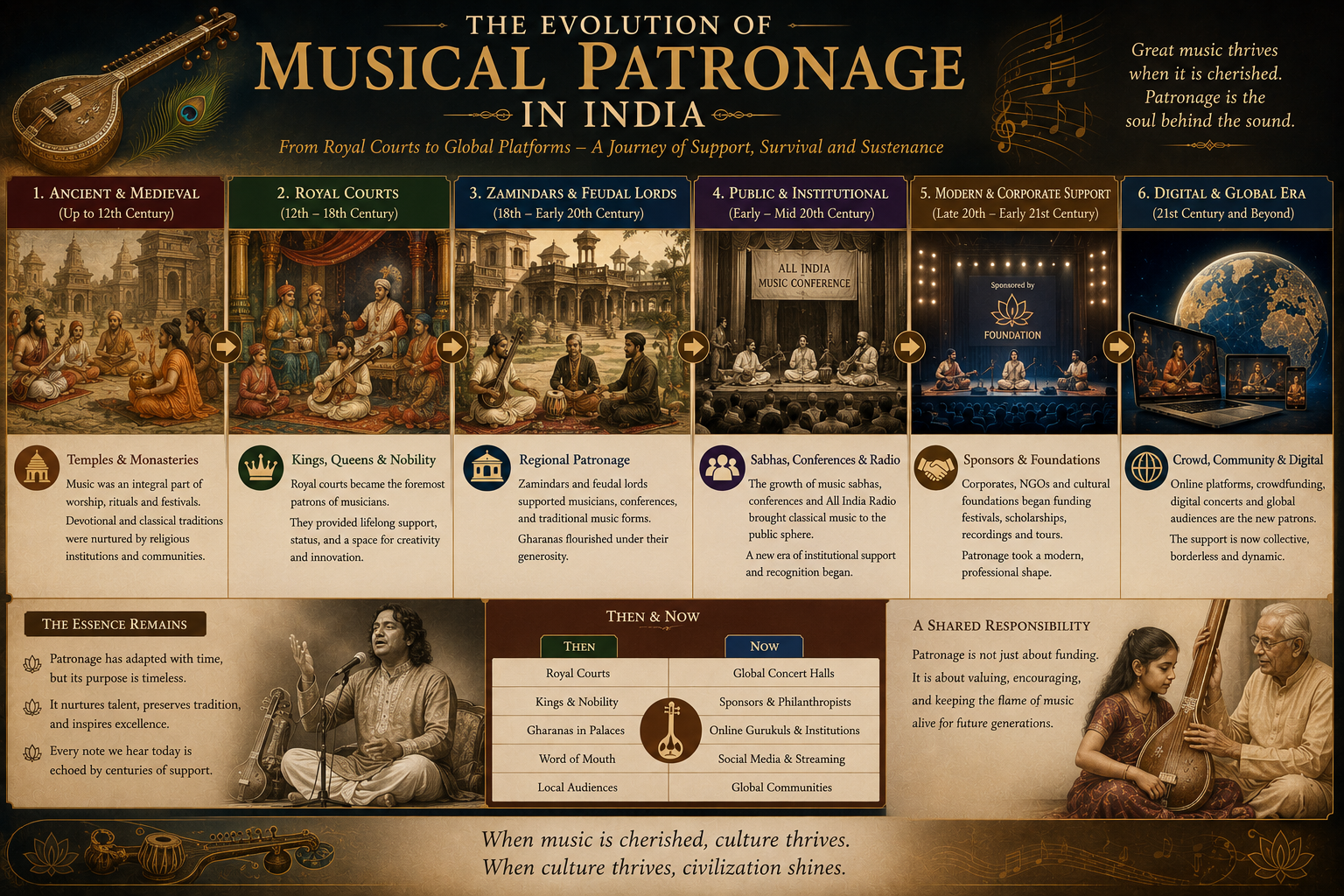
The roots of musical patronage in India reach back to the Vedic period, where musical recitation was integral to ritual life. The Sāmaveda, with its elaborate melodic frameworks for chanting, was sustained not by individual patrons but by an entire institutional ecosystem of Brahmanical learning. Music was not entertainment — it was dharma, and its preservation was a sacred obligation.
By the time of the Nāṭyaśāstra (circa 2nd century BCE to 2nd century CE), attributed to Bharata Muni, a more recognisable system of court patronage had taken shape. The treatise itself, with its exhaustive codification of svara, jāti, and rasa, presupposes a sophisticated culture of performance sustained by royal courts. The Gupta period (4th–6th century CE), often called the golden age of Indian culture, saw rulers like Samudragupta — himself depicted playing the vīṇā on his gold coins — elevate musicians to positions of honour and influence.
In the South, the great temple complexes became engines of musical patronage. The Chola dynasty's monumental temples at Thanjavur and Gangaikondacholapuram employed hereditary musicians and dancers — the devadāsī tradition being inseparable from temple worship. Inscriptions at the Bṛhadīśvara Temple (consecrated 1010 CE by Rājarāja Chola I) record detailed provisions for musicians, including their land grants and daily allowances. Music here was liturgical infrastructure, and the patron was simultaneously king, devotee, and state.
The Vijayanagara Empire (1336–1646) continued this tradition on a grand scale. Krishnadevaraya's court at Hampi was legendarily cosmopolitan, and the Saṅgīta Sāra and other musicological texts were produced under royal sponsorship. The aṣṭadiggajas — the eight great poets of his court — worked within a system where artistic output was directly tied to royal favour and reward.
The patron did not merely fund the musician; the patron determined the grammar of what could be composed, performed, and transmitted to the next generation.
The Mughal Synthesis and Nawābi Refinement
No discussion of Indian musical patronage is complete without the Mughal courts, which fundamentally reshaped Hindustani music. Akbar's court (r. 1556–1605) is the locus classicus: Tansen (Miyan Tansen), born Ramtanu Pandey in Gwalior, became the most celebrated musician in Indian history under Akbar's direct patronage. Abu'l-Fazl's Āʾīn-i-Akbarī records that Akbar maintained 36 musicians in his court, organised into seven divisions — one for each day of the week. Tansen's compositions in Dhrupad style, and the rāgas attributed to him (such as Darbārī Kānaḍā, Miyān kī Todī, and Miyān kī Malhār), were shaped by the aesthetics and demands of courtly performance.
The Mughal model established a pattern that persisted for centuries: the gharānā system itself is partly a product of patronage economics. Families of musicians attached themselves to specific courts — Gwalior, Jaipur, Agra, Lucknow — and developed distinctive stylistic identities that functioned as both artistic lineage and professional branding. The Lucknow gharānā of kathak, nurtured under Nawāb Wājid ʿAlī Shāh (r. 1847–1856), is a vivid example: his personal passion for thumrī, kathak, and rāhas līlā created an entire performance tradition that might not have existed without his lavish, some said ruinous, expenditure.
The princely states carried this tradition well into the 20th century. Maharaja Sayajirao Gaekwad III of Baroda patronised Faiyaz Khan; the courts of Rampur, Mysore, and Travancore each sustained distinctive musical cultures. In the South, the Thanjavur Quartet — Chinnayya, Ponnayya, Sivanandam, and Vadivelu — revolutionised Bharatanāṭyam and Carnatic concert repertoire under the patronage of the Maratha rulers of Thanjavur in the early 19th century. Svāti Tirunāl Rāma Varma (1813–1846), the Maharaja of Travancore, was himself a prolific composer in multiple languages, producing over 400 compositions in both Carnatic and Hindustani styles.
The critical point is this: court patronage was never neutral. It selected for certain forms over others. Dhrupad flourished under Mughal austerity; khyāl rose as courts grew more cosmopolitan; thumrī blossomed in the pleasure-seeking nawābi courts of Awadh. Repertoire, form, and even rāga development were shaped by the tastes of those who paid.
Colonial Sabhas, Nationalism, and the Democratisation of Access
The collapse of princely patronage — accelerated by the British annexation of kingdoms, the Doctrine of Lapse, and ultimately Indian independence and the abolition of privy purses in 1971 — created a crisis for hereditary musicians. The transition was neither sudden nor smooth, and the intervening period produced new institutional forms that reshaped Indian music profoundly.
The sabhā (music society) emerged as the crucial bridge. The Madras Music Academy, founded in 1927 alongside the All India Congress session in Madras, became the single most influential institution in Carnatic music. Its annual December conference and concerts — now the heart of the Margazhi season — established a new framework: music judged not by a single royal patron but by committees, critics, and an informed public. The Academy's role in standardising concert format (the modern Carnatic kutcheri structure of varṇam, main pieces, rāgam-tānam-pallavi, and lighter concluding items) cannot be overstated.
Simultaneously, the nationalist movement reframed music as cultural heritage rather than courtly luxury. V.D. Paluskar (1872–1931) founded the Gandharva Mahavidyalaya in Lahore in 1901, explicitly seeking to democratise Hindustani music and wrest it from what he saw as the exclusivity of Muslim gharānā culture. V.N. Bhatkhande (1860–1936) undertook his monumental classification of rāgas into thāṭ system and published the Hindustānī Saṅgīt Paddhati, making theoretical knowledge accessible beyond hereditary lineages. Both men, in different ways, were creating new structures of patronage — the music school, the textbook, the public concert — that would replace the disappearing court.
- All India Radio (AIR), established in 1936, became perhaps the single largest patron of Indian classical music in the 20th century, employing staff artists and grading musicians (Top Grade, A, B, and so on) in a system that carried enormous prestige and financial consequence.
- The Sangeet Natak Akademi, founded in 1952, institutionalised state recognition through fellowships and awards.
- ITC Sangeet Research Academy, established in 1977 in Kolkata by the ITC conglomerate, revived something close to the guru-śiṣya paramparā by providing stipends to scholars studying under master musicians — a corporate reimagining of the court system.
The recording industry — from the Gramophone Company of India's early 78 RPM discs featuring Gauhar Jaan (often cited as the first Indian recording artist, 1902) to HMV's long-playing records of Bhimsen Joshi and M.S. Subbulakshmi — created yet another layer of patronage, one mediated by market demand rather than royal taste or institutional committee.
The New Landscape: Crowdfunding, Streaming, and the Uncertain Future
Today, Indian classical music exists in a fragmented patronage landscape that is simultaneously more democratic and more precarious than at any point in its history.
Corporate sponsorship remains significant but is often tied to branding rather than deep engagement. The SPIC MACAY movement (founded 1977 by Dr Kiran Seth) has brought classical music to college campuses across India, funded by a mix of corporate, governmental, and individual support. Festivals like the Dover Lane Music Conference (Kolkata, since 1952), Sawai Gandharva Bhimsen Mahotsav (Pune), and the Thyagaraja Aradhana (Thiruvaiyaru) continue to draw audiences, though many organisers speak candidly about the financial difficulties of sustaining multi-day events.
The digital revolution has introduced genuinely new dynamics:
- Streaming platforms — Spotify, Apple Music, YouTube Music — have made catalogues of rare recordings accessible worldwide, but the per-stream revenue model (fractions of a paisa per play) is wholly inadequate to sustain performing artists.
- YouTube has become a de facto archive and discovery engine. Channels like those maintained by Darbar Festival or the recordings uploaded by the archives of Prasar Bharati have introduced new audiences to masters past and present.
- Crowdfunding and direct support platforms — from Patreon and Ko-fi to Indian platforms like Wishberry — have enabled niche artists to find sustaining audiences without institutional intermediaries. The pandemic years (2020–2022) accelerated this, as musicians turned to baithak-style livestreams and virtual mehfils to survive.
Yet the fundamental question of patronage remains unchanged across millennia: who pays shapes what is played. If algorithmic playlists favour shorter, lighter pieces, will extended ālāp in a rare rāga survive? If corporate sponsors prefer marquee names, how do younger artists develop? If the guru-śiṣya paramparā requires years of full-time immersion, who funds the student's living expenses in an era when neither kings nor AIR perform that function reliably?
The rasika — the informed, devoted listener — has always been the ultimate patron. In the streaming age, that role carries more responsibility than ever before.
The history of Indian classical music is, in many ways, a history of patronage in disguise. Every rāga we cherish, every bandish we hum, every gharānā whose name we invoke was shaped by the material conditions under which it was created and transmitted. Understanding this is not a diminishment of the music's spiritual or aesthetic power — it is a recognition that art, however transcendent, exists in the world, sustained by human choices about what to value and what to fund. The challenge for today's rasikas, institutions, and artists is to build patronage structures worthy of the tradition they have inherited.