
In This Article
What Are Gamakas and Why Do They Matter?
To the uninitiated listener, Carnatic music can seem like an unbroken stream of fluid, sinuous melody — notes that never quite sit still, that shimmer and oscillate with a life of their own. This quality, more than any other, is what distinguishes the South Indian classical tradition from its Hindustani counterpart, from Western classical music, and indeed from virtually every other musical system in the world. The source of this quality is the gamaka — a term that encompasses the slides, oscillations, deflections, shakes, and ornamentations applied to svaras (notes) in Carnatic music.
The word gamaka derives from the Sanskrit root gam, meaning "to go" or "to move." In essence, a gamaka is the movement of a svara — the way a note travels to, from, around, and through its designated pitch. In Carnatic music, a svara is almost never rendered as a flat, static frequency. It is always alive, always in motion. This is not mere decoration; it is the very substance of the music. Remove the gamakas from a raga like Todi or Bhairavi, and you are left with a skeleton — technically correct, perhaps, but utterly devoid of rasa.
"Gamaka is not an ornament placed upon the note. The note is the gamaka. Without it, there is no raga." — T. Viswanathan, ethnomusicologist and flautist, in his landmark study Music in South India (1977, co-authored with Matthew Harp Allen).
The ancient treatise Sangeeta Ratnakara by Sarngadeva (13th century) enumerates fifteen types of gamakas, including tiripa (turns), sphurita (throbs), kampita (shakes), and ahata (struck notes). While modern Carnatic practice does not rigidly follow this classification, the treatise underscores a crucial point: Indian musicians have theorised about note-ornamentation for at least eight centuries, recognising it as fundamental rather than incidental to melodic expression.
The Principal Types of Gamakas in Practice
While Sarngadeva's fifteen-fold taxonomy remains a scholarly reference, contemporary Carnatic pedagogy and performance tend to work with a more practical set of gamaka types. These are not always named consistently across all teaching lineages, but the following categories are widely recognised:
- Kampita (oscillation): The most ubiquitous gamaka in Carnatic music. A note is rendered with a rapid, controlled oscillation between itself and an adjacent svara. The oscillation in the gandhara of raga Sankarabharanam, for instance, involves a shake between Ga and Ri, lending the note its characteristic warmth. The speed, width, and emphasis of kampita vary by raga and by artist.
- Jaru (slide/glide): A smooth, continuous slide from one note to another, either ascending (etra jaru) or descending (irakka jaru). The descending slide from Dhaivata to Panchama in raga Kalyani is a defining gesture of that raga's personality. Jaru is sometimes termed ullasita in older texts.
- Nokku (stress/push): A stressed approach to a note, often from a higher pitch, creating a brief but emphatic deflection. This is particularly prominent in ragas like Begada and Sahana, where certain phrases derive their identity from how forcefully a note is "pushed" into place.
- Odukkal (deflected release): The practice of releasing or quitting a note by deflecting it towards an adjacent svara rather than simply stopping. This gives Carnatic phrases their characteristic sense of continuity — no note exists in isolation; every note leads somewhere.
- Orikai (turn/gruppetto): A rapid turn around a note, touching the svaras immediately above and below before settling. This can be heard prominently in the rendering of certain phrases in ragas like Kambhoji.
- Pratyahata (rebounding): A note is approached from a neighbouring svara, bounced off, and returned — creating a brief, percussive ornamental effect.
It is essential to understand that these categories are not discrete boxes. In practice, a single melodic phrase may involve a jaru leading into a kampita that resolves through an odukkal — all within the space of a second or two. The artistry lies in the seamless integration of these movements into a continuous, organic melodic line.
Gamakas as the Architects of Raga Identity
Perhaps the most profound role of gamakas is their function as raga differentiators. Several ragas in the Carnatic system share identical scale degrees — the same set of svaras in the same ascending and descending order — yet sound completely different. The reason, almost invariably, is the gamaka treatment.
Consider the classic example of Sankarabharanam and Begada. Both employ the same svaras in many overlapping phrases, yet no experienced rasika would ever confuse the two. Begada's identity is forged by its distinctive nokku gamakas on the gandhara and the peculiar way its phrases curve around madhyama. Sankarabharanam, by contrast, features a more symmetrical, open oscillation pattern. The svaras are the same; the gamakas make them different ragas entirely.
An even more striking example is the pair Huseni and Kharaharapriya. Both are janya and melakarta (respectively) sharing a 22nd melakarta framework, but Huseni's characteristic phrases — with their distinctive sliding approach to the nishadha and the plaintive, weighted gandhara — create a mood of pathos quite distinct from Kharaharapriya's more expansive, all-encompassing character.
The great musicologist and vainikas S. Ramanathan and R. Rangaramanuja Ayyangar (author of the monumental History of South Indian (Carnatic) Music, 1972) both emphasised that gamakas are not supplementary to raga grammar — they are the grammar. A raga is not defined merely by its arohana and avarohana (ascending and descending scales), but by its gamaka-prayogas: the specific ornamental treatments applied to specific notes in specific melodic contexts.
This is precisely why notation is insufficient for learning Carnatic music. The standard notation system developed by pioneers like Subbarama Dikshitar (in his encyclopaedic Sangita Sampradaya Pradarshini, 1904) can indicate the svaras of a composition, but it cannot fully capture the gamaka treatment. Two vocalists may sing the same kriti — say, Tyagaraja's Endaro Mahanubhavulu in Sri — from the same notation, yet render it with subtly different gamaka inflections shaped by their respective guru lineages.
Learning, Mastering, and Deploying Gamakas: The Vocalist's Journey
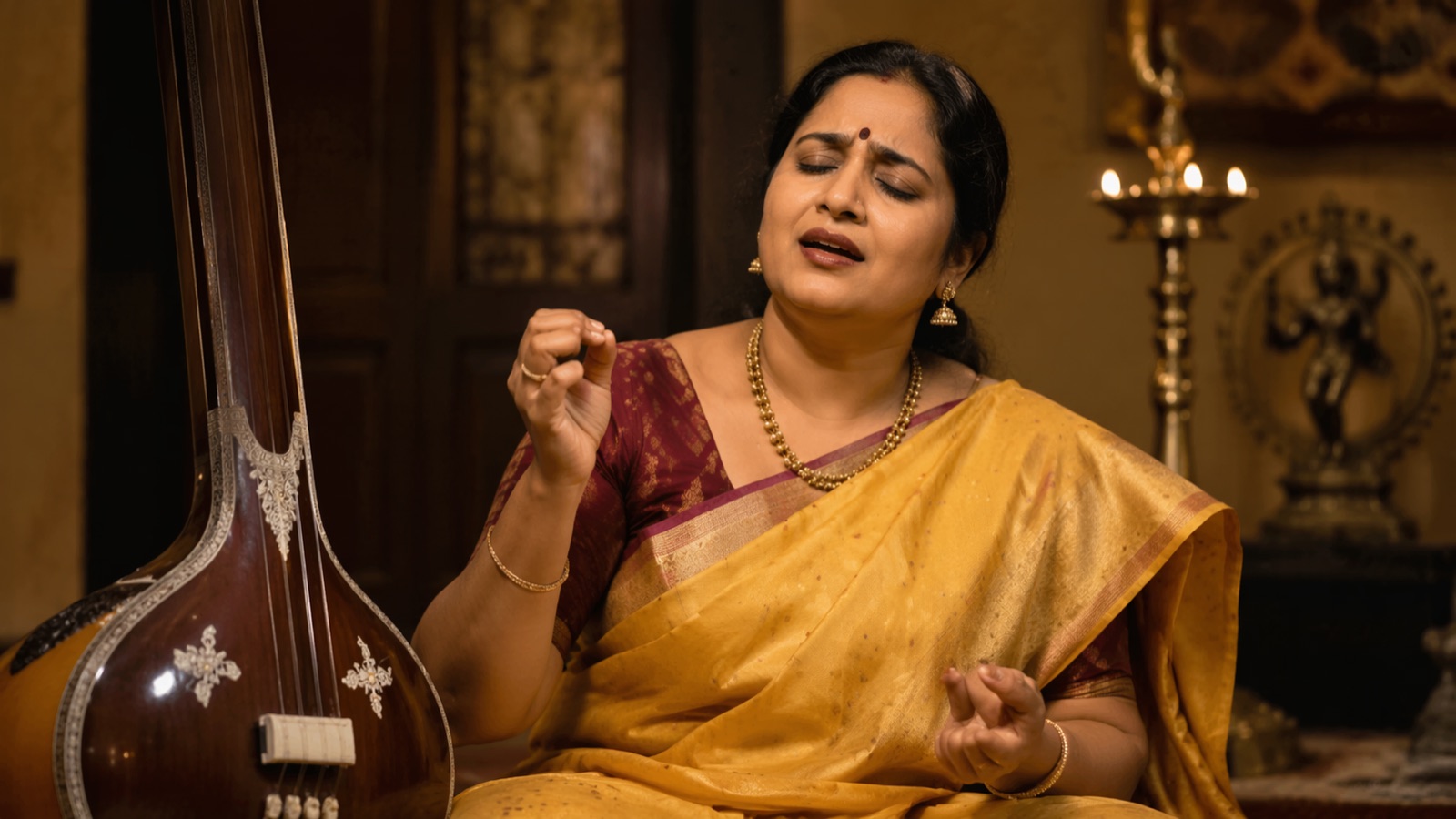
Gamakas cannot be learned from books. This is the single most important pedagogical truth in Carnatic music, and it is the reason the guru-shishya parampara (teacher-student lineage) remains indispensable despite the availability of recordings, tutorials, and digital tools. The student learns gamakas by imitation — by listening to the guru sing a phrase hundreds of times, attempting to reproduce it, being corrected, and gradually internalising the precise oscillation patterns, the exact weight and speed of each slide, the micro-tonal inflections that no notation can encode.
The process begins with the sarali varisai and janta varisai exercises that every beginner practises. Even at this foundational stage, the guru insists on correct gamaka rendition. The student does not merely sing "Sa Ri Ga Ma Pa Da Ni Sa" as flat tones; each note is rendered with the appropriate oscillation from the very first lesson. By the time the student progresses to geeta, svarajati, and eventually varnam — that supreme vehicle of gamaka training — the ornamentations are becoming second nature.
The varnam deserves special mention here. Compositions like Viriboni in Bhairavi (attributed to Pacchimiram Adiyappayya), Ninnukori in Mohanam (by Ramnad Srinivasa Iyengar), or Eranapai in Sri by Poochi Srinivasa Iyengar are not merely technical exercises — they are gamaka gymnasiums. The dense, rapid svara passages in a varnam's charanam sections demand precise control over every type of gamaka at tempo. A vocalist who can render a varnam with full gamaka fidelity at all three speeds (vilamba, madhyama, and durita kala) has achieved a formidable level of technical mastery.
Among the great vocalists of the modern era, certain names are synonymous with gamaka mastery. Semmangudi Srinivasa Iyer (1908–2003) was renowned for the majesty and weight of his oscillations — his rendering of gamakas in ragas like Todi and Bhairavi carried an almost gravitational force. M. D. Ramanathan (1923–1984), with his deep bass voice, deployed slow, deliberate gamakas that gave each note a meditative profundity, particularly in his iconic Kambhoji and Sahana renditions. D. K. Jayaraman (1928–1991), a disciple of Semmangudi, inherited his guru's gamaka vocabulary but inflected it with a lighter, more agile touch.
Among more recent and contemporary vocalists, T. M. Krishna and Sanjay Subrahmanyan represent two distinct approaches to gamaka deployment. Krishna's gamakas often emphasise deliberate, weighted oscillations that linger on each phrase, while Sanjay's approach features a quicksilver fluidity — gamakas that seem to ripple effortlessly across the melodic surface. Neither is "correct" in an absolute sense; both are faithful to the raga grammar while expressing profoundly individual artistic personalities.
This, ultimately, is the paradox and the glory of the gamaka tradition. The ornamentations are prescribed by raga grammar — one cannot arbitrarily change the gamaka treatment of a svara without distorting the raga — yet within those prescriptions, there is infinite scope for individual expression. The speed of an oscillation, the depth of a slide, the weight placed on a particular note-deflection, the fraction of a second spent lingering on a kampita before resolving — these are the micro-decisions that distinguish one great vocalist from another, one concert from another, one moment of transcendence from the merely competent.
Gamakas are where grammar meets poetry, where science meets devotion. They are the breath of the raga, the pulse of the tala, and the fingerprint of the artist — all at once.
For the serious rasika, cultivating sensitivity to gamakas is perhaps the single most rewarding investment in listening. Once you begin to hear not just which notes a vocalist sings but how they sing them — the micro-architecture of each phrase, the way a master vocalist sculpts silence and sound through gamaka — you will find that the music reveals depths you never suspected were there. This is the art within the art, the soul within the soul of Carnatic vocalism.