
In This Article
The Golden Age of Carnatic Music
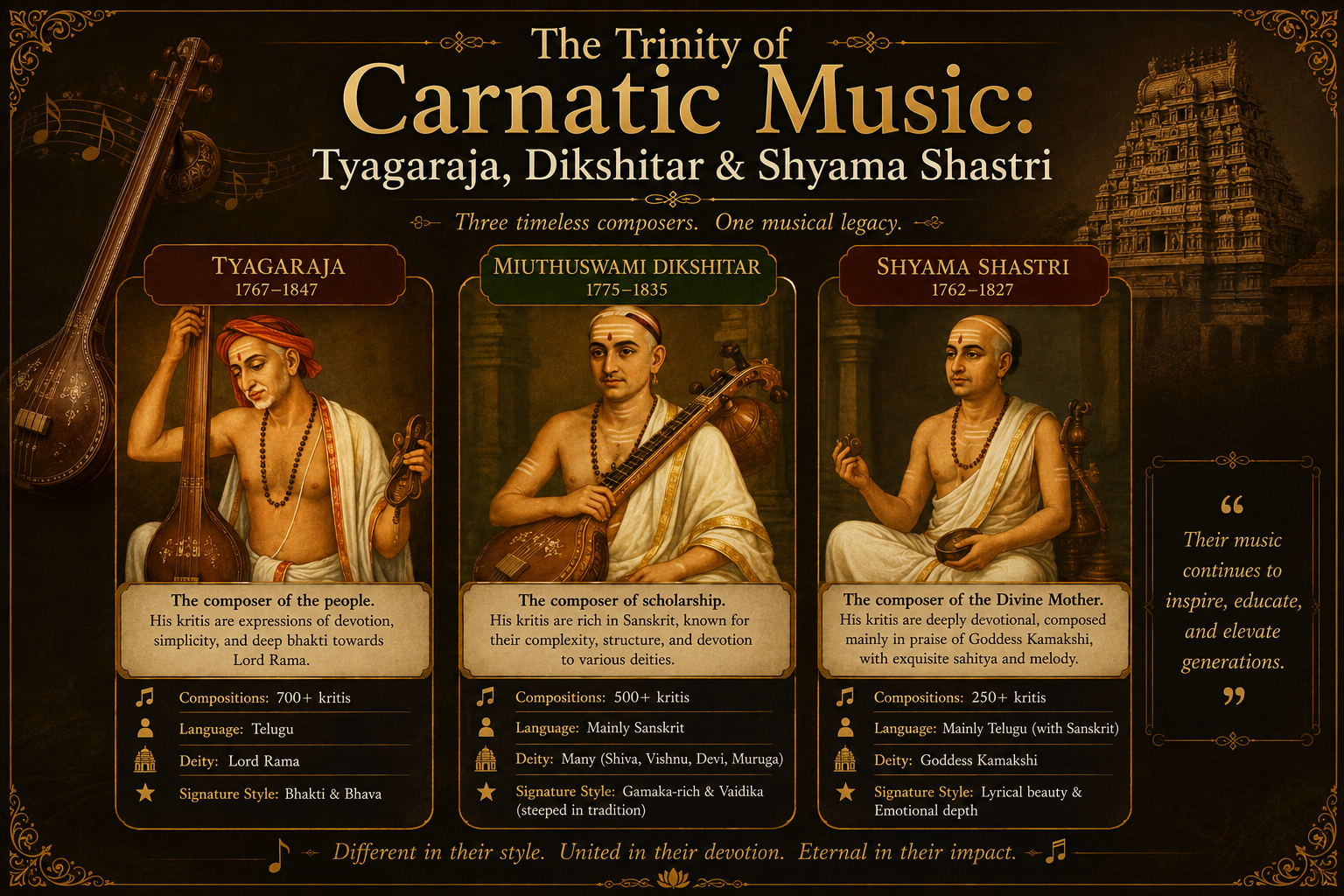
The late 18th and early 19th centuries in Thanjavur witnessed an extraordinary convergence — three composers, born within a few years of each other, who would collectively define the Carnatic music tradition. Tyagaraja (1767–1847), Muthuswami Dikshitar (1775–1835), and Shyama Shastri (1762–1827) are revered as the Musical Trinity (Sangeetha Mummoortigal).
What makes their contribution remarkable is not just the quantity of compositions — Tyagaraja alone composed over 700 kritis — but the completeness of their exploration. Between them, they covered virtually every raga, every emotional shade, and every structural possibility within the kriti format.
Tyagaraja — The Bhakta Composer
Sri Tyagaraja of Thiruvaiyaru is perhaps the most beloved figure in Carnatic music. His compositions, primarily in Telugu, express an intensely personal devotion to Lord Rama. Kritis like "Nagumomu" (Abheri), "Endaro Mahanubhavulu" (Sri), and "Bantureethi" (Hamsanadam) are the bedrock of every Carnatic musician's repertoire.
Tyagaraja's genius lies in the marriage of bhava (emotion) and raga bhava (melodic expression). His compositions are deceptively simple on the surface but reveal extraordinary depth when explored by a skilled performer. The annual Tyagaraja Aradhana at Thiruvaiyaru, where thousands of musicians gather to sing his Pancharatna kritis in unison, is one of the most moving spectacles in the world of music.
Muthuswami Dikshitar — The Scholar-Mystic
If Tyagaraja was the heart of Carnatic music, Dikshitar was its intellect. His compositions in Sanskrit are marvels of musical architecture — elaborate, dignified, and rich with vedantic philosophy. Each kriti is a meditation on a specific deity at a specific temple, making his body of work a musical pilgrimage across South India.
Dikshitar's compositions use slower tempos and more ornate phrases, demanding patience and depth from the performer. His exploration of rare ragas has preserved many melodic forms that might otherwise have been lost.
Shyama Shastri — The Perfectionist
The least prolific of the Trinity — with only about 300 known compositions — Shyama Shastri was a perfectionist whose works are prized for their rhythmic complexity and emotional intensity. His compositions to Goddess Kamakshi at Kanchipuram are filled with a yearning devotion that moves listeners deeply.
Shyama Shastri's mastery of tala was legendary. His swarajatis and kritis feature intricate rhythmic structures that challenge even accomplished musicians, and his influence on the development of rhythmic improvisation in Carnatic music is immeasurable.
Their Enduring Legacy
Together, the Trinity established the kriti as the central compositional form of Carnatic music. Every concert today is built around their works. Their compositions serve simultaneously as devotional offerings, educational material for students, and vehicles for artistic expression — a testament to the depth and universality of their genius.