
In This Article
Origins and Significance: The Inseparable Partner
In the sonic universe of South Indian classical and devotional music, few partnerships are as elemental as that of the nadaswaram and the thavil. Where the nadaswaram provides the soaring melodic line — a voice often described as the closest instrumental approximation to the human voice — the thavil provides its rhythmic foundation, its gravitational anchor. The pairing is not merely conventional; it is considered sacred. Temple rituals, particularly in Tamil Nadu, are deemed incomplete without the periya mēḷam (literally, "big ensemble"), in which the nadaswaram and thavil form the core, often supplemented by an ottu (drone pipe) and a second nadaswaram playing a supportive role.
The thavil's origins are deeply intertwined with the Dravidian temple traditions of South India, with references to barrel-shaped drums appearing in Sangam-era Tamil literature and in the sculptural programmes of Pallava and Chola temples. The instrument occupies an essential place in the Āgama texts governing temple worship, where its sound is believed to invoke auspiciousness. No Hindu wedding in Tamil Nadu, no temple utsavam (festival procession), no nadaswaram kutcheri is conceivable without the thavil's commanding presence.
Construction and Acoustics: Engineering Thunder
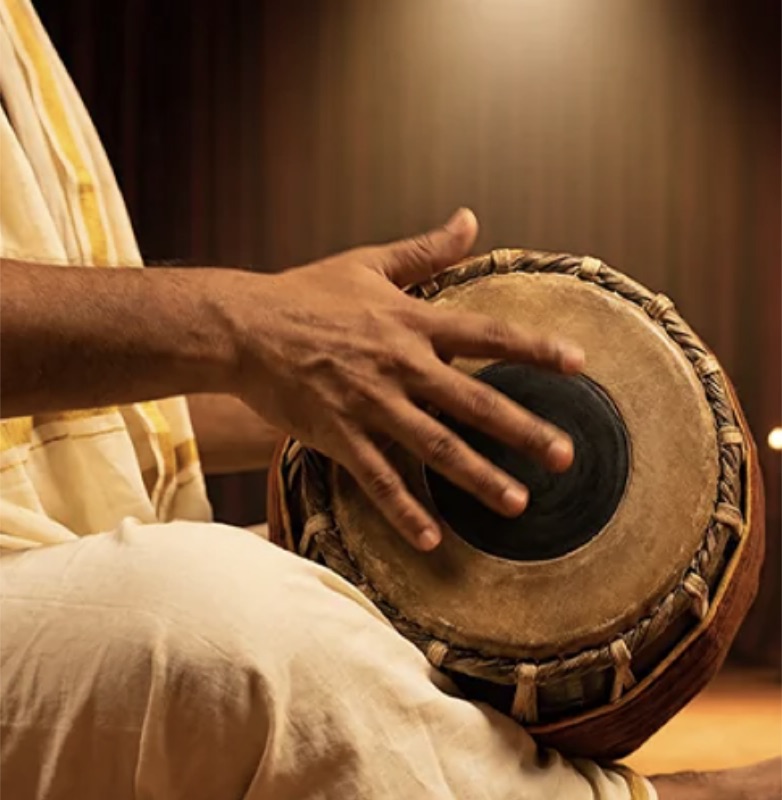
The thavil is a barrel-shaped, double-headed drum, typically around 40 to 45 centimetres in length and roughly 30 centimetres in diameter at its widest point. Its body, or shell, is traditionally carved from a single block of jackfruit wood (Artocarpus heterophyllus), chosen for its density, resonance, and resistance to cracking under the enormous tension exerted by the drumheads. The slightly bulging barrel shape is critical to the instrument's acoustics, producing a rich, full-bodied tone with substantial low-frequency energy that allows it to match the nadaswaram's formidable volume in open-air settings.
The two drumheads are made from buffalo hide, stretched over hoops and laced to one another with leather straps that run the length of the barrel. Tuning is accomplished by adjusting these straps and by the application of a paste — traditionally a mixture of semolina (rava) and water — to the left-hand head. This paste lowers the pitch of the left head, creating a deep, booming bass tone that contrasts with the sharper, higher-pitched right head. The tuning paste must be freshly applied before each performance, making it an ephemeral and exacting element of the instrument's preparation.
- Right head (valanthalai): Played with the fingers and palm of the right hand; produces higher-pitched, articulate strokes.
- Left head (idanthalai): Played with a thick stick made of tamarind or palmyra wood; produces deep bass tones shaped by the semolina paste.
- Shell: Jackfruit wood, barrel-shaped, with walls approximately 1.5–2 cm thick.
- Lacing: Buffalo-hide straps, tightened with cylindrical wooden wedges (surul) to adjust pitch.
The resulting instrument is heavy — often weighing between 6 and 8 kilograms — and demands considerable physical stamina from the player, who typically suspends it from the neck and shoulder using a thick cloth strap while performing standing for hours at a stretch during temple processions.
Playing Technique: Stick, Hand, and the Art of Ambidextrous Rhythm
What makes the thavil unique among South Indian percussion instruments is the radical asymmetry of its playing technique. The right hand engages the drumhead directly, using an elaborate vocabulary of finger strokes — open tones, closed tones, slaps, and intricate ornamental patterns executed with all five fingers. To protect the fingers from the abrasion of the coarse buffalo hide and to produce a sharper, more brilliant tone, thavil players traditionally wrap their right-hand fingers with adhesive tape or, historically, with dried areca palm fibre. The calluses and sometimes permanent thickening of the fingers that result from years of practice are a badge of dedication among thavil vidwans.
The left hand wields a short, stout stick, typically 15 to 20 centimetres long, fashioned from dense wood. The stick strikes the paste-laden left head to produce thunderous bass strokes that punctuate the rhythmic cycle and provide the characteristic boom that underpins the nadaswaram's phrases. The interplay between the two hands — one producing crisp, melodically inflected patterns, the other delivering powerful rhythmic accents — creates a polyrhythmic dialogue within a single instrument.
The rhythmic language of the thavil is rooted in the Carnatic tāḷa system. A skilled thavil vidwan navigates complex korvais (rhythmic cadences), mora patterns, and kuraippu (diminishing patterns) with precision, providing not merely accompaniment but a full-fledged rhythmic commentary on the nadaswaram's performance. In concert settings, the thavil player engages in tani āvartanam — the solo percussion interlude — where the full scope of technique is displayed, from thundering cascades of sound to whisper-soft fingertip work.
"The thavil is not merely a rhythm instrument. In the hands of a master, it speaks — it converses with the nadaswaram, argues, agrees, and celebrates." — attributed to T. N. Rajarattinam Pillai
Masters and Legacy: From Temple Courtyard to Concert Hall
No discussion of the thavil's artistic elevation can begin without the name Valayapatti A. R. Subramaniam (1917–2007). Born in Valayapatti, a village in Sivaganga district of Tamil Nadu renowned for its thavil tradition, Subramaniam transformed the instrument from a purely accompanying role into a vehicle for solo artistry. His concerts — both as an accompanist to nadaswaram legends like T. N. Rajarattinam Pillai and Thiruvavaduthurai Rajarattinam Pillai, and as a solo artist — demonstrated that the thavil could sustain an audience's attention with its own intrinsic musical richness. He received the Sangeet Natak Akademi Award in 1988 and the Padma Shri in 2004, rare national honours for a thavil artist, reflecting the wider recognition his artistry had earned.
Other stalwarts who shaped the thavil tradition include Needamangalam Meenakshisundaram Pillai, whose partnership with T. N. Rajarattinam Pillai in the mid-twentieth century is considered one of the greatest nadaswaram-thavil pairings in recorded history, and Injikudi Subramaniam, known for his extraordinary speed and precision. The tradition continued through artists such as Valayapatti A. R. Subramaniam's son, Valayapatti A. S. Gnanamani, and Mannargudi Easwaran, who have carried the art into the contemporary era, performing at major sabha concerts and international festivals.
The thavil's role in Tamil Nadu's cultural life remains indispensable. At the great temple festivals of Thyagaraja Swamy Temple in Thiruvarur, Meenakshi Amman Temple in Madurai, and Nataraja Temple in Chidambaram, the periya mēḷam ensemble continues to fulfil its ancient liturgical function. In the wedding halls of Tamil Nadu, the nadaswaram-thavil duo heralds the bride and groom, marks the muhurtham, and fills the air with auspiciousness. Meanwhile, on the concert stage, organisations like the Madras Music Academy and Krishna Gana Sabha in Chennai have, over the decades, provided platforms for thavil artists to perform solo recitals and demonstrations, gradually expanding the rasika's appreciation of the instrument's capabilities.
Yet challenges persist. The physical demands of the instrument, the declining number of temple appointments, and the relatively lower prestige (and remuneration) accorded to accompanists compared to soloists have contributed to a shrinking pool of dedicated thavil practitioners. Efforts by cultural organisations and government academies — including the Tamil Nadu Iyal Isai Nataka Mandram — to support training and performances are vital to ensuring that this magnificent tradition endures.
The thavil, in the final reckoning, is far more than an accompaniment. It is the heartbeat of the periya mēḷam, the rhythmic conscience of one of the world's great wind instruments, and — in the hands of its greatest exponents — a concert instrument of extraordinary power and subtlety. For the serious rasika, to hear a master thavil vidwan in full flow alongside a great nadaswaram player is to witness one of Carnatic music's most visceral and exhilarating experiences.