
In This Article
Origins and History of the Aradhana
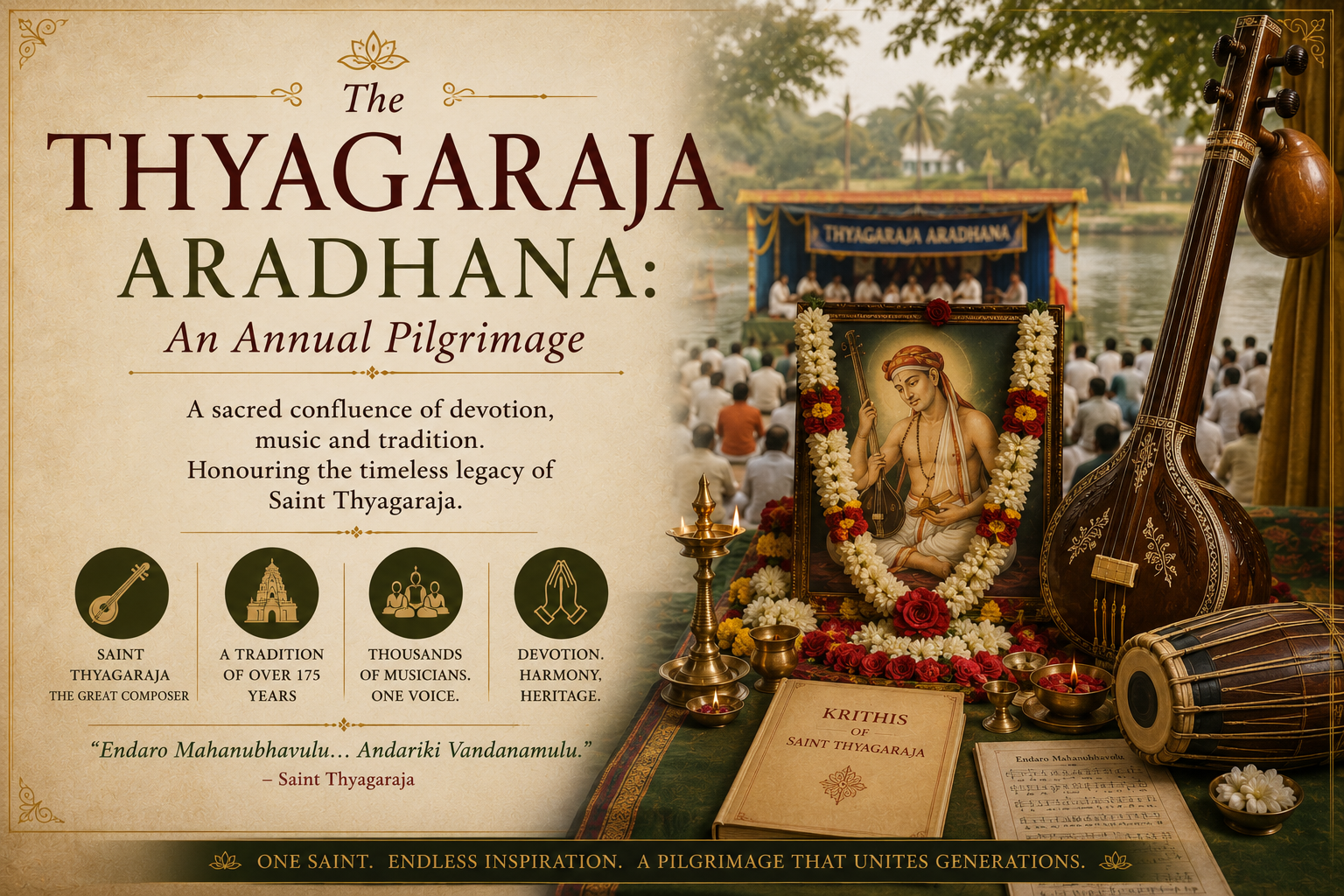
On the banks of the river Kaveri, in the modest temple town of Thiruvaiyaru in Tamil Nadu's Thanjavur district, one of the most remarkable events in the world of classical music unfolds each year. The Thyagaraja Aradhana is not merely a music festival — it is an act of collective devotion, a living tradition that honours the memory of Thyagaraja (1767–1847), the foremost of the Carnatic music trinity, whose compositions form the very bedrock of the South Indian classical tradition.
Thyagaraja attained samadhi on the Pushya Bahula Panchami day — the fifth day of the waning moon in the Tamil month of Pushya — in the year 1847. His disciples, led by figures such as Walajapet Venkataramana Bhagavathar and Manambuchavadi Venkatasubbayyar, began observing his death anniversary with rituals and the singing of his compositions almost immediately. In those early decades, the commemoration was an intimate affair, centred around Thyagaraja's samadhi on the southern bank of the Kaveri, near the Panchanadeeshwarar Temple.
The modern form of the Aradhana took shape in the early twentieth century. A pivotal moment came in 1907, when Bangalore Nagarathnamma, a distinguished musician and devadasi, took it upon herself to renovate and protect Thyagaraja's samadhi site from neglect and rival claims. Her tireless efforts — including a legal battle that reached the Madras High Court — ensured that the site remained a public monument dedicated to the saint-composer. She is rightly regarded as the saviour of the Aradhana tradition as we know it today.
Over the decades, the event grew from a regional observance into a national and even international pilgrimage. The Thyagaraja Aradhana typically falls in January, and the festivثفes span five days, though the programme has varied in duration over the years. The event is organised under the auspices of various trusts and sabhas, with the Sri Thyagabrahma Mahotsava Sabha playing a central coordinating role.
The Pancharatna Kritis: A Sacred Collective Offering
The undisputed centrepiece of the Aradhana is the unchavritti — the collective, congregational singing of Thyagaraja's five Pancharatna kritis (the "Five Gems") on the morning of the Aradhana day itself. This is a moment unlike any other in the Carnatic music calendar. Hundreds of musicians — from the most celebrated vidwans and vidushis to earnest students — sit together before the samadhi and sing these five masterworks in unison.
The five Pancharatna kritis, each set in a distinct raga and composed in Telugu, are:
- Jagadanandakaraka — Raga Nata, Adi tala
- Dudukugala — Raga Gowla, Adi tala
- Sadhinchene — Raga Arabhi, Adi tala
- Kana Kana Ruchira — Raga Varali, Adi tala
- Endaro Mahanubhavulu — Raga Sri, Adi tala
These are not ordinary compositions. Each kriti is a monumental, multi-sectioned work featuring elaborate charanas (stanzas), demanding both musical mastery and devotional depth. Jagadanandakaraka, in the majestic Nata raga, opens the sequence with regal grandeur, while the concluding Endaro Mahanubhavulu — arguably the most celebrated composition in all of Carnatic music — ends the sequence with a profound meditation on the "great souls" who have found bliss in the divine.
"Endaro mahanubhavulu, andariki vandanamulu" — "There are many great souls; to all of them, my salutations." These words, simple yet infinitely expansive, capture the essence of Thyagaraja's humility and his universal vision of devotion.
The congregational singing traditionally follows the versions established by the direct lineage of Thyagaraja's disciples. The lead is typically taken by a senior musician of great standing. In past decades, legends such as Semmangudi Srinivasa Iyer, D.K. Jayaraman, and Nedunuri Krishnamurthy have had the honour of leading the Pancharatna singing. The sight of hundreds of voices merging into a single stream of melody before the saint's resting place is profoundly moving — an experience that transcends the boundaries of performance and becomes pure worship.
Attending the Aradhana: A Practical Guide
For the serious rasika contemplating a visit to Thiruvaiyaru, some practical knowledge is essential. The Aradhana is typically held over five days in January, with the exact dates determined by the lunar calendar. The Pancharatna singing takes place on the final day, usually in the morning hours between 8:00 and 10:00 AM.
Getting there: Thiruvaiyaru is approximately 13 kilometres from Thanjavur (Tanjore), which is well connected by rail and road. The nearest major airport is Tiruchirappalli (Trichy), about 60 kilometres away. Most attendees base themselves in Thanjavur, where accommodation options range from heritage hotels to modest lodges. During the Aradhana week, rooms fill up quickly, and early booking is strongly advised.
The programme structure: The five-day festival includes:
- Nagaswaram and thavil performances inaugurating the proceedings
- Individual concerts by leading and upcoming Carnatic musicians throughout each day and evening
- Harikatha performances narrating episodes from Thyagaraja's life
- Unchavritti bhajana — a procession through the streets of Thiruvaiyaru, singing Thyagaraja's divyanama kritis and collecting alms, recreating the saint's own daily practice
- The climactic Pancharatna kriti singing on the final morning
What to expect: Thiruvaiyaru is a small town, and the Aradhana is an outdoor event centred on the samadhi and the adjacent mandapam. Conditions are simple — one sits on the ground, often in warm January sunshine, surrounded by thousands of fellow devotees. There is no ticketing or formal seating; the atmosphere is democratic and open. Carry a mat, water, and patience. The town's infrastructure is modest, and the crowds can be considerable, but this very simplicity is part of the Aradhana's charm. It strips away the formalities of the concert hall and returns music to its sacred origins.
It is worth noting that parallel Thyagaraja Aradhana celebrations are held in other cities — notably in Chennai, Hyderabad, and even in cities such as Cleveland and London — for those unable to travel to Thiruvaiyaru. However, none can replicate the atmosphere of the original.
The Spiritual Essence: More Than a Festival
What sets the Thyagaraja Aradhana apart from every other event in the Carnatic music calendar is its essentially spiritual character. This is not a competition, not a showcase, and not a career opportunity. It is, at its heart, an act of bhakti — devotion offered through the medium of music to a saint who himself offered his music as devotion to Lord Rama.
Thyagaraja composed an estimated 700 to 800 kritis, an extraordinary body of work that encompasses virtually every emotional shade of devotion — from ecstatic joy to anguished longing, from philosophical enquiry to tender intimacy with the divine. His life, as recounted by tradition, was one of radical simplicity: he refused the patronage of kings, choosing instead the path of unchavritti (living on alms), and dedicated every waking hour to the worship of Rama through song.
The Aradhana commemorates not just his compositions but this ideal — the vision of music as a spiritual discipline, a path to liberation. When the assembled musicians sing Dudukugala in Gowla raga, confessing the "faults" and worldly attachments that hinder the soul's progress, they are not merely performing a kriti; they are participating in a collective act of spiritual introspection that Thyagaraja himself modelled.
To sit before the samadhi as the first notes of Jagadanandakaraka rise from hundreds of voices in the morning air is to understand, viscerally, why Carnatic music has never been merely an art form. It is, in the truest sense, nada upasana — worship through sacred sound.
For the rasika who has spent years listening to these compositions in concert halls and recordings, the Aradhana offers something irreplaceable: context. Here, beside the Kaveri, in the very soil where Thyagaraja walked and sang, the music sheds its concert-hall formality and reveals its original purpose. The experience is at once humbling and elevating — a reminder that the tradition we cherish is not a museum piece but a living, breathing act of faith, renewed each year by the collective devotion of those who gather in Thiruvaiyaru.
The Thyagaraja Aradhana remains, after nearly two centuries, the beating heart of the Carnatic music world. To attend it at least once is not merely recommended — for the serious student and lover of this music, it is essential.