In This Article
Origins and the Three Saints
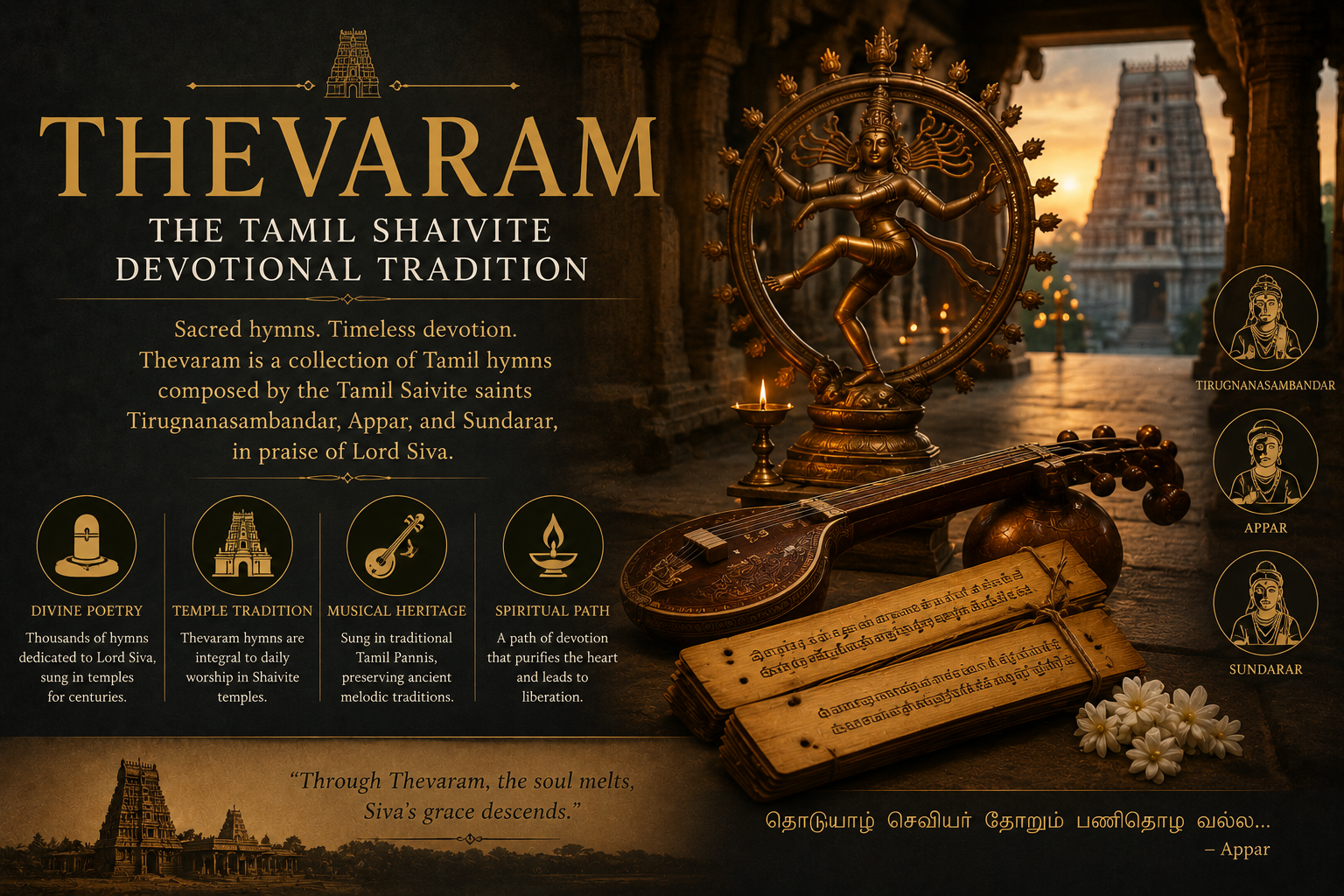
The Thevaram (தேவாரம்) represents one of the oldest and most revered bodies of devotional literature in the Indian subcontinent. Composed in Tamil between the 7th and 8th centuries CE, these hymns constitute the first seven volumes (thirumurai) of the twelve-volume Shaivite canon known as the Panniru Thirumurai. The word Thevaram itself is understood to mean "a garland for God" or "in praise of God," and these compositions are addressed to Lord Shiva in his various manifestations across the sacred landscape of Tamil Nadu.
Three poet-saints, collectively venerated as the Moovar (the Three), are responsible for this extraordinary corpus:
- Thirugnana Sambandar (c. 7th century CE) — The earliest of the three, Sambandar is said to have begun composing hymns as a child of three, after receiving the grace of Goddess Parvati. He composed the first three volumes of the Thevaram, comprising 4,158 verses (padigams or decades of verses). His poetry is characterised by a luminous sweetness and theological precision, often engaging polemically with the Jain and Buddhist traditions that were then influential in the Pandya kingdom.
- Thirunavukkarasar (Appar) (c. 7th century CE) — A contemporary and elder of Sambandar, Appar's path to Shaivism was dramatic: he converted from Jainism after a severe illness and devoted himself entirely to Shiva. His compositions, forming volumes four through six, number 4,906 verses. Appar's hymns are marked by an intensely personal, penitential tone — the anguished cry of a devotee who considers himself unworthy yet is overwhelmed by divine grace. His famous refrain, "Namasivaya vazhga" (Hail Namasivaya), echoes through Tamil devotional consciousness to this day.
- Sundarar (c. 8th century CE) — The last of the Moovar, Sundarar composed the seventh volume, containing 1,026 verses. His relationship with Shiva is strikingly intimate and even audacious; he addressed the Lord as a friend (thozan) and was not above reproaching the divine. His Thiruthondathokai, a hymn listing the sixty-three Nayanmars (Shaivite saints), became the foundational text for Sekkilar's later epic, the Periya Puranam.
Together, the Thevaram corpus comprises approximately 798 padigams (sets of usually ten or eleven verses) and over 10,000 individual stanzas, addressed to Shiva at more than 274 temples, known as Paadal Petra Sthalam — temples "that have received song." These sacred sites, spread across Tamil Nadu and parts of Sri Lanka, remain pilgrimage destinations precisely because they were immortalised in the Thevaram.
Rediscovery and the Temple Canon
The history of the Thevaram's preservation is itself a remarkable narrative. According to tradition, the hymns fell into neglect over the centuries until the great Chola king Rajaraja I (985–1014 CE), inspired by hearing a reference to them, dispatched scholars to recover the texts. The hymns were found, reportedly in fragmentary palm-leaf manuscripts eaten by white ants, in a sealed chamber within the Thillai Nataraja Temple at Chidambaram. The king entrusted the scholar-saint Nambiyandar Nambi with the monumental task of organising and compiling the texts into the Panniru Thirumurai canon.
Rajaraja I did far more than merely preserve the texts. He institutionalised their recitation as an integral part of temple worship across the Chola realm. Inscriptional evidence from the Brihadeeswara Temple at Thanjavur (consecrated c. 1010 CE) records the appointment of forty-eight individuals — singers and musicians — specifically for the daily recitation of the Thevaram. This royal patronage transformed the hymns from a wandering devotional tradition into a liturgical institution, embedding them permanently within the ritual architecture of Shaivite temples.
"The Thevaram is not merely literature to be read or music to be performed; it is a living act of worship, inseparable from the temple where it resounds."
The tradition of singing the Thevaram during the daily puja rituals — particularly during the procession of the deity — has continued without interruption for over a millennium. Even today, in major Shiva temples across Tamil Nadu, the Thevaram is recited during all six daily worship sessions (aru kala puja), with specific hymns chosen according to the time of day, the festival calendar, and the presiding deity of the temple.
Musical Structure and the Pann System
The Thevaram hymns are not merely poetry set to music; they were conceived as musical compositions from their inception. Each padigam is assigned a specific melodic mode called a pann (பண்), the ancient Tamil system of modal music that predates and is considered a precursor to the raga system of Carnatic music. The Thevaram employs 23 panns, each with a distinct aesthetic character and emotional resonance.
Scholars and musicologists have mapped correspondences between the ancient panns and later Carnatic ragas, though these relationships are approximate and debated:
- Nattapadai — often equated with Natabhairavi
- Kolli — associated with Kharaharapriya
- Pazham Panchuram — linked to Shankarabharanam
- Indalam — compared to Mayamalavagowla
- Sevvazhi — connected to Kalyani
- Kurinji — associated with Harikambhoji
Each padigam also follows a specific tala (rhythmic cycle), though the rhythmic framework in Thevaram singing tends to be less rigidly codified than in Carnatic concert music. The verses are structured in Tamil poetic metres — viruttam, venba, ahaval, and other classical forms — and the melodic rendering respects the prosodic structure of the verse. This intimate marriage of language, metre, and melody gives the Thevaram a sonic quality that is unmistakably distinct from later Carnatic compositions.
The musical notation of the Thevaram panns was historically transmitted orally, and much of the nuance of the original renderings has undoubtedly evolved over the centuries. In the early 20th century, the pioneering musicologist Abraham Pandithar, in his landmark work Karunamirtha Sagaram (1917), attempted a systematic documentation of the panns and their Carnatic equivalents. More recently, scholars such as S. Ramanathan of Wesleyan University and institutions like the French Institute of Pondicherry have undertaken significant research into reconstructing the original musical framework of the Thevaram.
The Odhuvar Tradition: A Living Heritage
The singing of the Thevaram in temples is the sacred responsibility of a class of singers known as odhuvars (ஓதுவார்), a word derived from the Tamil root odhu, meaning "to recite" or "to chant." The odhuvars are hereditary temple musicians, traditionally belonging to the Pillai community, who have preserved the oral transmission of the panns across generations. Their role is liturgical rather than performative: they sing not for an audience but as an offering to the deity, standing before the sanctum during the processional rituals.
The odhuvar tradition faces significant challenges in the contemporary era. The number of practising odhuvars has dwindled considerably — from the hundreds who once served in major temple complexes to a fraction of that number today. Financial constraints, the decline of hereditary patronage following the Hindu Religious and Charitable Endowments (HR&CE) department's administration of temples, and the migration of younger generations away from the profession have all contributed to this decline.
Yet there are grounds for cautious optimism. Institutions such as the Dharmapuram Adheenam and the Thiruvavaduthurai Adheenam — major Shaivite monasteries — have historically maintained schools for training odhuvars. In recent decades, organisations including the Thevara Panimandram and initiatives by individual scholars and musicians have worked to revitalise the tradition. The annual Arudra Darshan festival in Chidambaram and the Nayanmars' festivals at Shaivite temples remain occasions where the Thevaram resounds in its full liturgical glory, sung in procession as the bronze deities are carried through the temple corridors.
For the serious rasika of Indian classical music, the Thevaram offers something irreplaceable: a window into the pre-Carnatic musical world of South India, where melody, devotion, poetry, and ritual existed in an undifferentiated unity. The panns are not merely historical curiosities; they represent an independent and ancient modal system that shaped the very foundations upon which the later Carnatic edifice was constructed. To hear an odhuvar sing Sambandar's hymns in Nattapadai within the flickering lamp-lit corridors of a Chola-era temple is to encounter a musical tradition of staggering antiquity and undiminished spiritual power — a tradition that predates the trinity of Carnatic music by nearly a thousand years and yet remains, in its essential character, vibrantly alive.