
In This Article
The Birth of a National Patron
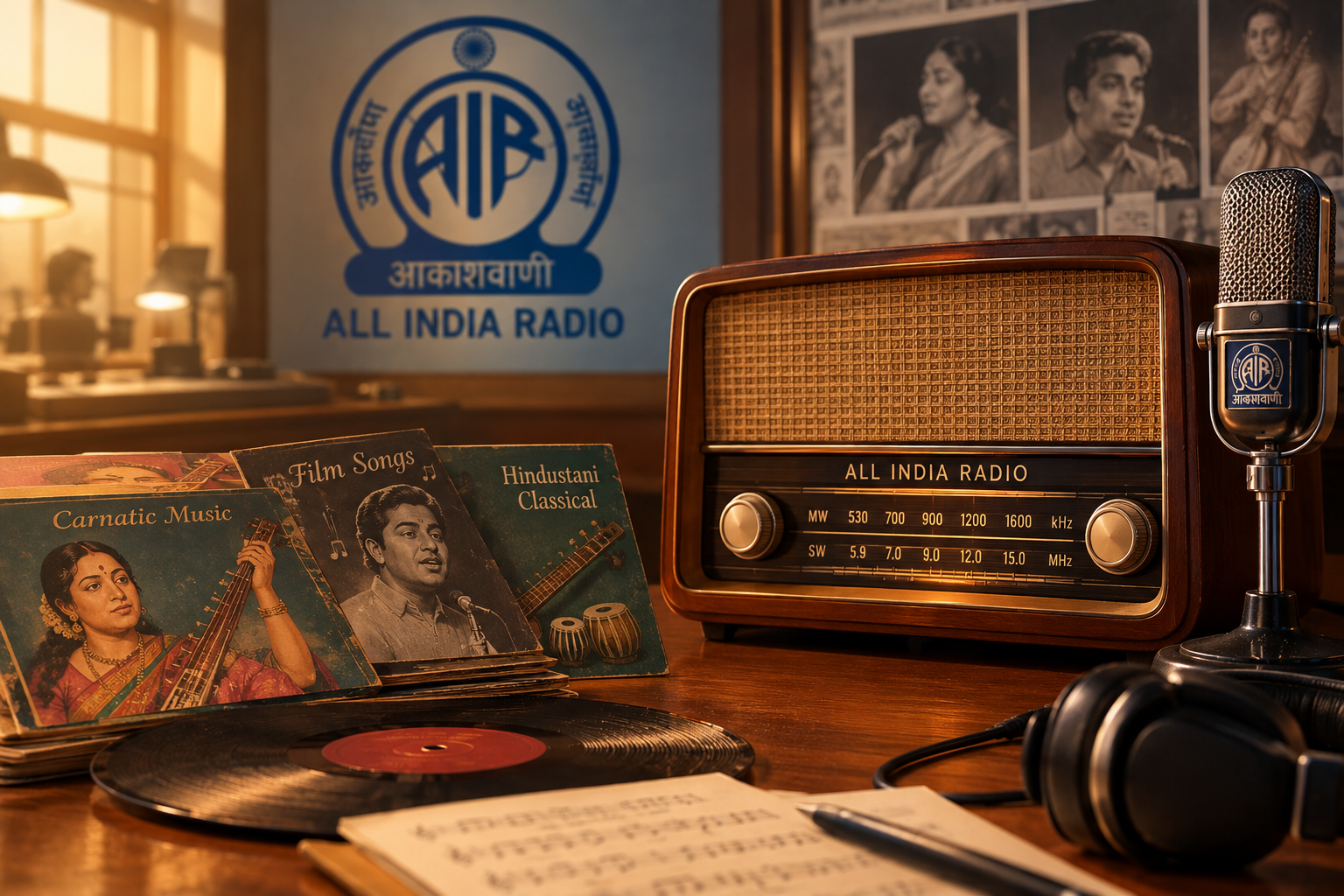
When India gained independence on 15 August 1947, its national broadcaster—All India Radio (AIR), or Akashvani—inherited a modest but consequential infrastructure. The Indian Broadcasting Company had begun transmissions in 1927 from Bombay and Calcutta, and by 1936, under British administration, it was rechristened All India Radio. But it was in the decades following Independence that AIR evolved into something without parallel in the history of any nation's engagement with its classical arts: a state institution that simultaneously served as patron, employer, concert organiser, pedagogy platform, and the single largest archive of Indian classical music recordings in existence.
The vision was shaped significantly by B.V. Keskar, India's Information and Broadcasting Minister from 1950 to 1962. Keskar was a deeply committed rasika who held strong—and sometimes controversial—views about the role of music in national culture. He famously banned film music from AIR in 1952, a decision that, whatever its broader cultural merits, dramatically expanded the airtime available for classical and light-classical forms. Under his stewardship, AIR became the most powerful institutional force in Indian classical music, surpassing even the erstwhile princely courts in its capacity to sustain artists and shape listening habits.
Keskar worked closely with musicologists and practitioners. Pandit V.N. Bhatkhande's classificatory framework and Pandit V.D. Paluskar's democratising ethos found a natural extension in AIR's mandate to bring music from the private mehfil to the public airwaves. The appointment of expert music producers at every station—figures like Pandit V.G. Jog in Bombay, Jnan Prakash Ghosh in Calcutta, and Sumati Mutatkar in Delhi—ensured that programming decisions were guided by genuine connoisseurship rather than bureaucratic convenience.
AIR as Employer: The Grading System and Staff Artists
Perhaps the most consequential mechanism AIR devised was its artist grading system, which classified performers into categories—initially A, B, and C, later expanded to include the top-tier designation of "Top Grade" (sometimes called "A-Top" or the highest grade). This grading determined not only the honorarium an artist received for a broadcast but also conferred a powerful form of institutional recognition. Being elevated to the Top Grade was, for many musicians, as significant a milestone as winning a national award.
The audition panels that determined these grades were formidable. They typically comprised senior musicologists, established performers, and AIR's own music producers. The process could be exacting, and the politics occasionally contentious, but the system succeeded in creating a broadly respected hierarchy of professional standing. Artists who held the Top Grade over the decades included titans such as:
- Ustad Bade Ghulam Ali Khan (Patiala gharana, vocal)
- Pandit Ravi Shankar (sitar)—who also served as Director of Music at AIR Delhi from 1949 to 1956
- Ustad Ali Akbar Khan (sarod)
- Ustad Bismillah Khan (shehnai)
- M.S. Subbulakshmi (Carnatic vocal)
- Semmangudi Srinivasa Iyer (Carnatic vocal)
- Gangubai Hangal (Kirana gharana, vocal)
- Pandit Kumar Gandharva (vocal)
Beyond graded artists who appeared periodically, AIR also employed staff artists—full-time musicians attached to specific stations. This was transformative, particularly for instrumentalists and accompanists. Accomplished tabla players like Pandit Nikhil Ghosh and Ustad Shaukat Hussain Khan, harmonium players, tanpura artists, and numerous vocalists found stable employment that freed them from complete dependence on the uncertain patronage of private concerts. For many musicians from modest backgrounds, an AIR staff position meant the difference between penury and a dignified life devoted to practice and performance.
The various AIR stations also became crucibles of regional style. AIR Lucknow nurtured the legacy of thumri and dadra; AIR Calcutta became a stronghold of the Bengal school of sitar and the Vishnupur gharana; AIR Madras (Chennai) served as a vital node for Carnatic music; and AIR Dharwad sustained the rich Hindustani traditions of North Karnataka.
Sangeet Sammelans and the National Programme of Music
AIR's most visible contribution to concert culture was the AIR Sangeet Sammelan—grand music festivals organised by the broadcaster at various stations across the country. Beginning in the early 1950s, these Sammelans brought together the finest musicians of the era on a single stage, often in combinations that would have been impossible in private concert circuits. The annual Sangeet Sammelans held in Delhi, Calcutta, Bombay, and Madras became landmark events in the cultural calendar. They were broadcast live or recorded for later transmission, reaching audiences in the remotest corners of the subcontinent.
Equally significant was the National Programme of Music, a prestige slot typically broadcast on Saturday or Sunday nights across the entire AIR network. To be invited to perform on the National Programme was among the highest honours an Indian classical musician could receive. These broadcasts—usually running sixty to ninety minutes—allowed artists the luxury of unhurried, expansive raga development that commercial recordings of the 78-rpm and early LP era could never accommodate. It was through National Programme broadcasts that millions of Indians first heard extended alap-jod-jhala renditions or the slow, majestic unfolding of a khayal in vilambit ektaal.
"AIR did what no court or concert organiser could do—it made the whole nation a single sabha. A farmer in Assam and a clerk in Madurai could hear the same recital by Amir Khan Sahab on the same evening."
Several landmark broadcasts have passed into the lore of Hindustani and Carnatic music. Ustad Amir Khan's iconic renditions of ragas Marwa and Darbari Kanada, Pandit Bhimsen Joshi's towering performances of Miyan ki Todi, Kishori Amonkar's explorations of Bhoop and Bageshri, and D.K. Pattammal's renditions of Muthuswami Dikshitar's kritis—many of these survive today only because AIR's engineers committed them to tape.
AIR also commissioned and broadcast special programmes for festivals such as Basant Panchami, Sharad Purnima, and Thyagaraja Aradhana, reinforcing the deep connection between raga and ritu (season) that is central to Indian musical aesthetics.
The Archive and Its Uncertain Legacy
Over more than seven decades of recording, AIR accumulated what is conservatively estimated to be over 100,000 hours of recorded classical music—a treasure trove without equivalent anywhere in the world. The Akashvani Sangeet Archives, housed primarily at AIR Bhawan in New Delhi with subsidiary collections at major stations, contain recordings of artists who left behind no commercial discography, or whose AIR performances captured heights they never scaled in the studio.
The archive holds recordings of artists from the early twentieth century—performers like Ustad Faiyaz Khan, Ustad Abdul Karim Khan, and Roshanara Begum—transferred from shellac to tape, as well as the vast body of work recorded directly from the 1950s onwards. There are believed to be substantial recordings of Pandit Omkarnath Thakur, Begum Akhtar, Ustad Vilayat Khan, and countless other masters, many of which have never been publicly released.
Therein lies the tragedy. Despite periodic efforts at digitisation—including a notable initiative in the early 2000s supported by the Ministry of Information and Broadcasting—the vast majority of AIR's recordings remain inaccessible to the public. Magnetic tapes deteriorate. Oxide sheds from backing. Bureaucratic inertia, copyright ambiguities, and insufficient funding have conspired to keep this irreplaceable heritage locked in vaults, slowly degrading with each passing monsoon season.
In recent years, organisations such as the Archives and Research Centre for Ethnomusicology (ARCE) at the American Institute of Indian Studies in Gurgaon, and private initiatives by dedicated collectors, have worked to preserve fragments of this legacy. The Prasar Bharati corporation, which now oversees AIR, has made some recordings available through its website and mobile applications. But these represent a tiny fraction of the whole.
The urgency cannot be overstated. Every year of delay means more recordings lost to time. What AIR built in the decades after Independence—a democratised, national culture of deep listening, sustained by institutional commitment and genuine love of the art—was one of the most remarkable cultural projects of the twentieth century. Its archive is not merely a collection of old recordings; it is the living memory of a civilisation's musical thought. Preserving it, digitising it, and making it accessible to the rasikas of today and tomorrow is not just a cultural imperative—it is a moral one.