
In This Article
The Colonial Shadow: How Indian Classical Music Lost Its Patronage
By the latter half of the nineteenth century, Indian classical music found itself in a state of profound crisis. The collapse of the Mughal court system and the annexation of princely states by the British East India Company — and later the Crown — dismantled the darbar (court) patronage networks that had sustained Hindustani music for centuries. The courts of Lucknow, Jaipur, Gwalior, Rampur, and Baroda, once teeming with ustads and pandits, shrank or vanished altogether. Musicians who had enjoyed aristocratic support were reduced to penury or forced to seek employment in contexts that the emerging Victorian-influenced Indian middle class regarded with suspicion.
The association of classical music with the kotha (salon) culture of tawaifs — courtesans who were, in fact, among the most rigorously trained musicians and dancers of the era — further damaged its social standing. The colonial administration and the Western-educated Indian elite frequently dismissed Indian music as unscientific, unsystematic, and morally dubious. English-medium education, which became the gateway to economic mobility, left little room for traditional arts. As the musicologist Janaki Bakhle has documented in her landmark study Two Men and Music (2005), the art form that had produced the sublimities of Tansen's dhrupad and the intricate khayal of the Gwalior gharana was, by 1900, in real danger of fragmentation and decline.
It was against this backdrop that two towering figures from Maharashtra — different in temperament, method, and vision — launched parallel movements that would collectively rescue, reorganise, and democratise Hindustani classical music.
Vishnu Narayan Bhatkhande: The Scholar Who Gave Music a Grammar
Vishnu Narayan Bhatkhande (1860–1936), a Bombay-trained lawyer with an insatiable passion for music, recognised that Hindustani classical music suffered from a fundamental problem: it lacked a coherent, widely accepted theoretical framework. The ancient treatises — Bharata's Natyashastra, Sharngadeva's Sangita Ratnakara, Lochan's Raga Tarangini — were written in Sanskrit, were frequently contradictory, and bore little resemblance to contemporary performance practice. Meanwhile, the oral guru-shishya parampara (master-disciple tradition) meant that each gharana jealously guarded its own versions of ragas, often refusing to share knowledge outside the lineage.
Bhatkhande's response was empirical. Between roughly 1904 and 1932, he undertook extensive tours across northern India, visiting the courts and homes of hereditary musicians — including figures such as Ustad Faiyaz Khan of the Agra gharana and musicians of the Gwalior and Jaipur-Atrauli traditions — painstakingly transcribing their compositions and noting their raga interpretations. He compiled this research into two monumental works:
- Hindustani Sangeet Paddhati (4 volumes, published between 1910 and 1932) — a comprehensive theoretical treatise written in Marathi that proposed a modern classification of ragas.
- Kramik Pustak Malika (6 volumes) — a graded collection of bandishes (compositions) in hundreds of ragas, designed as textbooks for systematic instruction.
Bhatkhande's most consequential contribution was his thaat system — a classification of all Hindustani ragas under ten parent scales (thaats): Bilaval, Khamaj, Kafi, Asavari, Bhairavi, Bhairav, Kalyan, Marwa, Purvi, and Todi. While scholars have debated its limitations — some ragas sit uncomfortably within any single thaat, and the system does not fully account for melodic movement (chalan) — it provided precisely the kind of organising framework that pedagogy demanded. For the first time, a student could approach the vast ocean of ragas with a navigational chart.
Bhatkhande also played a pivotal role in organising the All India Music Conferences — held in Baroda (1916), Delhi (1918), Benares (1919), and Lucknow (1925) — which brought together musicians from rival gharanas, encouraged dialogue, and debated standardisation. He was instrumental in founding the Marris College of Music in Lucknow in 1926 (later renamed the Bhatkhande Sangit Vidyapith, and today a deemed university), one of the first institutions to teach Hindustani classical music through a formal curriculum with examinations and degrees.
Vishnu Digambar Paluskar: The Populist Who Took Music to the Masses
If Bhatkhande was the intellectual architect of the revival, Vishnu Digambar Paluskar (1872–1931) was its passionate evangelist. Born in Kurundwad in southern Maharashtra, Paluskar trained for nearly a decade under Balakrishnabuwa Ichalkaranjikar of the Gwalior gharana. Blinded partially in one eye by a fireworks accident as a child, he possessed a voice of extraordinary power and devotion — and an unshakeable conviction that classical music must be liberated from the closed world of hereditary musicians and courtly culture.
In 1901, Paluskar founded the Gandharva Mahavidyalaya in Lahore — a groundbreaking institution that was open to students of all castes and communities, charged affordable fees, and followed a structured syllabus. The school was revolutionary not merely in its pedagogy but in its social vision: it sought to make music a respectable pursuit for the Hindu middle class. Paluskar subsequently established branches in Bombay (1908) and other cities, creating a network that trained thousands of students.
Paluskar's methods were distinct from Bhatkhande's in crucial ways:
- He emphasised devotional music — particularly bhajans and abhangas — as a gateway to classical forms, thereby aligning the art with the religious sensibilities of the nationalist middle class. His rendering of the Ram Dhun ("Raghupati Raghav Raja Ram") became so iconic that Mahatma Gandhi adopted it as a staple of his prayer meetings.
- He pioneered public ticketed concerts, moving performances out of private mehfils and into public halls, thereby creating a new concert culture and a paying audience base that could sustain musicians independently of aristocratic patronage.
- He developed his own notation system and published songbooks that made compositions accessible to literate students outside the oral tradition.
Paluskar's charisma and organisational energy helped forge a new social contract for classical music in India — one in which the art belonged not to the court or the kotha but to the educated public. His legacy is carried forward by generations of musicians trained in the Gandharva Mahavidyalaya tradition, including his son, the celebrated vocalist D.V. Paluskar, whose soulful renditions of ragas like Miyan ki Malhar remain touchstones of twentieth-century Hindustani music.
Institutions, Modernisation, and the Enduring Legacy
The twin impulses of Bhatkhande's scholarship and Paluskar's populism catalysed a broader institutional transformation across India in the decades that followed. Key milestones included:
- The establishment of Akhil Bharatiya Gandharva Mahavidyalaya Mandal as an examination board for music education, which continues to certify students across India and abroad.
- The founding of the ITC Sangeet Research Academy in Calcutta (1977), which revived the intensive guru-shishya model within an institutional setting, offering scholarships to promising students under masters such as Ustad Vilayat Khan and Pandit Ravi Shankar.
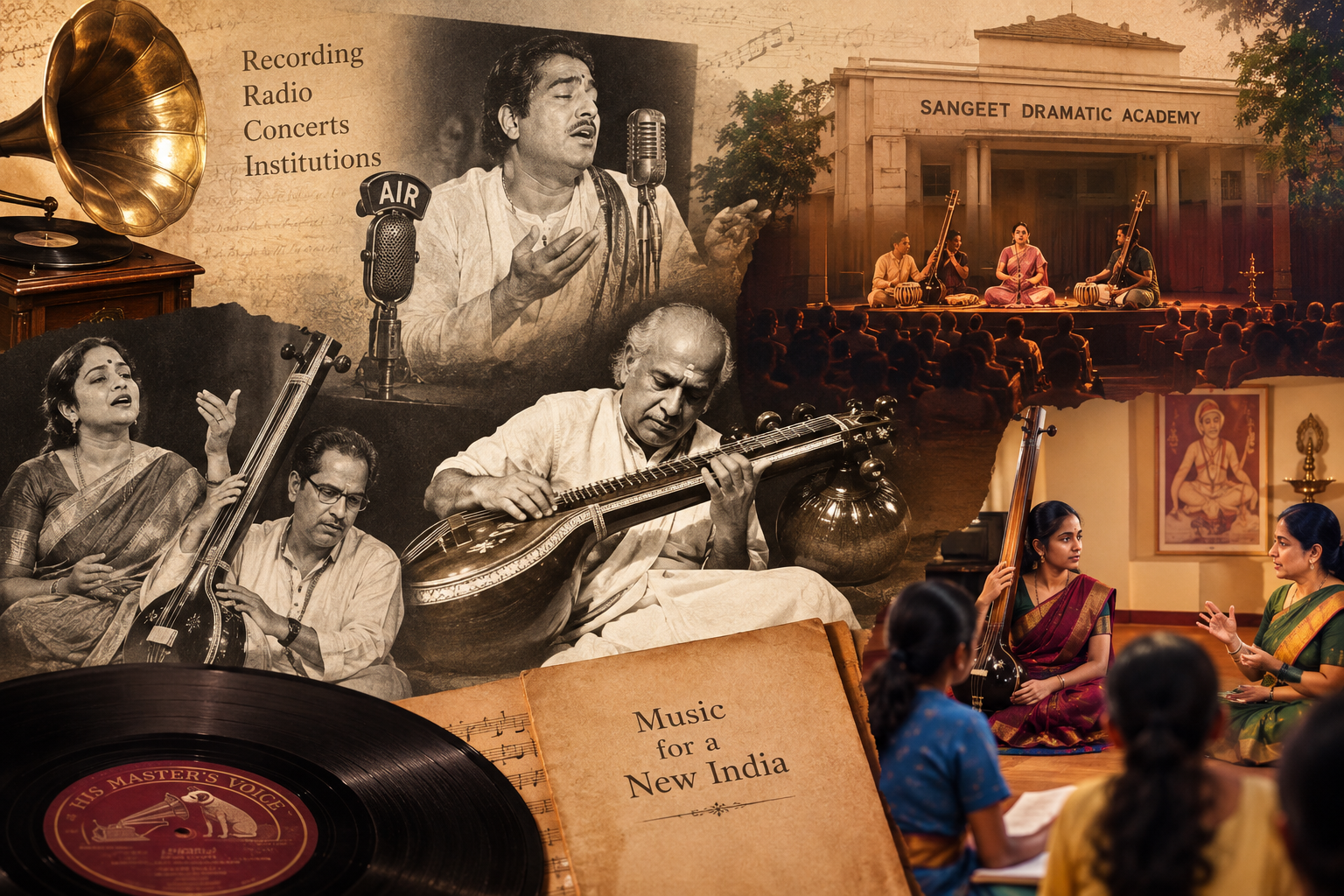
- All India Radio (AIR), established in 1936, which became perhaps the single most important platform for classical music in the twentieth century. AIR's grading system for musicians — from B-grade to Top Grade — created both a meritocratic hierarchy and a nationwide audience for artists who might otherwise have remained regional figures. The National Programme of Music, broadcast on Saturday nights, became a cherished ritual for rasikas across the country.
- University departments of music at institutions such as the Faculty of Performing Arts, M.S. University of Baroda (founded 1950) and the Department of Music, University of Delhi, which embedded classical music within the framework of higher education.
"What Bhatkhande and Paluskar achieved, in their different ways, was nothing less than the transformation of a feudal art into a democratic one — preserving its depth while vastly expanding its reach."
The modernisation of concert culture also reshaped the art itself. The emergence of the three-hour concert format — typically featuring an expansive vilambit khayal followed by a drut composition, a lighter piece such as a thumri or bhajan, and concluding with a tarana or brisk bandish — became the standard template by mid-century, replacing the all-night mehfils of earlier eras. Festivals such as the Sawai Gandharva Bhimsen Mahotsav in Pune (founded 1953 by Pandit Bhimsen Joshi in honour of his guru, Sawai Gandharva, himself a disciple of Paluskar) and the Dover Lane Music Conference in Calcutta (established 1952) became annual pilgrimages for connoisseurs.
The revival was not without tensions. Hereditary musicians — many of them Muslim ustads whose families had safeguarded entire repertoires for generations — sometimes felt marginalised by the new institutional culture, which could privilege textbook learning over the nuanced, embodied knowledge of the gharana. The democratisation of music, while socially vital, occasionally flattened the very idiosyncrasies that made each tradition distinctive. These are debates that continue to animate the world of Hindustani music today.
Yet the essential achievement stands: by the middle of the twentieth century, Indian classical music had been rescued from the margins, given a modern pedagogical infrastructure, embedded in national cultural policy, and opened to a vastly broader constituency of practitioners and listeners. The work begun by Bhatkhande and Paluskar — continued by their students, by All India Radio, by music colleges, and by the great performing artists of the century — ensured that the raga tradition not only survived the colonial encounter but entered the post-independence era with renewed vigour and a transformed, if still evolving, identity.