
In This Article
Early Life and Musical Formation
Few figures in the history of Indian classical music command the reverence accorded to Mian Tansen — born Ramtanu Pandey (also recorded as Tanna Mishra) around 1500 CE in the village of Behat, near Gwalior, in present-day Madhya Pradesh. The son of the poet and musician Mukund Pandey, young Ramtanu displayed an extraordinary ear for melody from childhood. According to the Ain-i-Akbari of Abu'l-Fazl ibn Mubarak, his talent was so evident that he was entrusted to the care of the great saint-musician Swami Haridas of Vrindavan, one of the most revered exponents of the dhrupad tradition.
Under Swami Haridas, Tansen spent years immersed in the rigorous discipline of nada sadhana — the spiritual pursuit of sound. He mastered the intricacies of dhrupad composition and the systematic exploration of raga, absorbing the musical heritage of the Gwalior tradition that had flourished under the patronage of Raja Man Singh Tomar (r. 1486–1516). Man Singh's court had already produced the seminal text Man Kautuhala, which codified ragas and established Gwalior as the foremost centre of Hindustani music. Tansen thus inherited an extraordinarily rich lineage even before he entered the orbit of Mughal power.
Before arriving at Akbar's court, Tansen served as a court musician under Raja Ramchandra Singh of Rewa (in present-day Madhya Pradesh), where he honed his art for several years and, by many accounts, converted to Islam — adopting the name Mian Tansen (or Muhammad Ata Ali Khan, according to some sources). His reputation grew so formidable that it eventually reached the ears of the young Mughal emperor himself.
Tansen in Akbar's Court: The Jewel Among Nine Gems
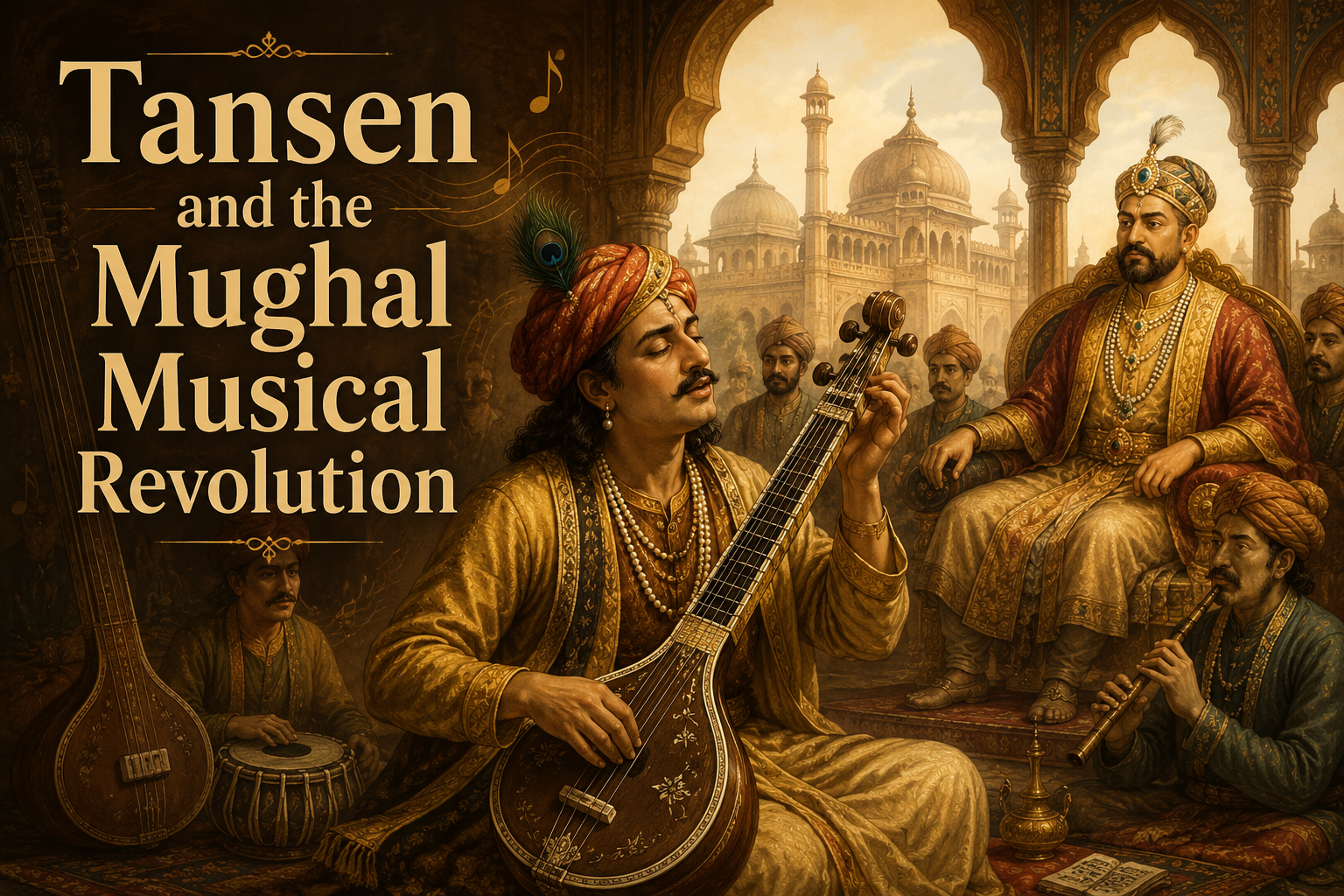
In approximately 1562 CE, Emperor Akbar (r. 1556–1605) invited Tansen to join his court at Fatehpur Sikri, reportedly requesting — or rather, insisting upon — his transfer from Raja Ramchandra's service. Tansen was installed as one of the Navaratnas (Nine Jewels), the celebrated circle of intellectuals, artists, and advisors that included figures such as Birbal, Todar Mal, and Abu'l-Fazl. Abu'l-Fazl himself recorded that Akbar held Tansen in the highest esteem, declaring that "a singer like him has not been in India for the last thousand years."
Akbar's court was a crucible of cultural synthesis. The emperor's deliberate policy of sulh-i-kul (universal peace) encouraged dialogue between Hindu and Muslim artistic traditions, and nowhere was this more productive than in music. Tansen stood at the confluence of two mighty streams:
- The Indian tradition — rooted in the ancient raga system, the dhrupad form, and the devotional ethos of Swami Haridas and the Vaishnavite saint-poets.
- The Persian-Central Asian tradition — brought by Mughal and earlier Sultanate courts, with its emphasis on maqam (modal scales), refined poetic metres, and instruments such as the rabab.
Tansen wove these strands together with genius. He is credited with the creation or formalisation of several ragas that remain pillars of Hindustani music today, including Raga Miyan ki Todi, Miyan ki Malhar, Darbari Kanada, and Miyan ki Sarang. The prefix "Miyan ki" itself — an affectionate Persianised honorific — testifies to the bicultural world he inhabited. His compositions in dhrupad, many set to the chautala rhythmic cycle, were transmitted orally through generations and continue to be performed in concert halls and temple courtyards alike.
"When Tansen sang, it is said, the clouds gathered, the lamps ignited, and the animals of the forest stood still — not because nature obeyed a sorcerer, but because art, at its zenith, becomes indistinguishable from the divine."
Legends and Their Musical Truth
No account of Tansen is complete without the celebrated legends that have accumulated around his name — stories that, while almost certainly embellished, encode deep truths about Indian musical philosophy.
The most famous of these is the tale of Raga Deepak. According to tradition, Akbar once challenged Tansen to demonstrate the full power of this raga, which was associated with the element of fire. As Tansen sang Deepak in the court, the oil lamps spontaneously ignited, and his body began to burn with an unbearable inner heat. Only the cooling strains of Raga Megh Malhar — sung, in some versions, by his wife Hussaini and his fellow pupil Tani (or, in other tellings, by two young women he had trained specifically for this purpose) — brought the rains that saved his life. This legend encodes the classical Indian belief in the rasa-raga correspondence: that specific melodic structures possess an intrinsic power to evoke and even manifest natural phenomena and emotional states.
Another enduring story describes Akbar disguising himself to hear Swami Haridas sing. When the emperor asked Tansen why his own music could not quite match his guru's, Tansen is said to have replied: "I sing before the Emperor of Hindustan; my master sings before God." This anecdote, whether historical or apocryphal, captures a fundamental tension in Indian classical music — the pull between courtly patronage and spiritual devotion, between sangeet as entertainment and sangeet as sadhana.
A third legend speaks of Tansen's ability to attract wild deer through his rendition of Raga Malhousak, and to communicate with animals through pure melodic expression — a motif linking him to the Orphic tradition of the West and reinforcing the pan-cultural intuition that music transcends the boundaries of species and language.
Tansen died around 1586 CE (though some scholars place his death as late as 1589) and was buried in Gwalior, near the tomb of his Sufi spiritual guide, Muhammad Ghaus. His mausoleum, shaded by a tamarind tree that musicians still visit in reverence, remains a pilgrimage site. Each year, the Tansen Samaroh — one of India's most prestigious classical music festivals — is held in Gwalior in his honour, typically in December, drawing leading artists from across the Hindustani tradition.
The Senia Legacy and Enduring Influence
Tansen's most tangible legacy lies in the Senia tradition (also spelt Seniya), the musical lineage that descends from him through his sons and disciples. His children — notably Bilas Khan, Surat Sen, Saraswati Devi, and Hamirsen — carried his teachings forward, branching into both vocal and instrumental streams. Bilas Khan is himself credited with the creation of Raga Bilaskhani Todi, said to have been born of his grief upon his father's death.
The Senia beenkar (vina players) and Senia rababiya (rabab players) traditions formed the bedrock upon which many later gharanas were built. The great sitar and surbahar traditions trace a line of descent — sometimes direct, sometimes through disciplic succession — back to the Senia school. The Senia-Maihar gharana, established by Baba Allauddin Khan in the twentieth century and continued by his illustrious pupils Pandit Ravi Shankar and Ustad Ali Akbar Khan, explicitly claimed Senia ancestry, thus linking the global popularisation of Indian classical music in the 1960s directly to Tansen's legacy.
Beyond genealogy, Tansen's influence pervades the very structure of Hindustani music. His contribution to the dhrupad repertoire established compositional models that informed later forms such as khayal, thumri, and instrumental gat. The ragas he created or reshaped — Darbari Kanada with its majestic, slow-curving phrases; Miyan ki Todi with its haunting, tensile beauty — remain among the most frequently performed and deeply explored ragas in the system. His integration of Persian aesthetic sensibilities into an Indian melodic framework helped create the distinctive character of Hindustani music as a tradition distinct from its Carnatic counterpart.
Tansen's life reminds us that the greatest musical traditions are rarely pure — they are born at the meeting point of cultures, sustained by individual genius, and transmitted through the living chain of guru-shishya parampara. In every concert hall where Darbari Kanada unfolds in the stillness of the night, and in every temple where Miyan ki Malhar summons the memory of rain, the voice of Tansen endures — not as legend alone, but as living, breathing music.