
In This Article
A Prodigy Forged in Tradition
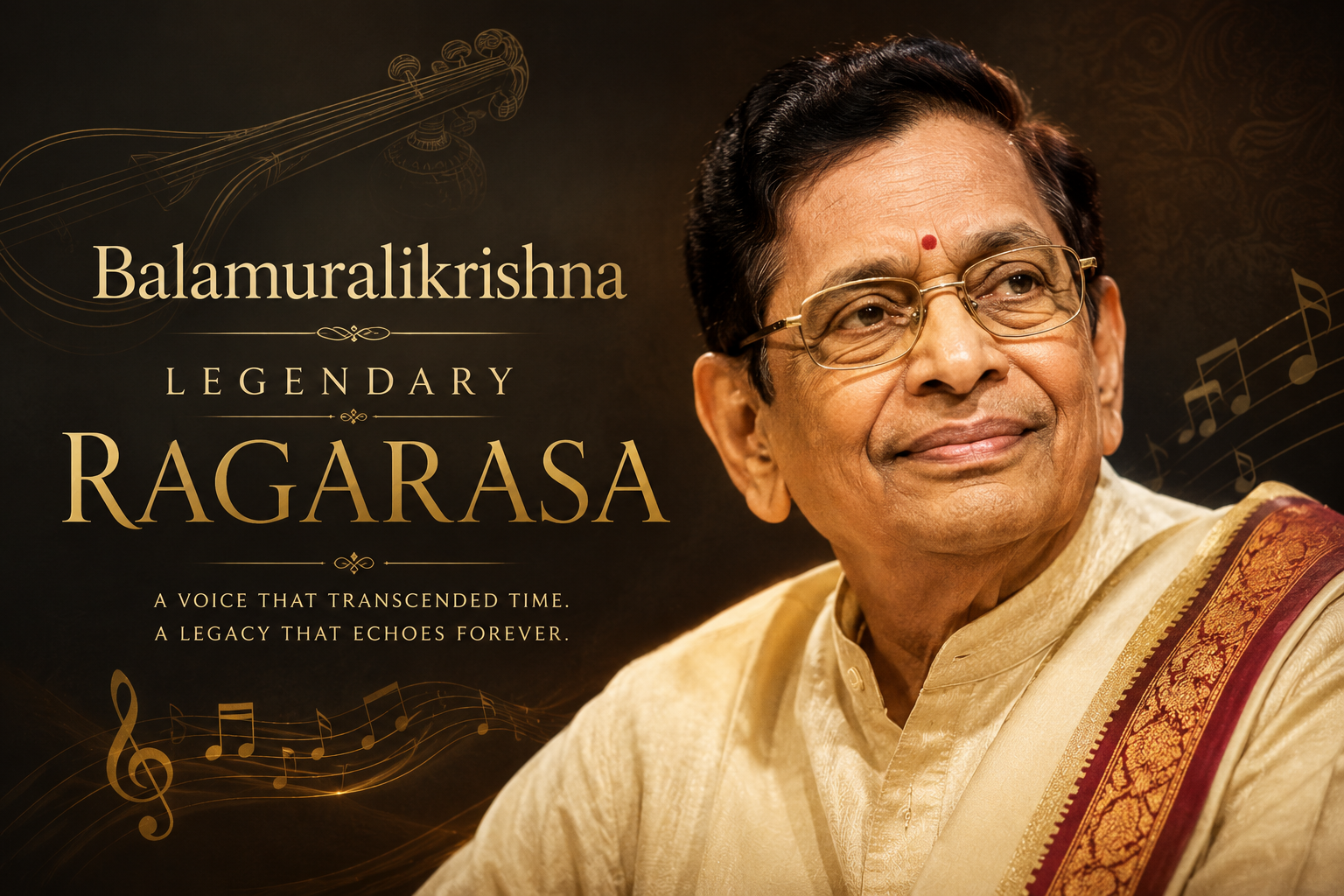
Mangalampalli Balamuralikrishna was born on 6 July 1930 in Sankaraguptam, a small village in the East Godavari district of Andhra Pradesh. Orphaned of his father at a young age, the boy was raised under the vigilant musical guardianship of his mother, Suryakanthamma, and his maternal grandfather. His formal training began under Parupalli Ramakrishnayya Pantulu, a distinguished disciple of the great Susarla Dakshinamurthi Sastri lineage, and it was this rigorous grounding in the lakshya and lakshana of Carnatic music that would later give Balamuralikrishna the confidence to innovate so radically.
The legends of his childhood are not exaggerated. He gave his first public concert at the age of six and is reported to have sung the complex raga Bhairavi with an assurance that left senior musicians astonished. By the time he was a teenager, he had already begun composing kritis and experimenting with rhythmic structures. His early exposure to the rich Telugu literary tradition — including the works of Tyagaraja, Annamacharya, and Kshetrayya — gave him a linguistic and devotional sensibility that would permeate his compositions throughout his life.
What set the young Balamuralikrishna apart was not just precocious talent but an insatiable intellectual curiosity. He studied the treatises — Chaturdandi Prakashika, Sangita Ratnakara, and Swaramelakalanidhi — and interrogated the theoretical foundations of the art form with a scholar's rigour. This dual identity as performer and theorist would define every phase of his career.
The Innovator: New Ragas, New Talas, New Horizons
No discussion of Balamuralikrishna is complete without acknowledging the sheer scale of his creative output. He composed over 400 compositions in languages including Telugu, Kannada, Sanskrit, Tamil, and Hindi. His works ranged from compact kritis and tillanas to elaborate ragamalika pieces and devotional bhajans, many set to his own newly created ragas.
Among his most celebrated innovations are the ragas he created, often derived from unexplored scalar combinations within the 72 melakarta framework:
- Mahati — a raga of serene beauty that he introduced to concert audiences and popularised through several of his own compositions
- Sumukham — characterised by a distinctive aesthetic charm that quickly found favour among other performers
- Lavangi — a delicate creation that showcased his ear for subtle melodic colour
- Siddhasena — a more austere raga reflecting his interest in the lesser-explored melakarta scales
- Manorama and Prithvi — further additions to the Carnatic raga repertoire that demonstrated his tireless inventiveness
He also devised new tala patterns, including cycles that challenged percussionists and expanded the rhythmic vocabulary of concert performance. His creation of talas with unconventional akshara counts pushed accompanists such as Vellore Ramabhadran, Umayalpuram K. Sivaraman, and Trichy Sankaran to raise their own artistry in response.
"I do not create new ragas to be different. I create them because the ocean of nada is infinite, and it is the duty of a musician to explore its depths."
His rendering of the traditional repertoire was equally transformative. His interpretations of Tyagaraja's Pancharatna Kritis, Muthuswami Dikshitar's majestic compositions, and Syama Sastri's intricate swarajatis bore the stamp of a mind that understood every nuance of the original yet was unafraid to present it through a deeply personal lens. His raga alapana in ragas such as Todi, Bhairavi, Kalyani, and Sankarabharanam was at once scholarly and emotionally overwhelming — a combination few artists have achieved with such consistency.
Multi-Instrumentalist, Film Composer, and Cross-Cultural Ambassador
Balamuralikrishna's versatility extended well beyond the vocal tradition. He was a proficient player of the violin, viola, mridangam, and kanjira, and would occasionally demonstrate his instrumental skills during concerts, much to the delight — and sometimes bemusement — of audiences. This multi-instrumental fluency gave his musical thinking a three-dimensional quality; he understood melody, rhythm, and timbre from the inside.
His contributions to Indian cinema, particularly Telugu and Kannada films, brought classical music to millions who might never have entered a sabha. He sang playback for composers such as S. Rajeswara Rao and worked with several film directors who sought the gravitas his voice could lend to devotional and philosophical sequences. His rendition of songs in films like Bhakta Prahlada and others became reference points for how classical authenticity could coexist with cinematic appeal. In Tamil cinema, his collaborations enriched several soundtracks with a distinctly Carnatic flavour.
On the international stage, Balamuralikrishna was a tireless ambassador. He performed across Europe, the United States, the Middle East, and Southeast Asia, often adapting his concert format to suit diverse audiences while never compromising on musical substance. His legendary jugalbandis with Hindustani maestros — including memorable collaborations with Bhimsen Joshi, Kishori Amonkar, and Hariprasad Chaurasia — demonstrated that the two great traditions of Indian classical music could converse with profound mutual respect. These cross-tradition dialogues, particularly the Balamuralikrishna–Bhimsen Joshi duets, remain some of the most treasured recordings in Indian music.
He also engaged with Western classical music, participating in experimental collaborations and demonstrating an openness that was remarkable for a musician so deeply rooted in the Carnatic tradition. His ear for harmony, unusual among orthodox Carnatic vocalists, occasionally surfaced in his improvisations and compositions.
Controversies, Honours, and an Enduring Legacy
A figure of such creative audacity could not escape controversy. Balamuralikrishna's willingness to modify the texts of canonical compositions — particularly those of the Trinity — drew sharp criticism from purists who regarded such interventions as sacrilegious. His occasional use of sahitya variations in Tyagaraja's kritis, his unconventional treatment of certain ragas, and his frank public statements about the need for evolution in Carnatic music made him a polarising figure in conservative circles.
His decision to incorporate lighter material into his concerts, his film associations, and his embrace of popular appeal were viewed by some traditionalists as dilutions of the art form. Yet for every critic, there were thousands of rasikas who recognised that his innovations came not from ignorance of tradition but from a mastery so complete that it demanded expansion. As the musicologist and critic S. Rajam once noted, Balamuralikrishna's departures were always grounded in an intimate knowledge of the rules he was bending.
The honours bestowed upon him reflect the breadth of his impact:
- Padma Vibhushan (2004) — India's second-highest civilian award, following his earlier Padma Shri (1971) and Padma Bhushan (1990)
- Sangeet Natak Akademi Award (1975) — the national academy's recognition of his performing artistry
- Chevalier of the Ordre des Arts et des Lettres — conferred by the French government in recognition of his cultural contributions
- Numerous honorary doctorates and titles from universities and cultural institutions across India
Balamuralikrishna passed away on 22 November 2016 in Chennai, leaving behind a body of work that continues to inspire musicians, scholars, and listeners. His students, including notable artists like Nithyashree Mahadevan, carry forward aspects of his approach, though none would claim to replicate the full spectrum of his genius.
In the final analysis, Balamuralikrishna's legacy is not merely a catalogue of ragas invented or awards received. It is the fundamental argument his life embodied: that tradition and innovation are not adversaries but partners, and that a truly great artist honours the past most profoundly by daring to imagine what comes next. For the serious rasika, engaging with his recordings — from the meditative depths of a Todi alapana to the playful brilliance of a newly minted tillana — remains one of the richest experiences Carnatic music has to offer.