
In This Article
Early Life and Spiritual Formation
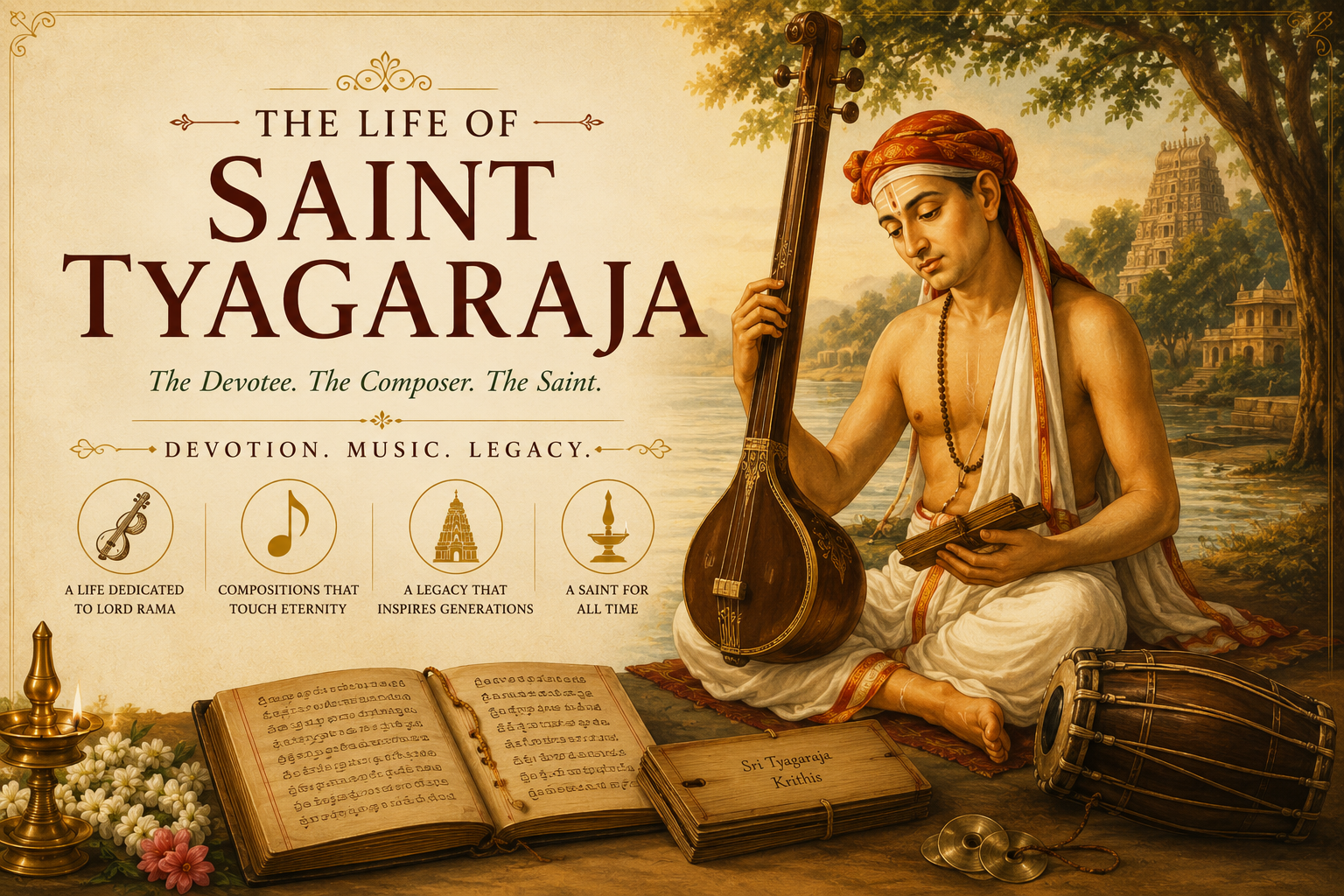
Kakarla Tyagabrahmam, revered universally as Saint Tyagaraja, was born on 4 May 1767 in Tiruvarur, in the Thanjavur district of present-day Tamil Nadu. His father, Kakarla Ramabrahmam, was a Telugu Smartha Brahmin and a modest scholar of Sanskrit; his mother, Sitamma, was known for her deep piety. The family traced its roots to Prakasam district in Andhra Pradesh but had settled in the Tamil heartland under the cultural patronage of the Thanjavur Maratha kings. When Tyagaraja was still a young boy, the family moved to Thiruvaiyaru, the town on the banks of the river Kaveri that would become inseparable from his name and legacy.
From an early age, Tyagaraja displayed an extraordinary aptitude for music and an instinctive devotion to Lord Rama. His father, recognising these gifts, arranged for his musical education under Sonti Venkataramanayya, a distinguished composer and scholar who was himself a disciple in the lineage stretching back to the great Narayana Tirtha, author of the Krishna Leela Tarangini. Under Venkataramanayya's tutelage, Tyagaraja received rigorous training in the theoretical and practical dimensions of Carnatic music, mastering the svarasthanas, lakshana, and lakshya traditions. He also undertook deep study of the Ramayana, the Bhagavata Purana, and the Narada Bhakti Sutras — texts that would infuse his compositions with layers of philosophical and devotional meaning.
A pivotal moment in his spiritual formation was his initiation into the Rama Taraka Mantra, traditionally said to have been bestowed through a family lineage of worship. Tyagaraja is believed to have completed the chanting of the mantra 96 crore (960 million) times — a feat of almost inconceivable devotion. Whether one regards this figure literally or symbolically, it speaks to the absolute centrality of Rama bhakti in every aspect of his life and art.
Devotion to Rama and the Refusal of Royal Patronage
The most celebrated episode illustrating Tyagaraja's character is his refusal of royal patronage from the Thanjavur Maratha court. According to well-established tradition, King Serfoji II (or, in some accounts, his predecessor) sent emissaries bearing lavish gifts to invite Tyagaraja to become a court musician. The saint-composer declined — not out of discourtesy, but from a profound conviction that his music belonged solely to Rama and could not be placed in the service of worldly power.
This episode gave rise to one of his most quoted compositions, Nidhi Chala Sukhama in raga Kalyani, in which he poses the rhetorical question:
"Nidhi chala sukhama, Ramuni sannidhi seva sukhama?"
Is it wealth that gives happiness, or is it the blissful service of Rama?
This was not merely a rhetorical flourish. Tyagaraja lived in genuine material simplicity, subsisting on uncha vritti — the practice of going from door to door, singing for alms of rice. His brother Japyesha (also known as Jalpesha) is said to have harboured resentment at this austere lifestyle and, in a moment of anger, cast Tyagaraja's beloved idol of Rama into the waters of the Kaveri. The grief-stricken composer wandered in anguish, composing heart-rending kritis during this period of separation, until the idol was recovered. This painful episode inspired several deeply moving compositions, including pieces that express the agony of divine absence with a rawness that still pierces the listener centuries later.
Tyagaraja's devotion was not passive; it was intellectually rigorous and emotionally expansive. His compositions explore navavidha bhakti — the nine modes of devotion — encompassing surrender, friendship, servitude, and even righteous indignation towards a seemingly indifferent God. This emotional breadth is what gives his music its astonishing universality.
A Prolific and Transformative Compositional Legacy
Tyagaraja's compositional output is staggering in both quantity and quality. He is credited with composing approximately 700 to 800 kritis, of which around 600 to 700 survive with authenticated lyrics and musical settings. These compositions span an extraordinary range of ragas — he is said to have employed over 200 ragas, including several that he himself created or revitalised, such as rare gems that might otherwise have been lost to the tradition.
His major works include:
- Pancharatna Kritis — The five celebrated compositions in Ata tala, set in the ragas Nata, Gaulai, Arabhi, Varali, and Sri, composed in Telugu and Sanskrit. These masterpieces, often rendered in grand choral form at the annual Tyagaraja Aradhana, represent the pinnacle of kriti composition in their structural sophistication, melodic grandeur, and devotional intensity.
- Utsava Sampradaya Kritis — A set of compositions designed for processional worship, reflecting the temple traditions of South India.
- Divyanama Kritis — Simpler devotional pieces centred on the divine names of Rama, accessible to all levels of musical ability.
- Two musical dramas (opera-like works) — Prahlada Bhakti Vijayam and Nauka Charitram, which are among the earliest examples of Telugu-language musical theatre and demonstrate Tyagaraja's dramatic sensibility.
What sets Tyagaraja apart from other great composers is the perfect marriage of bhava (emotional expression) and raga bhava (the intrinsic mood of the melodic framework). In compositions such as Endaro Mahanubhavulu (Sri), Kanakanaruchira (Varali), Raga Sudharasa (Andolika), and O Rangasayee (Kambhoji), the words, melody, and emotion become indivisible. His sangatis — the graduated melodic variations of a line — are marvels of organic musical development, each iteration deepening the emotional and aesthetic impact. It is no exaggeration to say that Tyagaraja's compositional method defined the modern Carnatic kriti form and established the framework within which performers have explored and improvised for generations.
Disciples, the Aradhana, and the Living Legacy
Tyagaraja was a generous and devoted teacher, and his disciples played a crucial role in preserving and transmitting his vast repertoire. Among the most prominent were:
- Walajapet Venkataramana Bhagavatar and his son Krishnaswami Bhagavatar, who maintained detailed notebooks of the compositions and their musical settings.
- Manambuchavadi Venkatasubbayyar, through whose lineage many compositions reached the twentieth-century masters.
- Tillaistanam Rama Iyengar and Susarla Dakshinamurthy, who carried the tradition into new regions.
These shishya paramparas (lineages of discipleship) ensured that Tyagaraja's kritis were transmitted with their musical nuances largely intact, even in an era before notation and recording technology. The subtle differences between lineages — in sangati patterns, tempo preferences, and ornamentation — continue to enrich Carnatic music discourse today.
Tyagaraja attained samadhi on 6 January 1847, on the day of Pushya Bahula Panchami, on the banks of the Kaveri in Thiruvaiyaru. His samadhi (memorial shrine) remains a place of pilgrimage. Every January, the Tyagaraja Aradhana draws thousands of musicians and rasikas from across the world for a festival of commemoration that centres on the communal singing of the Pancharatna Kritis — a tradition begun by his direct disciples and now observed not only in Thiruvaiyaru but in cities across India, the United States, Europe, and beyond.
It is a remarkable testament to Tyagaraja's genius that his compositions constitute the single largest body of work in the standard Carnatic concert repertoire. From the opening varnam to the concluding mangalam, a typical kutcheri is likely to feature multiple Tyagaraja kritis. His music is the touchstone against which artistry is measured, the ground upon which every serious Carnatic musician builds their craft. In the truest sense, he did not merely contribute to the tradition — he became the tradition.