
In This Article
Temple Origins: From Devadasi Tradition to Jagannath's Court
Odissi (Oḍissī) is among the oldest surviving classical dance forms of India, with archaeological and textual evidence stretching back over two millennia. Its roots lie in the sacred precincts of Odisha's temples — most notably the great Jagannath Temple at Puri, the Sun Temple at Konark, and the Lingaraja Temple at Bhubaneswar — where dance was not merely performance but an act of devotion, an offering of the body to the divine.
The earliest evidence of a codified dance tradition in the region appears in the Manchapuri cave of Udayagiri and Khandagiri near Bhubaneswar, dated to the 2nd century BCE, where carved figures of dancers and musicians suggest a sophisticated performative culture. By the medieval period, the dance had evolved into a highly structured temple ritual performed by maharis (temple dancers dedicated to Lord Jagannath) and later by gotipuas (young boys dressed as girls performing acrobatic dance). The Abhinaya Chandrika, a treatise attributed to Maheshwara Mahapatra and dating to the 15th or 16th century, served as an important codifying text for the form's grammar of movement, gesture, and expression.
The Jagannath temple tradition was central to Odissi's survival. The maharis performed nritya seva (dance service) as part of the daily rituals, interpreting devotional poetry — particularly the Gita Govinda of the 12th-century poet Jayadeva — through abhinaya. Jayadeva's exquisite Sanskrit verses describing the love of Radha and Krishna became, and remain, the soul of the Odissi repertoire. When the British colonial administration and subsequent social reform movements led to the abolition of the devadasi system in the early 20th century, Odissi faced an existential crisis. The art retreated from the temples, and its survival hung by the slenderest of threads — preserved in the memories of ageing maharis and in the acrobatic traditions of the gotipua troupes.
The Tribhanga Pose and Odissi's Sculptural Aesthetics
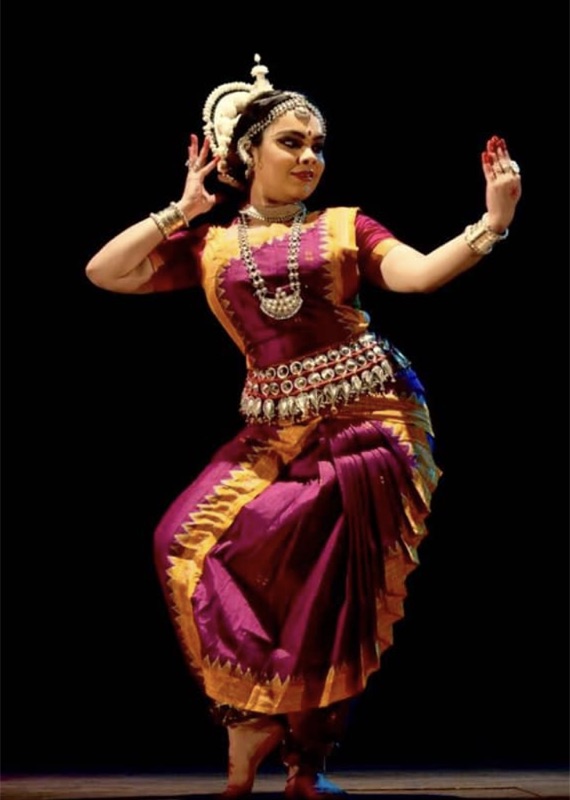
What distinguishes Odissi most immediately from other Indian classical dance forms is its profound relationship with sculpture. The dancer's body aspires to the condition of stone brought to life — or, more precisely, the temple carvings of Konark and Bhubaneswar aspire to capture the dancer's body in eternal motion. This reciprocal relationship between dance and sculpture is Odissi's defining aesthetic.
At the heart of this aesthetic is the tribhanga (tri — three; bhanga — bend), a triple-deflection posture in which the body curves at the neck, torso, and knee, creating an S-shaped line of extraordinary grace. This posture, deeply rooted in the sculptural traditions of Odisha and codified in the Abhinaya Darpana and regional texts, gives Odissi its lyrical, fluid quality. Unlike the angular geometry of Bharatanatyam's araimandi or the vigorous footwork of Kathak, Odissi privileges torso movement — the shifting of the upper body and hips in soft, undulating patterns that evoke ocean waves and the swaying of temple apsaras.
The Odissi repertoire is structured around several key elements:
- Mangalacharan: The invocatory item, typically an obeisance to Lord Jagannath, the Earth, the guru, and the audience, often concluding with a shloka.
- Batu Nritya (Battu): A pure dance piece (nritta) dedicated to Batuka Bhairava, an aspect of Shiva, featuring intricate footwork and statuesque poses drawn directly from temple sculpture.
- Pallavi: An elaborate pure dance composition set to a particular raga, in which the dancer explores rhythmic and spatial patterns with increasing complexity, akin to the musical concept of a raga's gradual blossoming.
- Abhinaya: An expressive piece, most often an ashtapadi from Jayadeva's Gita Govinda, in which the dancer employs subtle facial expressions, hand gestures (mudras), and body language to convey rasa.
- Moksha: The concluding item, a pure dance of spiritual liberation, building to a crescendo of joyous movement before ending in stillness.
The musical accompaniment draws on Odisha's own melodic traditions, employing ragas such as Kalyana, Nata, Shree, and Baradi, rendered on the mardala (a barrel-shaped drum central to Odissi rhythm), sitar or vina, flute, and violin, with the vocalist often singing compositions in Sanskrit or Odia.
The Great Revival: Kelucharan Mohapatra, Sanjukta Panigrahi, and Their Contemporaries
The mid-20th century revival of Odissi is one of the most remarkable stories in the history of Indian performing arts. After decades of decline, a small group of visionary artists and scholars undertook the monumental task of reconstructing Odissi from fragmentary sources — the surviving maharis, gotipua practitioners, temple sculptures, and textual references.
The watershed moment came in 1958, when Odissi was formally recognised as a distinct classical dance form at the national level, largely through the efforts of a committee that included the scholar Kavichandra Kalicharan Patnaik, the dancer and guru Pankaj Charan Das, and others. But the figure who did most to shape Odissi into the magnificent form known today was Guru Kelucharan Mohapatra (1926–2004).
A former gotipua dancer, accomplished mardala player, and painter, Kelucharan Mohapatra possessed a unique synthesis of talents. He meticulously studied the temple sculptures of Konark and Bhubaneswar, the remnants of the mahari tradition as preserved by practitioners like Mahari Laxmipriya, and the gotipua vocabulary, weaving them into a coherent, aesthetically refined classical grammar. His choreographic genius elevated the pallavi to an art of breathtaking complexity and reimagined the abhinaya tradition with a sophistication that drew comparisons to the finest traditions of Bharatanatyam and Kathak.
His foremost disciple, Sanjukta Panigrahi (1944–1997), became the embodiment of his vision. Trained from childhood, she brought Odissi to international stages with a combination of technical mastery and emotional depth that left audiences spellbound. Her performances at major festivals in Europe and the Americas in the 1970s and 1980s were pivotal in establishing Odissi's global reputation. Her untimely death at the age of fifty-three was a grievous loss to the dance world.
"When Sanjukta danced, you did not see a dancer — you saw the sculpture breathe, the poetry move, the raga take form." — a tribute often echoed by fellow artists and critics alike.
Other towering figures of the revival and its consolidation include Guru Deba Prasad Das, who emphasised the mahari lineage and a softer, more devotional style; Guru Mayadhar Raut, who contributed significantly to the gotipua-rooted vocabulary; and Guru Gangadhar Pradhan, whose powerful, masculine interpretation broadened the form's expressive range. The scholar Dr. Kapila Vatsyayan played an indispensable role in placing Odissi within the broader framework of Indian classical arts through her rigorous academic work.
Odissi Today: A Living Tradition on the World Stage
In the decades since its revival, Odissi has flourished both in India and internationally. The second and third generations of dancers have carried the form to new heights while engaging in thoughtful dialogue between tradition and contemporary expression.
Sujata Mohapatra, daughter-in-law and disciple of Guru Kelucharan Mohapatra, is widely regarded as the foremost exponent of his lineage today, preserving the subtlety and sculptural precision of his style with luminous artistry. Kumkum Mohanty, a senior disciple of Kelucharan Mohapatra, has been instrumental in both performance and pedagogy. Aruna Mohanty, trained under Guru Kelucharan Mohapatra, has earned acclaim for her powerful abhinaya and innovative choreographic ventures, including full-length dance dramas. Madhavi Mudgal, based in Delhi and trained under both Kelucharan Mohapatra and Pankaj Charan Das, brings a meditative refinement to her performances and has been a vital force in the capital's cultural landscape through her institution, the Gandharva Mahavidyalaya.
Internationally, practitioners such as Colleena Shakti (United States/India), Illeana Citaristi (Italy/Bhubaneswar), who has spent decades in Odisha studying under Kelucharan Mohapatra and contributing to the form's scholarship, and numerous dancers across Southeast Asia, Europe, and North America have woven Odissi into the fabric of global dance. The Odissi International festival and events organised by institutions such as the Srjan ensemble (founded by Guru Kelucharan Mohapatra and now led by Ratikant Mohapatra) and Nrityagram (near Bangalore, founded by Protima Bedi in 1990) continue to nurture new generations.
Yet challenges remain. Questions of stylistic authenticity versus creative evolution, the tension between guru-shishya lineage and institutional training, and the pressures of the global arts marketplace all shape the form's trajectory. What remains constant, however, is Odissi's extraordinary power to move — its capacity, rooted in two thousand years of devotion, to transform the human body into a vessel of rasa, to make the audience feel, in the stillness after the mardala's last beat, the presence of something sacred.
For the serious rasika, Odissi offers an experience unlike any other classical form: the sensation of watching ancient stone awaken, bend into tribhanga, and dance.