
In This Article
Origins and Meaning: The Roots of Musical Dialogue
The word jugalbandi — derived from the Hindi jugal (paired, twin) and bandi (bound, tied together) — literally means "entwined twins." It denotes a duet performance in which two musicians of comparable stature engage in a structured yet spontaneous musical conversation. While the concept of musical dialogue is ancient — traces of call-and-response can be found in Vedic chanting, dhrupad traditions, and the sawaal-jawaab exchanges between vocalist and percussionist — the modern jugalbandi as a formalised concert format emerged primarily in the mid-twentieth century.
The form gained its identity during a period of extraordinary cultural experimentation in post-Independence India. As the patronage system shifted from princely courts to public concerts, radio broadcasts, and recording studios, musicians found new incentives to collaborate across instrumental and stylistic boundaries. The All India Radio (AIR), established as a major cultural institution, played a pivotal role in commissioning and broadcasting jugalbandi performances from the late 1940s onwards, bringing them to audiences who might never have witnessed such encounters in a courtly mehfil.
At its aesthetic core, jugalbandi is governed by a delicate paradox: two musicians must assert their individual artistry — their gayaki, their gharana sensibility, their technical command — while simultaneously yielding to the demands of collective music-making. The finest jugalbandis are not competitions but conversations, where the musicians listen as deeply as they play.
Types of Jugalbandi: A Taxonomy of Encounter
Not all jugalbandis are alike. The form encompasses several distinct categories, each presenting its own artistic challenges:
- Same-tradition, same-instrument duets: Two sitarists or two tabla players from the same system (Hindustani or Carnatic) performing together. These demand the finest discrimination from the listener, as the contrasts are subtle — often revealing the aesthetic differences between gharanas or schools of playing.
- Same-tradition, different-instrument duets: Perhaps the most celebrated category. The pairing of sitar and sarod, or bansuri and santoor, within the Hindustani tradition allows each instrument's tonal character to shine while sharing a common raga grammar.
- Cross-tradition duets (Hindustani–Carnatic): The most ambitious and, arguably, most complex form. Here, musicians must navigate fundamental differences in tuning systems, ornamentation, raga interpretation, and rhythmic frameworks. A Hindustani musician's treatment of raga Yaman and a Carnatic musician's rendering of its rough equivalent, Kalyani, will differ markedly in gamakas, phrase construction, and aesthetic intent.
- Vocal–instrumental duets: A vocalist paired with an instrumentalist — such as a khayal singer with a sitar or sarangi player — creates a dialogue between the human voice and its instrumental counterpart, often highlighting the gayaki ang (vocal style) of the instrument.
The typical structure of a jugalbandi performance involves a shared alaap (often taken in turns), followed by a composed bandish or gat in a chosen raga, with alternating passages of improvisation — taans, jhala, and rhythmic play — culminating in a spirited, interlocking climax. The musicians may also perform separate ragas before converging on a common one, or they may explore ragas that share scalar material across the two traditions.
Landmark Partnerships: The Jugalbandis That Defined the Form
No discussion of jugalbandi can begin without acknowledging the towering partnership of Ustad Ali Akbar Khan (sarod) and Pandit Ravi Shankar (sitar). Childhood companions and fellow disciples of the legendary Baba Allauddin Khan of Maihar, they possessed an almost telepathic musical understanding. Their concerts from the 1950s and 1960s — including their celebrated performance at the Museum of Modern Art in New York in 1957 and their numerous AIR recordings — set the gold standard for the form. Their contrasting temperaments proved ideal: Ravi Shankar's crystalline precision and showmanship against Ali Akbar Khan's deep, meditative, and profoundly lyrical sarod. Together, they demonstrated that jugalbandi could be a vehicle for the highest musical expression, not merely an entertaining novelty.
"When Ali Akbar and I played together, it was not two musicians performing — it was one music speaking through two instruments."
— Pandit Ravi Shankar
Equally iconic is the partnership of Pandit Hariprasad Chaurasia (bansuri) and Pandit Shivkumar Sharma (santoor), marketed under the moniker Shiv-Hari. Their collaboration, which flourished from the 1970s, achieved something remarkable: it made jugalbandi a popular phenomenon. Their joint recordings, including the celebrated album Call of the Valley (1967, with guitarist Brij Bhushan Kabra), became one of the best-selling Indian classical recordings of all time. The ethereal timbre of the bamboo flute interlacing with the shimmering resonance of the santoor created a sound world that was immediately accessible yet musically sophisticated. The duo also famously composed film scores together, most notably for Yash Chopra's Silsila (1981), Chandni (1989), and Darr (1993).
The Hindustani–Carnatic jugalbandi has produced its own legends. The collaborations between Pandit Ravi Shankar and the South Indian violin maestro Dr. L. Subramaniam, or between sarod maestro Ustad Amjad Ali Khan and violinist Dr. L. Subramaniam, explored the fertile borderlands between the two systems. Vocalist Pandit Bhimsen Joshi and Dr. M. Balamuralikrishna created some of the most memorable cross-tradition vocal jugalbandis of the twentieth century, navigating shared ragas like Bhairavi/Sindhu Bhairavi and Hindolam/Malkauns with sovereign command and mutual generosity. Their 1980s concert recordings remain essential listening for any serious rasika seeking to understand how two vast musical traditions can meet without compromising either.
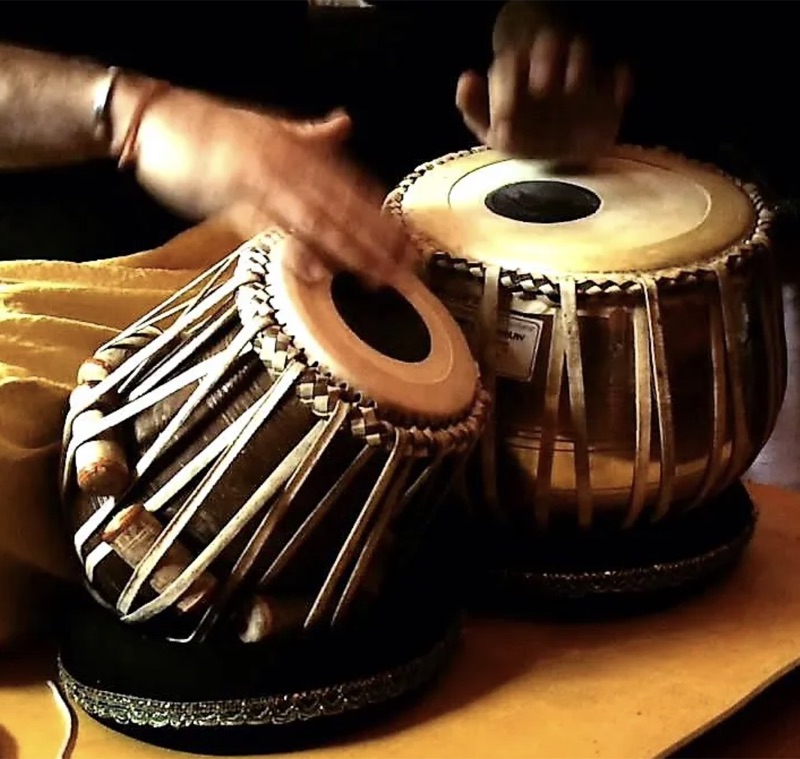
Other notable partnerships include Ustad Zakir Hussain (tabla) and Pandit Swapan Chaudhuri (tabla) — a tabla duet tradition that showcases the rhythmic dimension of jugalbandi — and the sitar-sarod pairing of Ustad Vilayat Khan and Ustad Ali Akbar Khan, which, though less frequent, produced performances of extraordinary fire and depth.
The Living Aesthetics: Challenges and the Future of Jugalbandi
The jugalbandi form demands virtues that extend beyond technical mastery. A musician must possess the humility to cede the musical space, the alertness to respond in real time, and the generosity to elevate the partner's contribution. When these qualities are absent, a jugalbandi degenerates into competition — a dangal (wrestling match) rather than a sangat (togetherness). Seasoned rasikas know the difference instinctively: a competitive jugalbandi may dazzle momentarily, but a truly collaborative one achieves a transcendence that neither musician could reach alone.
There are legitimate aesthetic critiques of the form. Purists have argued that jugalbandi, by its nature, curtails the uninterrupted meditative arc of a solo performance — the slow, organic unfolding of a raga over an hour or more. The need to share time, to match phrases, and to find common ground can, in lesser hands, produce music that is superficially brilliant but spiritually shallow. Cross-tradition jugalbandis face the additional challenge of reconciling fundamentally different approaches to intonation and ornamentation; a poorly conceived Hindustani–Carnatic encounter can reduce both traditions to their lowest common denominator.
Yet the form continues to evolve with vigour. Today's generation — including artists like Rakesh Chaurasia (bansuri), Amaan and Ayaan Ali Bangash (sarod), and Carnatic mandolin virtuoso U. Rajesh — brings new pairings and fresh perspectives to jugalbandi. Festival organisers at events such as the Sawai Gandharva Bhimsen Mahotsav in Pune and the Dover Lane Music Conference in Kolkata continue to programme ambitious duets that test the boundaries of the form.
At its finest, jugalbandi embodies a principle that extends far beyond music: that genuine dialogue — between traditions, between temperaments, between generations — does not erase difference but illuminates it. When two great musicians meet on stage, bound together by raga and tala yet free in their individual expression, the result is among the most electrifying experiences Indian classical music has to offer.