
In This Article
The Prahara System and Its Origins
Among the many distinguishing features of Hindustani classical music, perhaps none is as philosophically rich — or as hotly debated — as the samay siddhanta, the time theory of ragas. This system assigns each raga to a specific period of the day or night, and holds that a raga performed in its prescribed time yields its deepest aesthetic and emotional effect. While the theory is observed with varying degrees of strictness today, its underlying logic remains one of the great intellectual achievements of Indian musical thought.
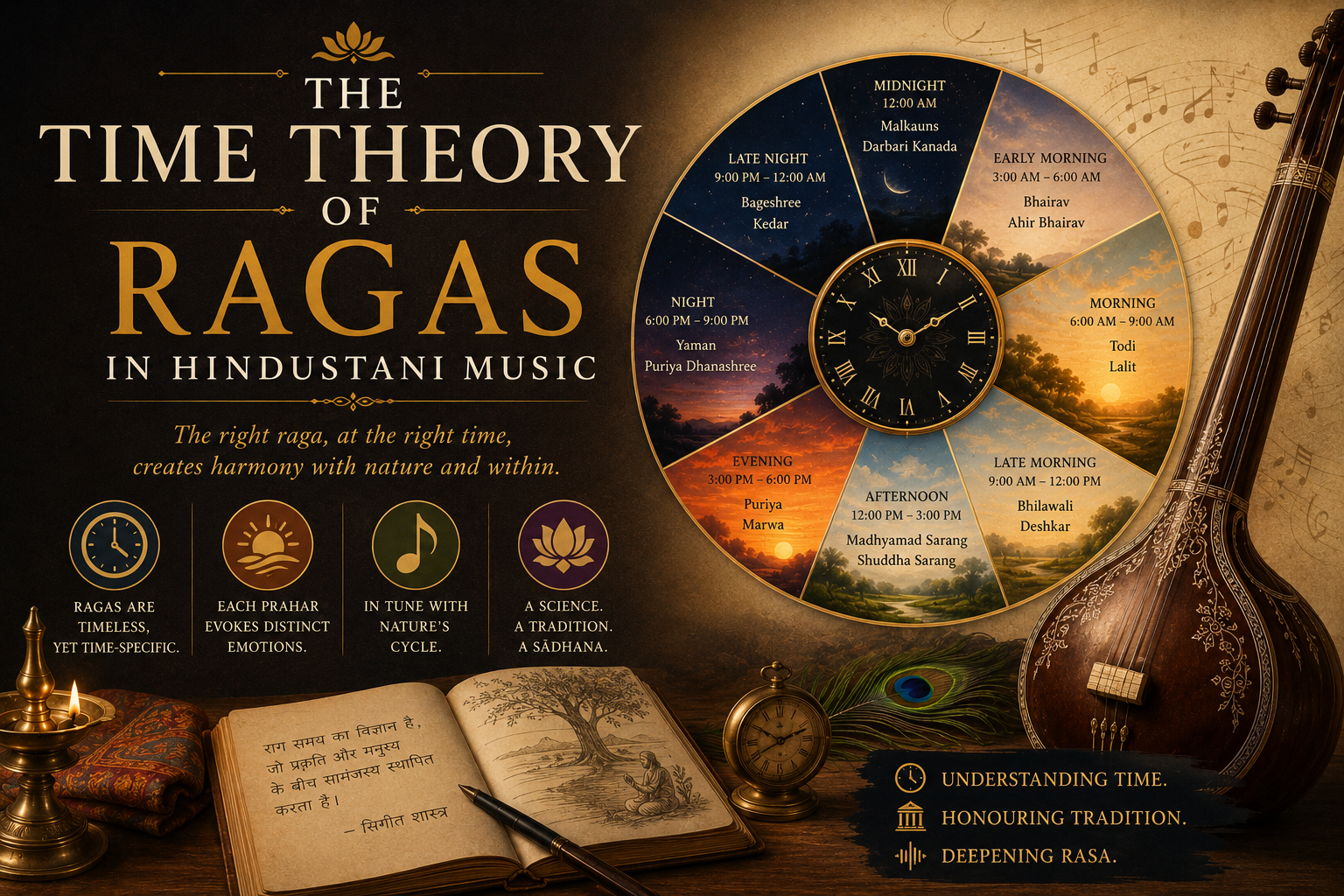
The traditional Indian day is divided into eight praharas (watches), each lasting approximately three hours — four for the day and four for the night. The cycle begins at sunrise (roughly 6:00 AM) and proceeds as follows:
- First prahara of the day: 6:00 AM – 9:00 AM (early morning)
- Second prahara of the day: 9:00 AM – 12:00 PM (late morning)
- Third prahara of the day: 12:00 PM – 3:00 PM (afternoon)
- Fourth prahara of the day: 3:00 PM – 6:00 PM (late afternoon)
- First prahara of the night: 6:00 PM – 9:00 PM (early evening)
- Second prahara of the night: 9:00 PM – 12:00 AM (late night)
- Third prahara of the night: 12:00 AM – 3:00 AM (deep night)
- Fourth prahara of the night: 3:00 AM – 6:00 AM (pre-dawn)
The roots of samay siddhanta can be traced at least as far back as the Sangita Ratnakara of Sharngadeva (13th century), though references to the mood-time association appear even earlier. By the time of the great ragamala paintings of the 16th and 17th centuries, the time associations were firmly embedded in North Indian aesthetic consciousness. The Mughal and Rajput courts, where many of these paintings were commissioned, visualised ragas not merely as musical entities but as living presences that inhabited specific hours, seasons, and emotional landscapes.
The Scientific and Modal Logic Behind Time Assignment
The time theory is not arbitrary. Musicologists — most notably Pandit Vishnu Narayan Bhatkhande (1860–1936), the towering systematiser of modern Hindustani music — identified clear patterns in the modal structure of ragas that correlate with their assigned times. Bhatkhande's framework, elaborated across his monumental Hindustani Sangeet Paddhati (published between 1910 and 1932), proposed several governing principles:
- The Re-Dha principle: Ragas using shuddha (natural) Re and Dha tend to be morning or evening ragas performed around the sandhiprakash (twilight) hours — both dawn and dusk. Examples include Bhairav (komal Re, komal Dha) and Marwa (komal Re, shuddha Dha). Conversely, ragas with komal (flat) Re and komal Dha — the hallmark of the Bhairav family — dominate the early morning, while those with shuddha Re and shuddha Dha rule the late morning and afternoon.
- The Ga-Ni principle: Ragas with shuddha (natural/tivra) Ma tend to occupy the first half of the day-night cycle, while those with tivra (sharp) Ma migrate towards the second half. This is why Yaman, with its characteristic tivra Ma, is an early-evening raga.
- The sandhiprakash ragas: The most distinctive category. These twilight ragas — Bhairav, Todi, Purvi, Marwa, Sri — share the use of komal Re and/or komal Dha, intervals that create a particular tension and poignancy suited to the liminal hours when day transitions into night and vice versa.
Beyond modal logic, there is an acoustic and psychophysiological argument. The Indian musicological tradition has long held that the human nervous system responds differently to sound at different hours. The gentle, meditative swaras of Lalit or Bhairav in the pre-dawn stillness produce a qualitatively different effect than they would at midday. As Pandit Ravi Shankar wrote in his autobiography My Music, My Life (1968):
"Each raga has its own particular time… The notes of a raga, when heard at the proper time, have a much more profound effect on the listener. There is something that happens between the sound and the silence of that hour."
Ragas Across the Diurnal Cycle: A Guided Journey
Let us trace a full cycle through the day, noting key ragas and their aesthetic associations:
Pre-dawn and early morning (4:00 AM – 7:00 AM): This is the domain of some of the most profound ragas in the Hindustani canon. Lalit, with its haunting combination of both shuddha and tivra Ma, evokes the trembling anticipation before sunrise. Bhairav, the great morning raga named after Lord Shiva in his fierce aspect, uses komal Re and komal Dha to conjure an atmosphere of austere devotion. It is no coincidence that the morning aarti in many Shaiva temples across Varanasi and Ujjain has historically been performed in Bhairav or its allied ragas. Ahir Bhairav, a gentler variant blending Bhairav with the pastoral sweetness of Kafi, suits the hour when the first light softens the darkness.
Late morning (9:00 AM – 12:00 PM): The mood brightens. Asavari, with its plaintive komal Ga, komal Dha, and komal Ni, carries a quality of wistful tenderness. Deshkar and Bilawal — the latter being the Hindustani equivalent of the Western major scale — bring a luminous, uncomplicated clarity suited to the advancing day.
Afternoon (12:00 PM – 4:00 PM): The Sarang family reigns supreme. Miyan ki Sarang, Shuddha Sarang, and Brindabani Sarang share a bright, open character, often featuring a prominent shuddha Re and the omission of Ga in the ascent. These ragas evoke the blazing midday sun, the shimmer of heat on open plains. The great dhrupad singer Ustad Zia Fariduddin Dagar was celebrated for his deeply meditative renditions of Sarang, transforming the afternoon raga into something transcendent.
Late afternoon and twilight (4:00 PM – 7:00 PM): The sandhiprakash ragas emerge. Purvi, Marwa, and Sri are among the most complex and emotionally demanding ragas in the system. Marwa, which remarkably avoids the shadja (Sa) in its traditional rendition, creates an almost unbearable tension — the musical equivalent of the sun's last rays dissolving into darkness. Yaman (also known as Kalyan), perhaps the first raga taught to most students, is assigned to the early evening, its tivra Ma and luminous ascent perfectly capturing the serene beauty of dusk.
Night (9:00 PM – 1:00 AM): The deeper nocturnal ragas take over. Malkauns, a magnificent pentatonic raga using komal Ga, komal Dha, and komal Ni, is one of the most powerful ragas in the tradition — associated with deep contemplation and, in legend, with the power to invoke supernatural forces. Darbari Kanada, said to have been a favourite of Tansen at the court of Akbar in the late 16th century, creates an atmosphere of regal gravity with its characteristic slow, oscillating komal Ga. Bageshri and Chandrakauns bring a lyrical, romantic quality to the late night hours.
Deep night and pre-dawn (1:00 AM – 4:00 AM): Ragas like Sohni and Paraj inhabit these solitary hours, though in practice, few concerts extend this deep into the night. The great all-night baithak and mehfil traditions of Lucknow, Kolkata, and Hyderabad once provided the ideal setting for these rare and intimate ragas to be explored in their proper time.
Relevance and Debate in Contemporary Practice
The advent of the modern concert format — typically a two-to-three-hour evening programme beginning at fixed times dictated by venue schedules — has inevitably compressed the time theory. When a concert begins at 6:30 PM, a performer might begin with Yaman or Puriya Dhanashri and, by the second half, move to a later-night raga like Bageshri or Malkauns. But a morning raga like Todi at 9:00 PM? This remains, for most traditional musicians, aesthetically uncomfortable.
Yet there have always been dissenters. The iconoclastic genius Pandit Kumar Gandharva (1924–1992) famously challenged the rigidity of time theory, arguing that a great artist could evoke the rasa of any raga at any hour through the sheer force of musical conviction. His controversial but deeply moving recordings of morning ragas performed at unconventional times remain a testament to this view.
The recording industry, radio broadcasting (particularly All India Radio, which from its earliest days in the 1930s organised its music programming according to time theory), and now digital streaming have further complicated the picture. A listener may encounter Bhairav on their headphones at midnight. Does the raga lose its power? Most rasikas would say that while the raga's intrinsic beauty survives, something ineffable is lost — or, at least, altered.
What remains beyond debate is the extraordinary sophistication of the system itself. The time theory of ragas represents a holistic worldview in which music is not an isolated art but an integral part of the cosmic rhythm — the turning of the earth, the movement of light and shadow, the ebb and flow of human consciousness through the hours. To experience Darbari in the deep stillness of a winter night, or Bhairav as the first light breaks over the Ganga at Varanasi, is to understand why this tradition has endured for centuries and why, for the serious rasika, samay siddhanta is not mere convention but a profound truth about the relationship between sound, time, and the human soul.