
In This Article
From Pastoral Fields to Concert Halls: A History of the Bansuri
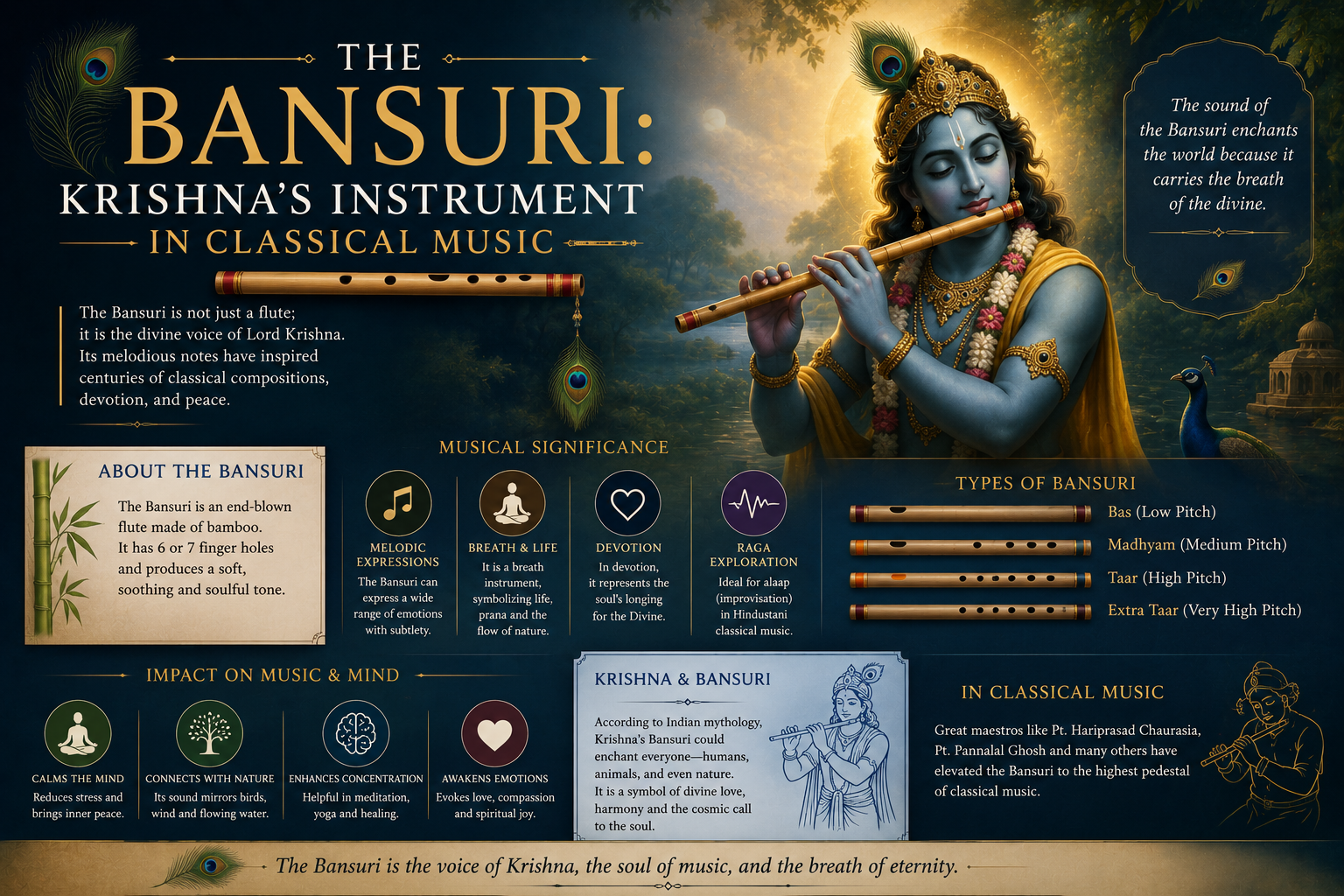
No instrument in the Indian musical imagination carries the mythological weight of the bansuri. In literature, sculpture, and painting spanning more than two millennia, the transverse bamboo flute appears as the inseparable companion of Lord Krishna — the divine cowherd whose melodies enchanted the gopis of Vrindavan and, by extension, all of creation. The Narada Purana, the Vishnudharmottara Purana, and countless verses of Jayadeva's Gita Govinda (12th century) celebrate the flute's voice as an expression of divine love. In temple iconography from Khajuraho to Hampi, Krishna is rarely depicted without it.
Yet for all its sacred prestige, the bansuri long remained outside the formal edifice of Hindustani classical music. Until well into the twentieth century, it was regarded primarily as a folk and devotional instrument — adequate for pastoral melodies, bhajans, and light airs, but considered too limited in range and volume to sustain the elaborate alap-jod-jhala architecture of a full-length raga exposition. The concert stage was dominated by the sitar, sarod, and, above all, the human voice. The flute's transformation from a humble folk instrument into a respected vehicle for raga sangeet is one of the most remarkable chapters in the modern history of Indian music, and it owes its course chiefly to two towering figures.
The Pioneers: Pannalal Ghosh and Hariprasad Chaurasia
Pannalal Ghosh (1911–1960) is rightly honoured as the father of the classical bansuri. Born Amulya Jyoti Ghosh in Barisal (now in Bangladesh), he was a disciple of the legendary dhrupad singer Allauddin Khan of Maihar — the same guru who shaped the artistry of Ravi Shankar and Ali Akbar Khan. Pannalal's great insight was that the bansuri needed to be physically reimagined before it could meet classical demands. He lengthened the instrument from the small folk flutes of roughly 14 inches to a concert flute of 26 inches and later even 32 inches, adding a seventh finger hole to extend its range to three full octaves. This larger bore produced the deep, resonant mandra saptak (lower octave) tones essential for alap and dhrupad-style exposition. By the 1940s, Pannalal was performing full ragas on All India Radio and on the concert stage, astonishing audiences who had never heard the flute treated with such gravitas. His recordings of ragas such as Yaman, Marwa, and Darbari Kanada remain landmark documents. Tragically, his early death in 1960 cut short a career that was still expanding the instrument's possibilities.
The mantle passed to Pandit Hariprasad Chaurasia (b. 1938), who has arguably done more than any other musician to place the bansuri at the centre of Indian and world music. Born in Allahabad, Chaurasia initially trained in vocal music under Pandit Rajaram before studying flute with Annapurna Devi, the reclusive daughter of Allauddin Khan. Where Pannalal Ghosh established the instrument's classical legitimacy, Chaurasia expanded its emotional and stylistic vocabulary. His approach draws heavily on gayaki ang — the vocal style of playing — imbuing every phrase with the inflections, gamak, and meend of a trained singer. His landmark recordings include mesmerising expositions of Raga Lalit, Raga Chandrakauns, and Raga Kirwani. Beyond the classical stage, his flute scores for Hindi films — most famously the soundtrack of Silsila (1981) and the album Call of the Valley (1967, with Shivkumar Sharma and Brij Bhushan Kabra) — introduced millions to the bansuri's voice. He has also collaborated with Western musicians such as John McLaughlin and Jan Garbarek, and founded the Vrindaban Gurukul in Mumbai and Bhubaneswar to train the next generation.
Other notable artists who have enriched the tradition include Raghunath Seth, Vijay Raghav Rao, Nityanand Haldipur, Ronu Majumdar, and Rakesh Chaurasia (Hariprasad's nephew), each bringing distinctive sensibilities to the instrument.
The Bamboo and the Breath: Construction of the Bansuri
The bansuri's apparent simplicity belies the exacting craft required to produce a concert-quality instrument. It is fashioned from a single length of Bambusa tulda or Pseudostachyum polymorphum, species favoured for their thin walls, even bore, and natural resonance. The best bamboo is traditionally sourced from the forests of Assam, Meghalaya, and the foothills of the eastern Himalayas, harvested during winter when the moisture content is lowest.
- Seasoning: The cut bamboo is dried for months, sometimes years, to prevent cracking. Some makers treat the interior with mustard oil or apply heat curing to stabilise the wood.
- Bore and length: Concert bansuris range from approximately 22 inches (key of E) to 34 inches or more (key of A or B-flat in the bass register). A longer flute produces a deeper fundamental but demands greater lung capacity and wider finger stretches.
- Holes: Six or seven finger holes are burnt or drilled with precision, their size and placement determining the tuning. A separate embouchure hole (mukha randhra) is fashioned near the sealed end. Fine-tuning is achieved by minutely adjusting hole diameters.
- The stopper: The blowing end is sealed by a natural bamboo node. The internal bore must be smooth and free of obstructions for clean airflow.
Unlike the Western concert flute, the bansuri has no keys, no mechanical pads, and no metal. Every note, every microtonal shade, is produced solely by the interplay of breath, lip position, and the partial or full covering of open holes. This directness of contact between player and instrument is central to the bansuri's expressive identity.
Playing Techniques and the Expressive Voice
The bansuri's capacity for nuance rivals that of the human voice — a quality that rasika listeners prize above all. The principal techniques that enable this expressiveness include:
- Meend (glissando): By gradually uncovering a finger hole, the player produces seamless slides between notes, essential for the slow, meditative unfolding of alap. The bansuri's open-hole design permits continuous meend across intervals as wide as a fifth.
- Gamak: A forceful oscillation between adjacent notes, achieved through controlled diaphragmatic pulses and finger movements, lending phrases weight and intensity.
- Andolan: A gentle, slow oscillation around a single note — critical in ragas like Darbari Kanada and Marwa where specific swaras must be rendered with delicate wavering.
- Cross-fingering and half-holing: The bansuri's shruti-rich palette of microtones — komal, tivra, and all the shades between — is accessed by partially covering holes or using alternate fingering combinations.
- Overblowing: By increasing air pressure and adjusting the embouchure angle, the player shifts from the fundamental octave (mandra) to the middle (madhya) and upper (tara) registers, each with its own timbral character.
- Breath control (prana vayu): Mastery of the bansuri demands years of breath training. Sustaining a single phrase through a lengthy alap, managing dynamic swells, and executing rapid taan passages all depend on deep diaphragmatic support and efficient air use. Circular breathing, while not traditional, is occasionally employed by contemporary players for extended phrases.
"The flute does not speak for itself; it speaks for the one who breathes into it. That is why it is Krishna's instrument — it is the perfect emblem of surrender."
— attributed to Pandit Hariprasad Chaurasia
What ultimately sets the bansuri apart is its timbral intimacy. The breathy, slightly airy tone — sometimes called the instrument's foonk — carries an inherent warmth that synthesisers and metal flutes cannot replicate. In a dimly lit baithak or a hushed auditorium, the bansuri's voice seems to arise not from an object but from the breath itself, unmediated and profoundly human. It is this quality that continues to draw listeners into its orbit, from the temple courtyards of Vrindavan to concert halls in London, Kolkata, and beyond — proof that Krishna's flute, far from being a relic of mythology, remains one of the most living and luminous voices in Indian classical music.