
In This Article
Colonial Origins and Arrival in India
The harmonium as we know it traces its European lineage to the physharmonica, developed by Anton Haeckl in Vienna around 1818, and the subsequent refinements by Alexandre Debain, who patented his "harmonium" in Paris in 1842. These free-reed, bellows-driven keyboard instruments were designed for churches, parlours, and missionary work — portable enough to travel where pipe organs could not.
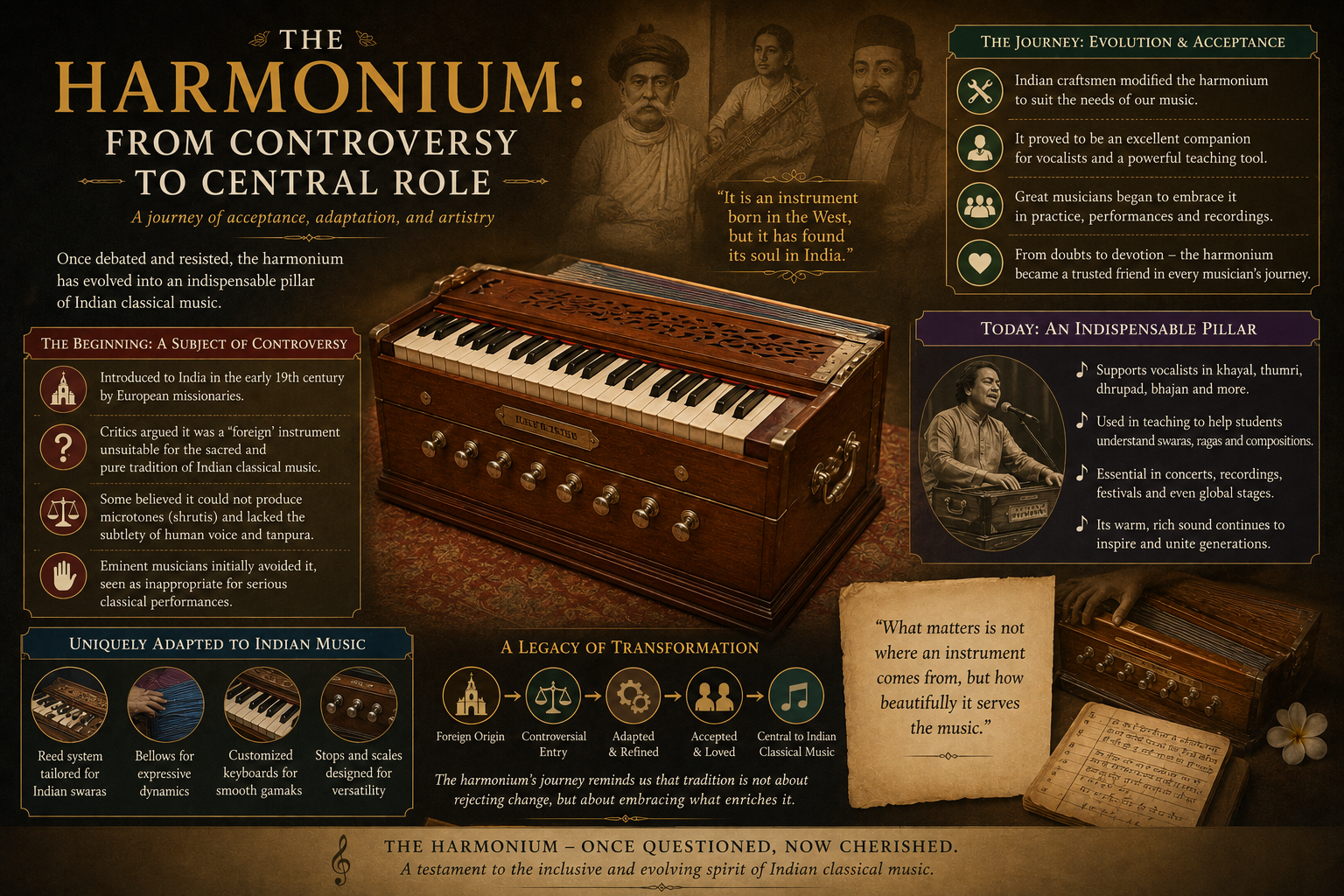
European Christian missionaries brought the harmonium to India in the mid-nineteenth century, primarily as an accompaniment for hymn singing. By the 1860s and 1870s, the instrument had begun appearing in Calcutta, Bombay, and other presidency towns, where it quickly attracted the curiosity of Indian musicians. Its appeal was immediate and practical: here was an instrument that could produce a sustained drone and melodic lines simultaneously, was relatively affordable, required no lengthy tuning rituals, and could withstand the rigours of India's climate far better than the European piano.
Indian craftsmen soon began modifying the instrument to suit local musical needs. The most significant adaptation was the shift from the foot-operated bellows of the European parlour model to a hand-pumped bellows system, allowing the musician to sit cross-legged on the floor in the traditional manner. Makers in Calcutta, and later in cities like Palitana, Delhi, and Kolhapur, developed what became the distinctly Indian hand harmonium — a compact, portable box with a three-octave keyboard, internal drone stops, and a bellows operated by the left hand while the right hand played the keys. Scale-changing mechanisms and coupler systems were added over time, and by the early twentieth century, India had become one of the world's largest manufacturers and consumers of harmoniums.
The Purists' Revolt and the AIR Ban
The harmonium's rapid adoption did not go unchallenged. From the very beginning, scholars and performers steeped in the traditional guru-shishya parampara raised serious aesthetic objections. The core of their argument was — and remains — that the harmonium is a fixed-pitch, equal-tempered instrument incapable of producing the subtle shrutis (microtonal inflections), meend (gliding movements between notes), andolan (gentle oscillations), and gamak (ornamental shakes) that are the very soul of Hindustani raga exposition.
Vishnu Narayan Bhatkhande and Vishnu Digambar Paluskar, the two towering figures of early twentieth-century musicology, held differing views on many matters, but the harmonium's limitations were widely acknowledged in scholarly circles. The instrument, critics argued, was flattening the microtonal landscape of Indian music, training young ears to accept twelve equally-spaced semitones as the norm, and thereby eroding the very foundation of raga grammar.
This opposition reached its institutional zenith in 1940, when All India Radio (AIR) banned the harmonium from its broadcasts as a solo instrument. The ban, championed by B.V. Keskar during his tenure as Minister of Information and Broadcasting in the 1950s, was rooted in a nationalistic desire to "purify" Indian music of colonial-era accretions. Keskar's broader programme of music reform on AIR favoured the sarangi and the tanpura as the authentic accompaniments for vocal music, and the harmonium was deemed aesthetically unfit for the airwaves.
"The harmonium has done incalculable harm to our music. It cannot produce the graces and nuances which are the life-breath of our melodic system." — A view commonly attributed to the discourse surrounding the AIR ban era.
The ban lasted for over thirty years and was not officially lifted until 1971, and even then, its restoration to the airwaves was gradual and grudging. During those decades, however, the harmonium had continued to flourish in live concert halls, recording studios, baithak settings, and especially in the worlds of bhajan, qawwali, ghazal, bhavgeet, and Marathi natyasangeet, where its robustness and versatility made it practically irreplaceable.
Acceptance and the Masters Who Elevated It
Despite the institutional hostility, a number of exceptional musicians demonstrated that the harmonium, in skilled hands, could serve Indian classical music with extraordinary sensitivity. Their artistry did more to legitimise the instrument than any policy reversal could.
- Govindrao Tembe (1881–1955) — A pioneering figure in Marathi sangeet natak, Tembe was among the earliest serious classical musicians to champion the harmonium as a concert-worthy instrument.
- Appa Jalgaonkar — Renowned as an accompanist of remarkable empathy, Jalgaonkar accompanied many of the great vocalists of the mid-twentieth century, earning deep respect for his tasteful and supportive playing.
- Pt. Tulsidas Borkar (1934–2017) — A disciple of the Gwalior and Kirana traditions, Borkar was instrumental in establishing the harmonium as a legitimate solo concert instrument in Hindustani classical music. His performances demonstrated that raga aalap, jod, and even extended bandish development could be rendered with surprising nuance on the instrument.
- Pt. Purushottam Walawalkar and Pt. Vasant Achrekar — Both contributed significantly to the Maharashtrian tradition of harmonium solo performance.
In the realm of accompaniment, the harmonium gradually displaced the sarangi as the preferred instrument to shadow the vocalist. This shift, accelerated from the 1950s onwards, had both practical and social dimensions. The sarangi, despite its unmatched ability to replicate the human voice, was burdened by caste stigma and the declining number of skilled players willing to take the arduous path of taalim. The harmonium, by contrast, was easier to learn to a functional level, readily available, and socially "neutral." By the 1970s and 1980s, harmonium accompaniment had become the norm in the majority of Hindustani vocal concerts.
The great vocalists themselves played a role in this transition. Pt. Bhimsen Joshi, Pt. Jasraj, Begum Akhtar, and Kishori Amonkar all performed regularly with harmonium accompanists, implicitly conferring legitimacy upon the instrument. In the qawwali tradition, the harmonium's role was never questioned — Nusrat Fateh Ali Khan's electrifying performances made the pumping bellows and cascading keyboard runs an iconic image of Sufi devotional music worldwide.
The Harmonium Today: Indispensable Yet Still Debated
Today, the harmonium occupies a paradoxical position in Hindustani music. It is ubiquitous — present in the vast majority of vocal concerts, recording sessions, music schools, and domestic practice rooms across the subcontinent. At institutions like the ITC Sangeet Research Academy in Kolkata, Sangeet Mahabharati in Mumbai, and countless gandharva mahavidyalayas, it remains the primary tool for teaching raga and composition. Young students overwhelmingly learn their first ragas on the harmonium's keys.
Yet the aesthetic objections have never been fully answered. The instrument still cannot produce meend. A komal gandhar in Raga Darbari Kanada demands a specific, lowered micro-pitch with a characteristic slow oscillation — the harmonium can only approximate this. The exquisite distinction between the shuddha madhyam used in Raga Yaman and the slightly different inflection in Raga Bihag is, strictly speaking, beyond its mechanical capacity. Purists argue that decades of harmonium-centric pedagogy have produced generations of musicians with a subtly impoverished sense of shruti.
Recent years have seen some fascinating responses to this critique:
- Shruti harmoniums with additional keys (sometimes 22 per octave, aligning with the traditional shruti system) have been developed by makers and researchers, though they remain niche instruments.
- A revival of the sarangi as a vocal accompaniment — championed by artists like Pt. Dhruba Ghosh, Ustad Sultan Khan, and the younger generation including Sabir Khan and Noor Bhai — has offered concert-goers an alternative timbre, though the harmonium's dominance persists.
- The digital domain has produced electronic shruti-accurate keyboards and software-based tanpuras, but these have yet to displace the acoustic harmonium from the live stage.
Perhaps the most balanced view is this: the harmonium is a compromise, and Indian musicians have always been pragmatists as much as idealists. It provides a harmonic bed, a pitch reference, and a melodic counterpoint that supports the vocalist effectively in live performance. Its limitations are real, but so are its contributions — to pedagogy, to the dissemination of classical and semi-classical music among the broader populace, and to genres like qawwali, thumri, and bhajan that have enriched millions of lives.
The harmonium's story is, in the end, a story about adaptation — of an instrument reshaped by Indian hands, of a musical tradition flexible enough to absorb a foreign import without losing its essence, and of an ongoing, healthy tension between purity and practicality that keeps Hindustani music a living, evolving art. Whether one views the harmonium as a necessary companion or an unfortunate imposition, its centrality to the soundscape of Indian classical music in the twenty-first century is beyond dispute.