
In This Article
The Foundation of Carnatic Rhythm: Why Seven Talas?
Rhythm in Carnatic music is not merely a backdrop to melody — it is an independent, intellectually rigorous system that has been refined over centuries into a structure of remarkable mathematical elegance. At its heart lies the Saptha Tala system, a framework of seven fundamental talas that, through systematic variation, yields 35 distinct rhythmic cycles. This system, codified in treatises such as Sangeeta Ratnakara by Sarngadeva (13th century) and further crystallised in the post-Purandara Dasa era of Carnatic pedagogy, remains the bedrock upon which every composition, improvisation, and rhythmic exploration rests.
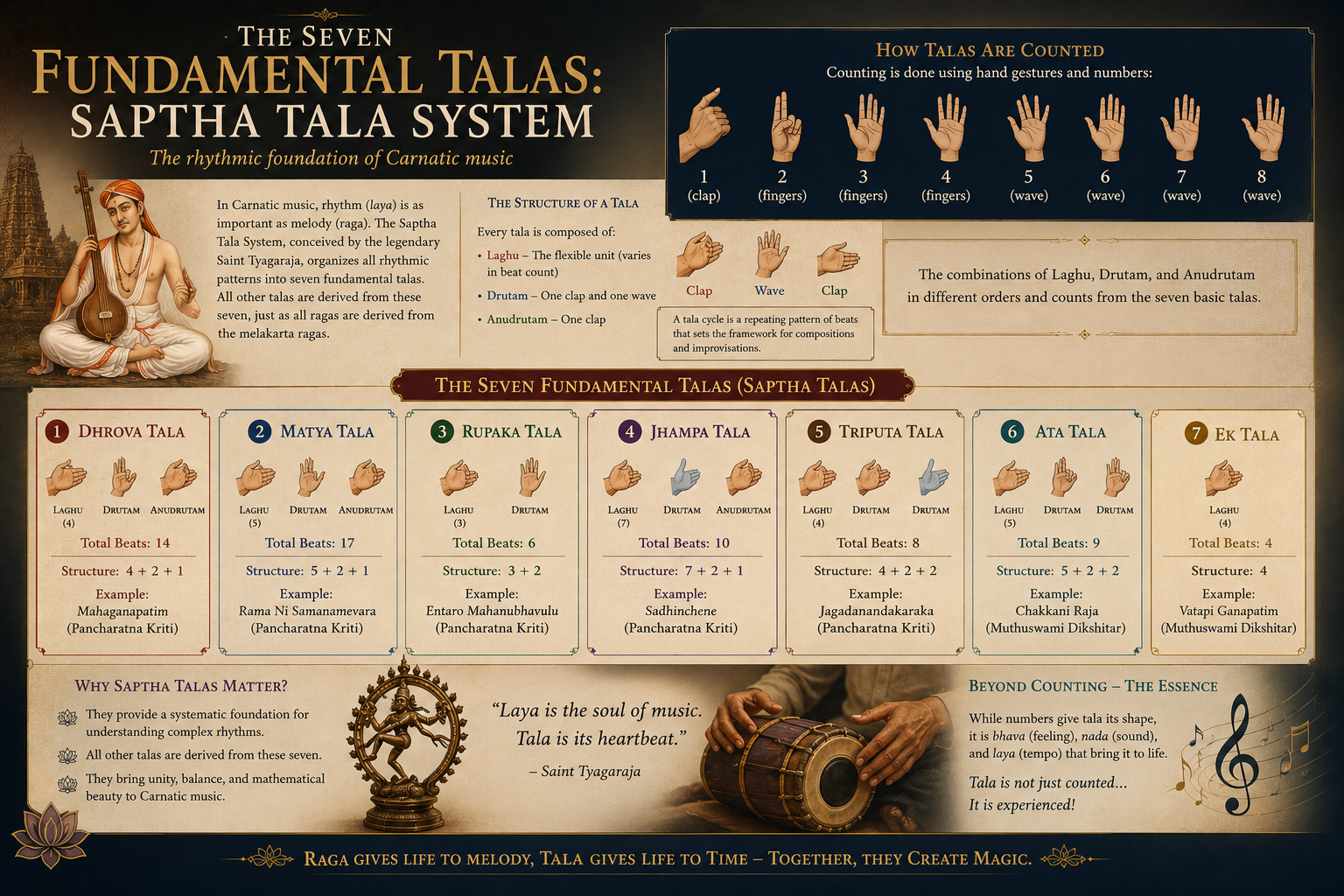
To understand why precisely seven talas form the foundation, one must first grasp the three basic angas (limbs or components) from which all talas are constructed:
- Laghu (I) — a variable-length unit consisting of a beat (clap) followed by finger counts. Its length depends on the jati (more on this below) and can be 3, 4, 5, 7, or 9 aksharas.
- Drutam (O) — a fixed unit of 2 aksharas, executed as a clap followed by a wave of the hand.
- Anudrutam (U) — a fixed unit of 1 akshara, marked by a single clap.
The seven talas are simply the seven distinct ways these three angas can be meaningfully combined to create rhythmic cycles. Each tala has a unique anga pattern, giving it a characteristic internal structure — not merely a different total count, but a different architecture of stresses, subdivisions, and gestural patterns.
The Seven Talas and Their Structures
The seven talas of the Saptha Tala system, along with their constituent angas, are as follows:
- Dhruva Tala — Laghu + Drutam + Laghu + Laghu (I O I I). In Chatusra jati (the default), this yields 4+2+4+4 = 14 aksharas. Dhruva tala is associated with steadfastness, as its very name suggests (dhruva meaning "fixed" or "constant"). Tyagaraja's Navarasa Kanada kriti "Enthanerchina" in Chatusra-jati Dhruva tala is a celebrated example.
- Matya Tala — Laghu + Drutam + Laghu (I O I). In Chatusra jati: 4+2+4 = 10 aksharas. Relatively rare in concert repertoire, yet compositions like Tyagaraja's "Kovur Panneeru" in this tala demonstrate its distinctive lilt.
- Rupaka Tala — Drutam + Laghu (O I). In Chatusra jati: 2+4 = 6 aksharas. This is one of the most commonly heard talas in concert, and arguably the most frequently used after Adi tala. Syama Sastri's masterpiece "O Jagadamba" in Anandabhairavi and Tyagaraja's "Koluvaiyunnade" in Bhairavi are cornerstones of the Rupaka tala repertoire.
- Jhampa Tala — Laghu + Anudrutam + Drutam (I U O). In Misra jati (its most common form): 7+1+2 = 10 aksharas. Jhampa tala compositions are relatively uncommon, lending them a special charm. Muthuswami Dikshitar's "Balasubrahmanyam" in Misra-jati Jhampa tala is a revered example.
- Triputa Tala — Laghu + Drutam + Drutam (I O O). In Chatusra jati: 4+2+2 = 8 aksharas. This is the universally known Adi tala — the single most prevalent tala in Carnatic music. From Tyagaraja's "Nagumomu" in Abheri to Dikshitar's "Sri Subrahmanyaya Namaste" in Kambhoji, the repertoire is vast and inexhaustible.
- Ata Tala — Laghu + Laghu + Drutam + Drutam (I I O O). In Khanda jati (its most characteristic form): 5+5+2+2 = 14 aksharas. Ata tala compositions often carry a grand, expansive quality. Tyagaraja's "Vidulaku Mrokkeda" in Mayamalavagowla and Syama Sastri's "Marivere Gathi" in Anandabhairavi are landmark works in this tala.
- Eka Tala — Laghu (I). In Chatusra jati: simply 4 aksharas. The most structurally austere of all talas, consisting of a single laghu. Despite its simplicity, Eka tala compositions demand great rhythmic precision. Tyagaraja's "Giripai Nelakonna" in Sahana is a beloved example.
"The beauty of the Saptha Tala system lies not in complexity for its own sake, but in the generation of extraordinary variety from minimal elements — three angas, seven combinations, and the transformative power of jati."
The Five Jatis: From 7 to 35
The true genius of the system reveals itself through the concept of jati. Since the laghu is a variable-length anga, its duration changes depending on which jati is applied. The five jatis are:
- Tisra jati — Laghu = 3 aksharas (1 clap + 2 finger counts)
- Chatusra jati — Laghu = 4 aksharas (1 clap + 3 finger counts)
- Khanda jati — Laghu = 5 aksharas (1 clap + 4 finger counts)
- Misra jati — Laghu = 7 aksharas (1 clap + 6 finger counts)
- Sankeerna jati — Laghu = 9 aksharas (1 clap + 8 finger counts)
Each of the seven talas can be rendered in each of the five jatis, yielding 7 × 5 = 35 talas. The nomenclature follows a consistent pattern: for instance, Tisra-jati Triputa tala has a laghu of 3 followed by two drutams (3+2+2 = 7 aksharas), while Misra-jati Rupaka tala has a drutam followed by a laghu of 7 (2+7 = 9 aksharas). The familiar Adi tala is formally Chatusra-jati Triputa tala.
This expansion is not merely theoretical. While certain combinations — particularly Chatusra-jati Triputa (Adi) and Chatusra-jati Rupaka — dominate the concert platform, the great composers have explored rare corners of this 35-tala matrix. Muthuswami Dikshitar, in particular, was renowned for composing in unusual tala-jati combinations as part of his systematic tala-varnams and kritis. The musicological treatise Chaturdandi Prakashika by Venkatamakhin (c. 1635), which also famously enumerated the 72 melakarta ragas, reinforced this 35-tala framework as foundational to the Carnatic system.
It is worth noting that talas with the same total akshara count but different anga structures are not the same tala. For example, Chatusra-jati Dhruva tala and Khanda-jati Ata tala both total 14 aksharas, but their internal architectures — the placement of claps, waves, and finger counts — create entirely different rhythmic experiences for performer and listener alike.
A Living Framework: The Saptha Tala System Today
On the modern concert stage, a handful of talas from the 35 dominate practical usage. Adi tala (Chatusra-jati Triputa), Rupaka tala, Misra Chapu, and Khanda Chapu account for the overwhelming majority of performances. It is important to note that the Chapu talas — Misra Chapu (7 aksharas) and Khanda Chapu (5 aksharas) — are technically outside the Saptha Tala system, being classified as desi talas or chapu talas with their own distinct kriya (hand gesture) patterns. Their prevalence in the post-Trinity repertoire, especially in compositions by Papanasam Sivan, Subramanya Bharathiyar, and modern vaggeyakaras, speaks to the Carnatic tradition's capacity for evolution beyond its classical framework.
Yet the 35-tala system remains indispensable for several reasons. First, the great pedagogical tradition established by Purandara Dasa (1484–1564), honoured as the Sangeeta Pitamaha (grandfather of Carnatic music), structured early rhythmic training around the Saptha Tala framework. The sarali varisais, alankarams, and geetams that every student learns are practised across multiple talas and jatis, embedding the 35-tala matrix into the musician's muscle memory from the earliest stages.
Second, the system provides the conceptual grammar for advanced rhythmic improvisation. When a mridangist like the legendary Palghat Mani Iyer or contemporary masters such as Karaikudi Mani and Umayalpuram K. Sivaraman execute complex korvais, mohra-korvais, and tani avartanams, the underlying arithmetic is always grounded in the anga structure of the prevailing tala. The distinction between a laghu and a drutam is not merely notational — it shapes phrasing, accent, and the very architecture of rhythmic composition.
Third, the 35-tala system continues to inspire contemporary composers. Works in rare talas — Sankeerna-jati Eka tala (9 beats), Tisra-jati Matya tala (3+2+3 = 8 beats), or Khanda-jati Dhruva tala (5+2+5+5 = 17 beats) — surface periodically in concerts and recordings, reminding audiences that the system's full expanse remains available for creative exploration.
The Saptha Tala system, in its mathematical completeness and practical flexibility, stands as one of the great intellectual achievements of Indian musical thought. It is simultaneously a closed, rigorous framework and an open invitation — a reminder that within clearly defined boundaries, the possibilities for rhythmic expression are, for all practical purposes, infinite.