
In This Article
Before Ariyakudi: The Concert as It Once Was
To appreciate Ariyakudi Ramanuja Iyengar's contribution, one must first understand what Carnatic music concerts looked like in the late nineteenth and early twentieth centuries. Before the 1930s, there was no standardised format for a public performance. Concerts — often held in temple precincts, the halls of zamindars, or during the Navaratri festivities of the Mysore and Travancore courts — could last anywhere from four to eight hours, sometimes stretching through the night. The vidwan chose compositions at will, sometimes repeating ragas, sometimes dwelling on a single raga for an hour or more. There was little predictable shape to the experience.
The harikatha tradition and the earlier paddhati of the Thanjavur court musicians had their own internal logic, but these were not concert formats in the modern sense. The great Trinity — Tyagaraja, Muthuswami Dikshitar, and Syama Sastri — composed prolifically, yet there was no established template for how their kritis should be arranged within a performance. Pallavi singing, once the centrepiece of a musician's art, could consume an entire evening. The audience, typically a small gathering of connoisseurs, was willing to sit through extended explorations without concern for time.
Several forces conspired to change this: the rise of the sabha system in Madras (now Chennai), the advent of All India Radio broadcasts with fixed time slots, the influence of the Madras Music Academy (founded in 1927), and the growing urban middle-class audience that desired both aesthetic richness and reasonable duration. It was into this moment of transition that Ariyakudi Ramanuja Iyengar stepped, not merely as a performer but as an architect.
The Ariyakudi Format: A Blueprint for the Modern Kutcheri
Ariyakudi Ramanuja Iyengar (1890–1967), born in the village of Ariyakudi in the Sivaganga district of Tamil Nadu, was a disciple of Poochi Srinivasa Iyengar and later received guidance from the legendary Tiruvottiyur Tyagier. By the 1930s, he had established himself as one of the foremost vocalists of his generation. But his most enduring legacy was not any single performance — it was the kutcheri paddhati, the concert format that he systematised and popularised, particularly through his performances at the Madras Music Academy and the sabhas of Mylapore and T. Nagar.
The format he crystallised, typically for a concert of roughly three hours, followed this progression:
- Varnam: The concert opens with a varnam, a composition that serves as both an invocation and a technical warm-up. The varnam showcases the raga's essential phrases and sets the tonal foundation. Ariyakudi often chose varnams in ragas like Todi, Bhairavi, or Kalyani to open his concerts with authority.
- Initial kritis: Two or three kritis in different ragas follow, typically rendered briskly with minimal elaboration. These serve to establish variety and build momentum. They might include compositions by the Trinity or by composers like Swathi Thirunal and Papanasam Sivan.
- Kritis with neraval and kalpanaswaram: The middle section features two or three kritis in which the musician begins to elaborate — offering neraval (melodic improvisation on a chosen lyric line) and kalpanaswaram (improvised solfa passages). This is where the concert deepens in emotional and intellectual engagement.
- Main piece (maṇi pravāḷam or centrepiece): The concert reaches its apex with the main item — typically a weighty kriti in a major raga such as Todi, Shankarabharanam, Kalyani, Kambhoji, or Bhairavi. This piece receives full raga alapana, neraval, and extended kalpanaswaram. In Ariyakudi's own concerts, this was often a Tyagaraja or Dikshitar composition rendered with magisterial poise.
- Ragam–Tanam–Pallavi (RTP): Occasionally included after or in place of the main kriti, the RTP is the supreme test of a musician's improvisation. Ariyakudi integrated this judiciously, ensuring it complemented rather than overwhelmed the concert.
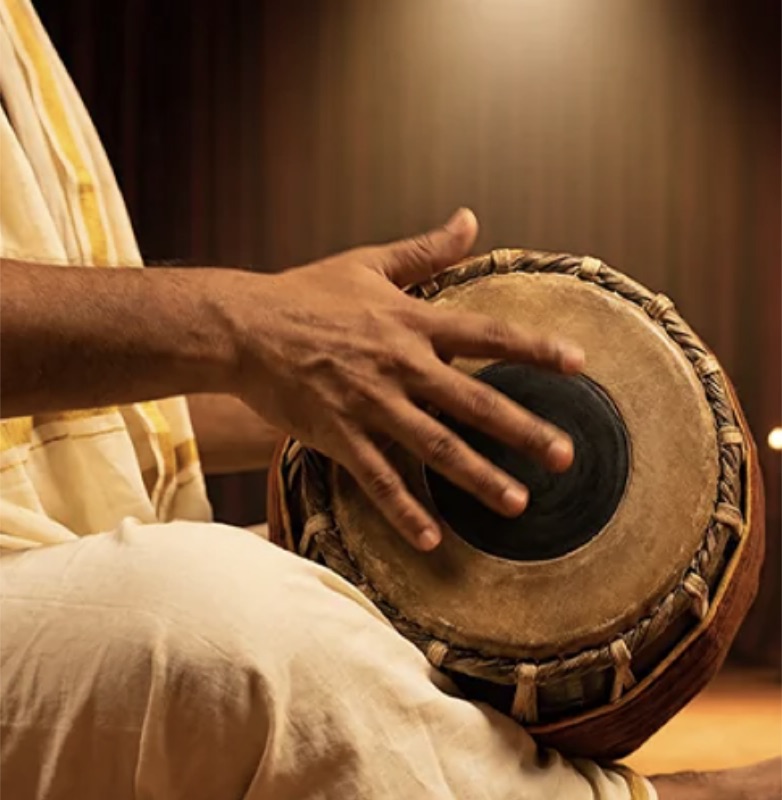
- Thani avartanam: Following the main piece, the mridangam artist (and accompanying percussionists) perform a solo percussion interlude. This provides a necessary change of texture and allows the vocalist a brief rest before the concluding section.
- Tukkadas (lighter pieces): The concert concludes with shorter, accessible compositions — bhajans, javalis, padams, thillanas, or devotional songs. These serve as a gentle descent from the concert's peak, sending the audience home with melody lingering in their minds. Ariyakudi was famous for his exquisite rendering of padams and javalis, drawing from the compositions of Kshetrayya, Sarangapani, and others.
"The concert must be like a well-planned meal — it should begin with something that awakens the palate, build to a rich and satisfying main course, and conclude with something sweet that leaves one content."
— A sentiment widely attributed to the Ariyakudi school of thought
Why This Structure Works
The genius of the Ariyakudi format lies in its understanding of aesthetic pacing and audience psychology. It is, at its heart, a narrative arc applied to abstract music.
The varnam functions as an overture — it grounds the listener in the grammar of Carnatic music, establishing sruti, raga, and tala from the outset. The early kritis build variety without demanding deep concentration, allowing the audience to settle in. The gradual introduction of improvisation — first brief passages of swaram, then full-scale alapana — mirrors the way a raga itself unfolds: from the seed of a phrase to the full flowering of its emotional potential.
The main piece, arriving roughly two-thirds of the way through the concert, benefits from all the preparation that has preceded it. The listener's ear is now attuned; the musicians are warmed up and in deep rapport. The raga alapana of the main piece can thus achieve a depth and intensity that would be impossible at the start of the concert. The thani avartanam that follows provides a necessary structural punctuation — a moment of rhythmic exhilaration that also allows the emotional weight of the main piece to settle.
The tukkadas are not mere afterthoughts. They perform the crucial function of denouement. After the intellectual rigour of the main piece, the lighter compositions — often in mellifluous ragas like Sindhu Bhairavi, Kapi, or Behag — offer emotional release. A well-chosen padam or javali can be as moving as the grandest alapana, precisely because it arrives at a moment of heightened receptivity.
This format also solved a practical problem: it made the Carnatic concert programmable. Sabhas could schedule concerts with reasonable certainty about duration. Radio broadcasts could be planned. And audiences — increasingly comprising working professionals rather than leisured aristocrats — could attend a concert on a December evening during the Music Season and return home at a reasonable hour.
Evolution, Challenges, and Living Legacy
The Ariyakudi format has proved remarkably durable. Nearly ninety years after its crystallisation, the vast majority of Carnatic concerts — whether at the Madras Music Academy, the Krishna Gana Sabha, or festivals in Thiruvaiyaru and Tiruvayaru — follow its essential structure. This is a testament to its soundness.
Yet the format has also evolved. Semmangudi Srinivasa Iyer, a contemporary of Ariyakudi, brought a more expansive approach to raga alapana that pushed the main piece to even greater prominence. Maharajapuram Santhanam and Madurai Mani Iyer each inflected the format with their own temperaments — Santhanam with his grand, sweeping approach, Mani Iyer with his intense emotional concentration. In later generations, T. M. Krishna has explicitly questioned the format's conventions, arguing that the hierarchy between "main piece" and "tukkada" creates an artificial valuation that diminishes certain genres. His experiments — placing a padam at the centre of a concert or beginning with a detailed alapana without a varnam — have provoked vigorous debate among rasikas.
Other contemporary musicians have introduced thematic concerts, raga-based explorations, or collaborative formats that push against the Ariyakudi template. The rise of shorter concerts — ninety-minute "lec-dems" and festival slots — has also compressed the format, sometimes reducing the opening kritis to a single piece and abbreviating the tukkada section.
Despite these experiments, the fundamental insight of Ariyakudi remains unchallenged: a concert must have shape. Whether one follows his template exactly or departs from it deliberately, every serious Carnatic musician today is in dialogue with the structure he bequeathed. The varnam still opens most concerts. The main piece still commands the greatest elaboration. The thani avartanam still offers percussionists their moment of glory. And the tukkadas still send audiences into the Mylapore night humming a melody.
Ariyakudi Ramanuja Iyengar did not merely sing beautifully — he designed an experience. In doing so, he gave Carnatic music a framework supple enough to accommodate individual genius yet sturdy enough to endure across generations. That is no small achievement. It is, in its own way, a composition as elegant as any kriti — a structure in which every element has its place, its purpose, and its beauty.