
In This Article
Understanding Sruti: More Than Just a Pitch
In Western music, the concept of pitch is relatively straightforward — A4 is 440 Hz, and the twelve semitones of the chromatic scale are fixed by equal temperament. Indian classical music operates in a profoundly different sonic universe. The term sruti (also transliterated as shruti) derives from the Sanskrit root śru, meaning "to hear," and it refers to the finest perceivable gradations of pitch. The ancient treatise Natyashastra of Bharata Muni (circa 2nd century BCE to 2nd century CE) enumerated 22 srutis within one octave — microtonal intervals that are far more nuanced than the Western semitone.
In practical concert usage, however, sruti most commonly refers to the tonic pitch — the fundamental note, or shadja (Sa), to which a performer tunes. Every musician selects a sruti that best suits the natural range and timbre of their voice or instrument. For vocalists, this choice is deeply personal: Pandit Bhimsen Joshi typically sang in B natural (Kali 1), while Kishori Amonkar often chose C-sharp (Kali 2). In Carnatic music, the legendary M. S. Subbulakshmi's concerts were generally set to 5 or 5½ sruti (approximately G or G-sharp on the Western scale), and the great Semmangudi Srinivasa Iyer performed at a majestic 4½ sruti.
The sruti numbering system used in Carnatic music counts upward from C as 1, so 1 sruti = C, 2 = D, 3 = E, and so on, with half-values indicating sharps and flats. This system allows musicians, accompanists, and instrument makers to communicate pitch settings with precision.
"The sruti is the mother of the svara. Without the sruti being firmly established, the svara has no life." — A widely cited axiom in traditional gurukula training.
The Tambura: The Eternal Drone
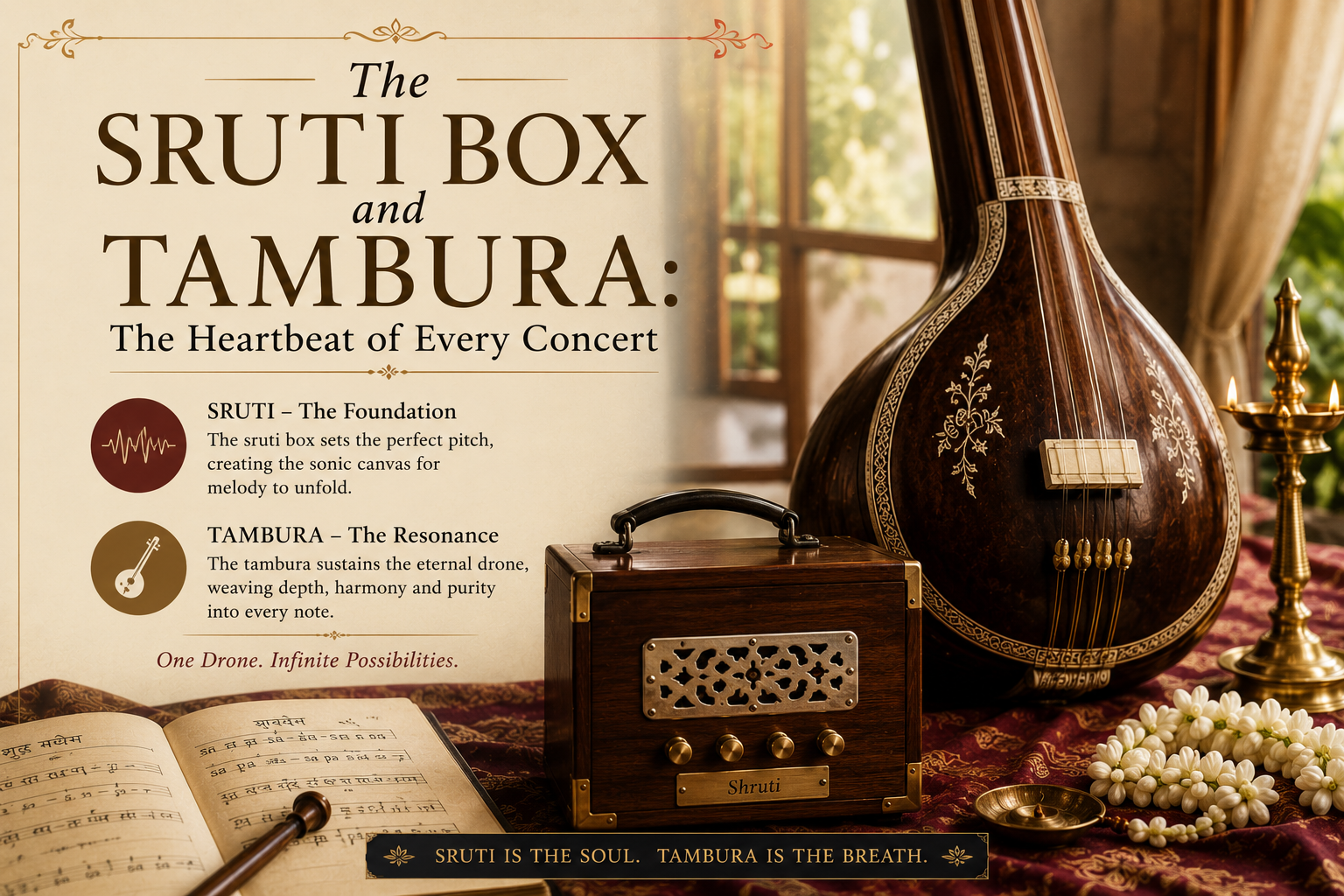
The tambura (or tanpura) is arguably the most important instrument on the Indian classical stage, yet it plays no melody and no rhythm. Its sole function is to produce a rich, continuous drone — typically sounding the notes Sa, Pa, Sa, Sa (tonic, fifth, upper tonic, and tonic) or Sa, Ma, Sa, Sa when the raga emphasises the fourth (madhyama). This seemingly simple combination generates a shimmering curtain of overtones and harmonics that creates what acousticians call a harmonic series matrix — a tonal field in which the svaras of a raga naturally emerge and resonate.
The instrument itself typically has four or five strings stretched over a long, unfretted neck attached to a large gourd resonator. The bridge, made of bone or deer horn, is carefully shaped with a slight curvature — a technique called jivari (giving life) — that allows the string to graze against its surface, producing the characteristic buzzing, overtone-rich sound. The craft of shaping the jivari is a highly specialised art; master tambura makers in Miraj (Maharashtra) and Thanjavur (Tamil Nadu) have perfected this over generations. Miraj, in particular, has been the epicentre of tambura-making since the 19th century, with families such as the Sardar family and workshops like those of the late Hamid Husain producing instruments renowned worldwide.
The acoustic principle at work is profound. When a vocalist sings a note against the tambura's drone, the alignment — or deliberate tension — between the sung pitch and the drone's harmonic series is what gives each svara its emotional colour. The komal gandhara (flat third) in Raga Darbari Kanada, for instance, acquires its distinctive gravity partly because of how it sits against the tambura's overtone field. As the celebrated sitarist Pandit Ravi Shankar wrote in his book My Music, My Life (1968): the tambura is not mere accompaniment — it is "the bed of sound upon which the entire performance rests."
- Male tambura: larger, typically tuned to lower pitches (A to D), with a deeper resonance; preferred by male vocalists and instrumentalists playing in lower registers.
- Female tambura: smaller, tuned higher (D to G), with a brighter tone; commonly used by female vocalists and lighter-toned instruments.
- Tamburi: a miniature variant, sometimes used in lighter classical or devotional music settings.
From Gut Strings to Electronic Drones: The Evolution
For centuries, the acoustic tambura was the only source of drone. Accompanying artists — often young disciples of the main performer — would sit behind the soloist, patiently plucking the strings in a slow, cyclical rhythm throughout concerts that could last several hours. This practice was itself a form of musical training: students learned to internalise the sruti and understand the harmonic relationships of svaras by immersing themselves in the drone for years before they were permitted to perform.
The first significant disruption came in the 1970s and 1980s with the advent of electronic sruti boxes. Early models were simple analogue oscillators that produced a flat, monotone hum — functional but aesthetically impoverished compared to the living warmth of a real tambura. These early devices, often manufactured by companies such as Radel (founded in Bengaluru in 1984 by T. V. Raman), gradually improved in sound quality and reliability.
The Radel Saarang series, introduced in the late 1990s, represented a major leap, incorporating digitally sampled tambura sounds and offering fine-tuning controls for pitch, string selection, and tonal quality. By the 2000s, smartphone applications such as iTanpura and Tanpura Droid brought electronic drones to every musician's pocket, democratising access in an extraordinary way. Today, sophisticated software like iTabla Pro and hardware like the Radel Digi-108 offer remarkably convincing digital tambura simulations with adjustable jivari characteristics.
Yet the debate continues. Many senior musicians — among them the late Ustad Vilayat Khan and Pandit Jasraj — were emphatic that no electronic device could replicate the organic interaction between a live tambura and a performer's voice. The acoustic tambura responds to the room, to temperature, to humidity; its overtones shift subtly over the course of a concert, creating a living, breathing soundscape. An electronic box, however refined, produces a fixed signal.
"The tambura is a sahayogi — a companion, not a machine. It breathes with you." — Pandit Jasraj, in a 2015 interview with Sruti Magazine.
In contemporary practice, a hybrid approach has become common: many concert artists use one or two live tamburas supplemented by an electronic sruti box, ensuring that the drone remains stable even during the inevitable pauses when a human player re-tunes or rests.
How the Drone Shapes the Music
The tambura's drone is not merely a reference pitch — it is an active participant in the creation of raga. Several critical musical phenomena depend on it:
- Svara identity: Each note of a raga acquires its precise character from its relationship with the drone. The same interval — say, a komal nishad (flat seventh) — will sound markedly different against a Sa-Pa drone versus a Sa-Ma drone, altering the emotional register of the performance.
- Intonation and microtonal nuance: The 22 srutis are not abstract theoretical divisions; they are heard against the drone. A masterful vocalist like Kishori Amonkar or D. K. Jayaraman would subtly inflect a svara, pulling it a microtone higher or lower to heighten emotional intensity — a nuance only perceptible because the drone provides an unwavering reference.
- Rasa and mood: The drone's overtone field creates a kind of psychoacoustic environment. Research by scholars such as Wim van der Meer (Hindustani Music in the 20th Century, 1980) and Mark Levy has demonstrated that listeners perceive svaras differently depending on the density and richness of the tambura's harmonics. This directly influences the rasa — the aesthetic emotion — that a raga evokes.
- Alap and meditative space: The opening alap of a Hindustani concert, where the raga is slowly unveiled note by note without rhythmic accompaniment, depends entirely on the interplay between voice and drone. The tambura fills the silence between phrases, sustaining the raga's atmosphere and giving the listener a tonal anchor.
Understanding the sruti and the tambura is, in many ways, the gateway to understanding Indian classical music itself. Whether you are a beginning student selecting your first tonic or a seasoned rasika listening for the delicate interplay of overtones in a midnight Malkauns, the drone is always there — patient, constant, and infinitely generous. It asks nothing of the listener but attentiveness, and it repays that attention with a depth of sonic experience that no chord progression or harmonic modulation can replicate. The next time you attend a concert, close your eyes during the alap and listen not just to the singer, but through the tambura. You will hear the raga differently — as it was always meant to be heard.