
In This Article
Origins in the Krishna Delta
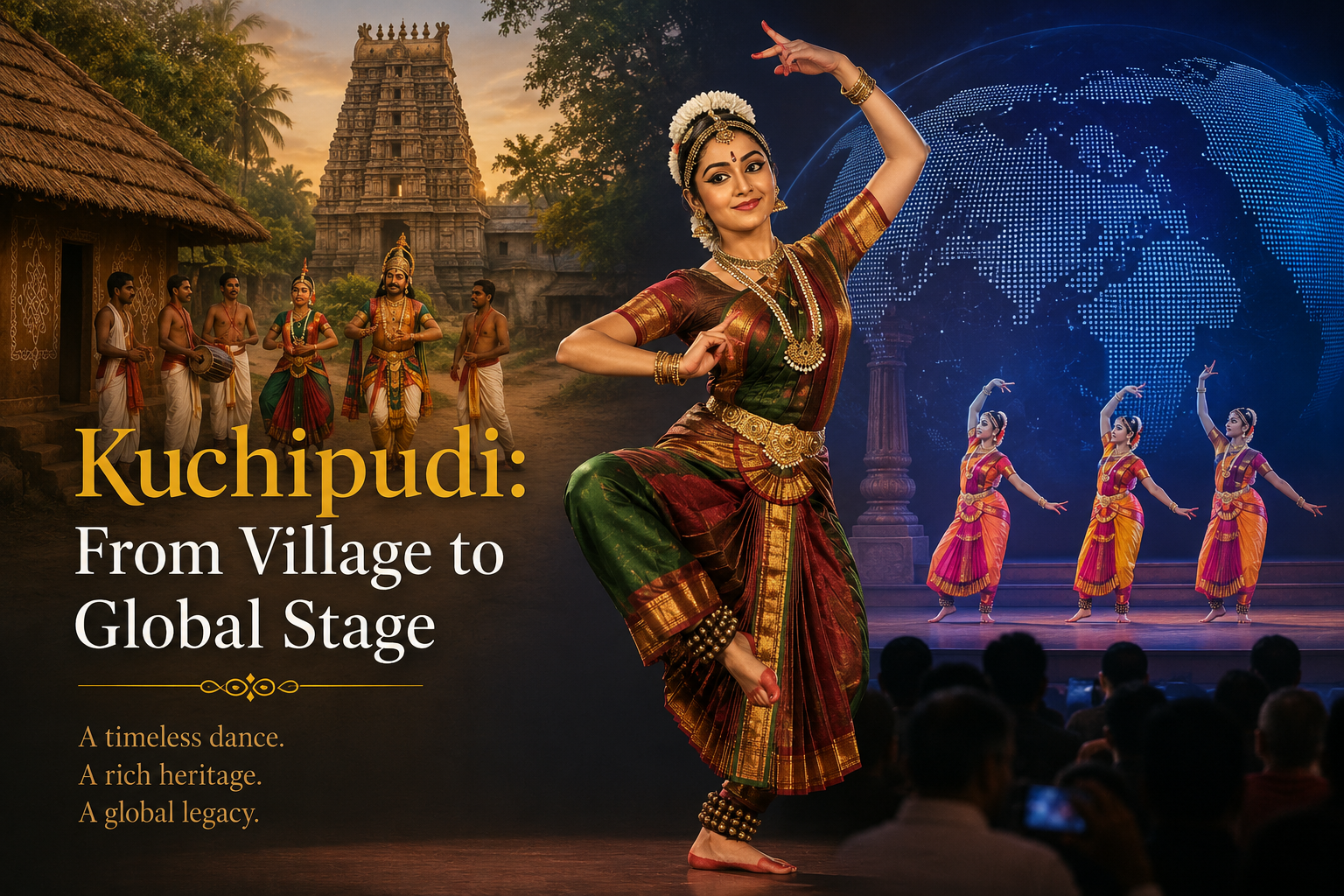
The story of Kuchipudi begins in a small agraharam nestled on the banks of the Krishna River in what is now Andhra Pradesh's Krishna district. Kuchipudi village (historically known as Kuchelapuram or Kuchelapuri) lent its name to a dance-drama tradition that would, over centuries, evolve into one of India's eight recognised classical dance forms. The village, located near Machilipatnam, became the crucible for a unique synthesis of Bhakti devotion, Sanskrit theatrical convention, and Telugu literary sensibility.
The tradition's formalisation is most commonly attributed to Siddhendra Yogi, a Vaishnavite sannyasin believed to have lived in the 14th or 15th century (though some scholars place him in the 17th century). According to well-established oral and textual accounts, Siddhendra Yogi composed Bhama Kalapam, a dance-drama centring on the character of Satyabhama — the proud, jealous, and ultimately devoted consort of Lord Krishna. This work became the cornerstone of the Kuchipudi repertoire. Siddhendra Yogi is said to have assigned families of Brahmin men in Kuchipudi village the hereditary responsibility of performing this and other dance-dramas as a form of temple offering.
Several features distinguished this early tradition:
- Exclusively male performers: All roles, including female characters like Satyabhama, were enacted by male artists, a convention that persisted well into the 20th century.
- Dance-drama format: Unlike the solo recital structure of Bharatanatyam, Kuchipudi was inherently theatrical — a natya tradition with dialogue, group choreography, and dramatic narrative.
- Devotional purpose: Performances were offered to deities, particularly in Vaishnavite temples, and were considered acts of worship rather than secular entertainment.
- Telugu literary roots: The tradition drew upon Telugu padams, kirtanas, and literary compositions, giving it a distinct regional flavour rooted in the Andhra cultural milieu.
Other significant early works in the repertoire include Parijatapaharanam (attributed to various composers), Golla Kalapam, and Vipra Narayana Kalapam. The Kalapam format — a dramatic narrative built around a central character's emotional journey — became a defining genre of Kuchipudi.
Twentieth-Century Transformation
The 20th century brought sweeping changes to Kuchipudi, transforming it from a localised village ritual into a codified classical art form with national and international recognition. This metamorphosis was the work of several towering figures, each contributing a vital dimension to the tradition's evolution.
Lakshminarayana Shastri (1886–1956) was among the first to take Kuchipudi beyond the confines of the village, performing at cultural events and bringing wider attention to the form. His student, Vedantam Lakshminarayana Sastry, became legendary for his portrayal of Satyabhama, setting an unmatched standard for male performers enacting female roles.
However, the single most transformative figure in modern Kuchipudi history is undeniably Vempati Chinna Satyam (1929–2012). A visionary choreographer and pedagogue, Chinna Satyam fundamentally reimagined Kuchipudi for the modern era. His contributions were manifold:
- He developed a solo repertoire for Kuchipudi, systematising the margam (sequence of items) to parallel the concert format of Bharatanatyam, while retaining Kuchipudi's distinctive theatrical energy.
- He opened the tradition to women performers, training generations of female dancers who would carry the art form to global audiences.
- He established the Kuchipudi Art Academy in Chennai (then Madras) in 1963, creating an institutional framework for rigorous training outside the hereditary village system.
- He choreographed numerous full-length dance-dramas, including Sri Krishna Parijatam, Padmavati Srinivasa Kalyanam, Ksheera Sagara Madhanam, and Harischandra, blending classical technique with compelling stagecraft.
Simultaneously, Dr. Vempati Chinna Satyam's contemporaries made vital contributions. Chinta Krishnamurthy and Tadepalli Perayya Sastry kept the village tradition alive, while Yamini Krishnamurthy (1940–2024), trained under both Chinna Satyam and other masters, became one of the most celebrated faces of Kuchipudi on the national stage, earning the Padma Vibhushan. Raja and Radha Reddy, a husband-and-wife duo trained in part by Chinna Satyam, developed a powerful, sculptural style that brought Kuchipudi to international festivals and concert halls from the 1970s onwards.
"Kuchipudi is not merely dance. It is natya — a total theatre of body, voice, emotion, and spirit. When you remove the drama, you remove its soul."
— Vempati Chinna Satyam
The inclusion of Kuchipudi in the programmes of national institutions such as the Sangeet Natak Akademi (which honoured the Kuchipudi tradition with its award as early as 1965) and its recognition by the government of India as a distinct classical form cemented its status in the cultural canon.
Distinctive Features and Technique
While Kuchipudi shares certain foundational principles with other Indian classical dance forms — including the vocabulary of adavus (basic steps), the grammar of hastas (hand gestures) codified in texts like the Natyashastra and Abhinaya Darpana — it possesses several features that render it unmistakable.
The Tarangam — dancing on a brass plate: Perhaps the most visually spectacular element of Kuchipudi is the tarangam, in which the dancer performs intricate footwork while standing on the edges of a brass plate (talambralu plate or thali), sometimes simultaneously balancing a pot of water on the head. This feat, traditionally performed to the tarangams (lyrical compositions in praise of Krishna) of Narayana Teertha from his magnum opus Sri Krishna Leela Tarangini, demands extraordinary balance, rhythmic precision, and muscular control. It remains one of the most iconic images of the art form.
Other distinctive characteristics include:
- Fluid, rounded movements: Unlike the angular geometry that sometimes characterises Bharatanatyam, Kuchipudi technique emphasises a more lyrical, flowing quality in its movement, with graceful torso shifts and a buoyant use of the araimandi (half-sitting position).
- Integration of speech and song: In the traditional dance-drama format, performers speak and sing their own lines — a practice virtually unique among Indian classical dance forms and directly linked to its theatrical roots.
- Rapid footwork combined with expressive abhinaya: Kuchipudi demands a seamless oscillation between vigorous nritta (pure dance) passages and deeply nuanced abhinaya (expressive storytelling), often within the same composition.
- Use of the sutradhara: In dance-drama presentations, a narrator-director figure introduces characters and guides the narrative, a convention drawn directly from Sanskrit dramatic tradition.
- The Pravesha Daruvu: Each character in a Kuchipudi dance-drama is introduced through a specific entry song and dance, establishing identity and temperament — a convention that carries echoes of ancient Natya practice.
The musical framework of Kuchipudi is rooted in Carnatic music, with compositions set in ragas and talas of the South Indian system. Telugu padams, kritis, slokams, and ashtapadis from Jayadeva's Gita Govindam form the literary and musical bedrock of the solo repertoire.
Current Practitioners and Global Presence
Today, Kuchipudi thrives through a vibrant community of practitioners who honour the tradition's roots while exploring its contemporary possibilities. The art form has established a significant presence across India and in diaspora communities worldwide.
Among the most prominent contemporary artists, Shobha Naidu (1956–2024), a senior disciple of Vempati Chinna Satyam, was instrumental in maintaining the academy's legacy and training hundreds of students. Kaushalya Reddy, Manju Bhargavi, and Bala Kondala Rao represent important lineages within the tradition. Yamini Reddy, daughter of Raja and Radha Reddy, has emerged as a powerful next-generation voice, blending her parents' sculptural aesthetic with her own artistic sensibility.
The village of Kuchipudi itself remains an active centre. Efforts by organisations such as the Siddhendra Yogi Kala Peetham and annual festivals in the village help preserve the dance-drama traditions that are the art form's original expression. The Kuchipudi Kalakshetra, a residential academy in the village, continues to train young artists in both the solo and group traditions.
On the international stage, Kuchipudi has found dedicated practitioners and audiences in the United States, the United Kingdom, Australia, and Southeast Asia. Universities and cultural institutions increasingly programme Kuchipudi performances and lecture-demonstrations, contributing to its scholarly and popular recognition.
Yet challenges persist. The traditional male dance-drama tradition, once the very definition of Kuchipudi, is now practised by a dwindling number of artists in the village. The solo female-dominated recital format, while commercially and artistically successful, represents only one facet of a much richer legacy. The task before today's practitioners is a delicate one: to sustain the theatrical natya tradition that gave Kuchipudi its identity, even as they carry its beauty to ever-wider audiences.
From the oil-lamp-lit courtyards of a Krishna delta village to the concert stages of London, New York, and Sydney, Kuchipudi's journey is a testament to the resilience of a living tradition — one that continues to move, speak, and enchant.