
In This Article
Costume as Grammar: More Than Mere Adornment
In the Indian classical dance tradition, costume is never an afterthought. It is, in the truest sense, an extension of the dancer's body — a visual grammar that amplifies every adavu, every mudra, every fleeting expression of rasa. The great Bharatanatyam revivalist Rukmini Devi Arundale, who founded Kalakshetra in 1936, understood this instinctively. When she reimagined the Bharatanatyam costume from the looser, draped textile of the devadasi tradition into the structured, fan-pleated sari we recognise today, she was not merely making a sartorial choice. She was reshaping the visual architecture of the dance itself.
Each of India's classical dance forms — codified and recognised by the Sangeet Natak Akademi — has developed a distinctive costume tradition that responds to the biomechanics of the form, the cultural geography from which it emerges, and the philosophical impulse that animates it. To study these costumes is to understand something essential about what each dance seeks to express.
"The costume must disappear into the dance. When it is right, the audience sees not cloth but movement, not ornament but light." — Padma Subrahmanyam, dancer and scholar
Silk, Gold, and the Southern Traditions: Bharatanatyam and Kuchipudi
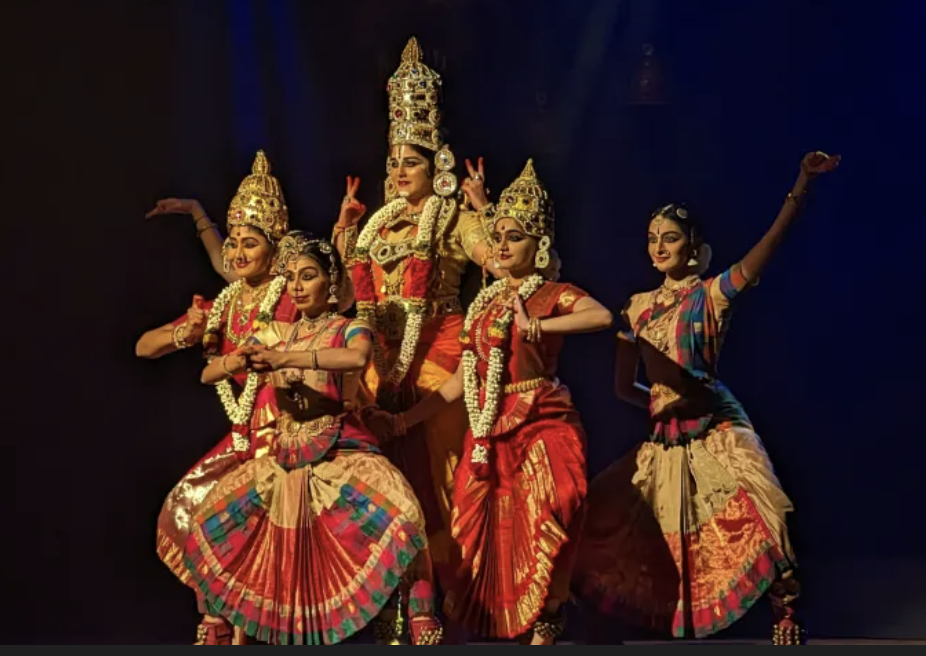
Bharatanatyam, rooted in the temples of Tamil Nadu, demands a costume that can withstand the vigorous geometry of the aramandi (half-seated position) while simultaneously creating visual splendour. The standard costume today is fashioned from Kanjeevaram silk — the heavy, lustrous textile woven in the temple town of Kanchipuram, renowned for its rich zari borders and extraordinary durability. A typical Bharatanatyam costume comprises several key elements:
- The pyjama: Stitched trousers that allow full range of movement in the deep-knee bends and stamping footwork characteristic of the nritta sections.
- The fan (pleats): A separate piece of pleated fabric attached at the waist, which opens dramatically during the aramandi to create the iconic cascading silhouette — a visual echo of the tribhanga postures seen in Chola bronze sculptures.
- The drape: A length of fabric that passes over the left shoulder and is tucked at the waist, recalling the sari's traditional form.
- The border pieces: Contrasting zari-edged strips that frame the legs and the fan, delineating the body's lines for the audience.
Rukmini Devi's innovation in the 1930s and 1940s was to introduce temple jewellery motifs into the costume's border designs, drawing upon the iconography of the Brihadeeswara Temple at Thanjavur and the bronzes of the Nayak period. Her Kalakshetra style — characterised by restrained colour palettes and emphasis on line — contrasts with the more flamboyant Vazhuvoor style popularised by Vazhuvoor Ramaiah Pillai, which favours richer, more saturated hues.
Kuchipudi, the classical form from Andhra Pradesh, shares some structural similarities with Bharatanatyam costume but maintains its own identity. Traditionally, Kuchipudi was performed by male Brahmin artists of the Kuchipudi village near Machilipatnam, and the costume for female roles involved a distinctive tunic and pleated dhoti combination. Today, the standard women's costume features a lightweight silk sari — often in vibrant shades of parrot green, red, or royal blue — with a shorter, more mobile fan pleat than Bharatanatyam. This reflects Kuchipudi's greater emphasis on fluid, rounded movements and its unique tarangam sequences, where the dancer performs upon the edges of a brass plate. The lighter fabric and shorter pleats allow the rapid footwork and dramatic jarus (gliding steps) that distinguish the form.
Northern Radiance and Kerala's Grace: Kathak and Mohiniyattam
Kathak, the classical dance of North India, presents a fascinating study in costume as cultural autobiography. The form's dual heritage — Hindu temple tradition and Mughal court culture — is written directly into its two dominant costume styles:
- The Hindu court style: A richly embroidered lehenga (long, flared skirt), choli (fitted blouse), and odhni (gossamer veil). The lehenga's generous circumference — sometimes as much as twelve metres of fabric — is essential for the form's celebrated chakkar (spinning turns). As the dancer executes three, seven, or even twenty-one consecutive spins, the skirt rises and fans outward in a perfect disc, creating a mesmerising visual vortex. The Jaipur gharana, founded by Bhanuji and developed by masters such as Jai Lal and later Rajendra Gangani, is particularly associated with this spectacular skirt work.
- The Mughal court style: An anarkali or churidar-kurta ensemble, often in white or pastel shades with gold chikankari or zardozi embroidery. This style, closely associated with the Lucknow gharana of Pandit Birju Maharaj (1938–2022), reflects the refined nazaakat (delicacy) that the Mughal courts prized. Here, costume restraint foregrounds the dancer's abhinaya — the subtle facial expressions and hand gestures that carry the narrative weight of thumri and ghazal interpretations.
Mohiniyattam, Kerala's lyrical dance of enchantment, achieves perhaps the most striking unity of costume and movement philosophy in all of Indian classical dance. The costume is deceptively simple: a white-and-gold kasavu sari — the traditional Kerala mundu textile — with a fitted blouse and a pleated front piece. The kasavu's muted palette of off-white cotton and restrained gold border reflects the aesthetic sobriety of Kerala's visual culture, from its temple murals to its Kathakali traditions.
Yet this simplicity is profoundly functional. Mohiniyattam's movement vocabulary — codified by scholars like Vallathol Narayana Menon, founder of the Kerala Kalamandalam in 1930 — emphasises lasya (graceful, flowing movement) over tandava (vigorous, rhythmic movement). The soft cotton fabric, lighter than Kanjeevaram silk, ripples with the dancer's characteristic swaying motions, the gentle lateral shifts of the torso that evoke the movement of coconut palms in the Kerala breeze. The gold border catches the light of traditional nilavilakku (brass oil lamps) under which the dance was historically performed, creating a luminous outline around the dancer's body.
Jewellery, Adornment, and the Act of Transformation
No discussion of classical dance costume is complete without addressing jewellery, which serves both decorative and dramaturgical functions. Bharatanatyam's temple jewellery — the surya and chandra (sun and moon) pieces worn on either side of the head parting, the jimiki (jhumka earrings), the vanki (armlet), and the heavy oddiyanam (waist belt) — derives directly from the adornment of temple deities. When the dancer dons these pieces, she enacts a form of avahanam — invocation — becoming, in the ritual logic of the tradition, a living vessel for the divine.
Kathak's jewellery tradition is lighter, emphasising maang tikka, delicate nose rings, and the ghungroo — the ankle bells that are arguably the most important 'ornament' of all. A senior Kathak artist may wear between one hundred and two hundred ghungroos on each ankle, each bell carefully selected for tonal clarity. The weight of the ghungroos — sometimes exceeding two kilograms per ankle — fundamentally shapes the musculature of the dancer's legs and the quality of the footwork.
Kuchipudi and Mohiniyattam each maintain distinctive jewellery vocabularies as well. Kuchipudi favours bold, studded pieces in the Andhra tradition, with large netti chutti (head ornaments) and prominent kasulu sara (coin necklaces). Mohiniyattam's jewellery — simple gold choker necklaces, jasmine flowers woven into the side bun — mirrors the form's philosophy of understated elegance.
Ultimately, the act of costuming in Indian classical dance is an act of transformation. The green room — known as the chowki in some traditions — is a liminal space where the everyday self is gradually effaced. Each element of costume and jewellery, applied in a specific sequence over the course of an hour or more, functions as a layer of ritual preparation. By the time the dancer steps onto the stage, she is no longer merely a performer. She is the tradition itself, made visible in silk, gold, and movement.