
In This Article
Ancient Foundations: From Natyashastra to Medieval Treatises
The impulse to codify musical knowledge in writing is as old as Indian civilisation itself. The Natyashastra, attributed to Bharata Muni and dated variously between the 2nd century BCE and the 2nd century CE, represents perhaps the earliest systematic attempt to describe the tonal materials of Indian music. Bharata's text enumerated the shadja-grama and madhyama-grama — two parent scale systems from which all melodic structures were derived — and described 22 shrutis (microtonal intervals) within the octave. Yet critically, Bharata did not notate melodies in the way we might understand the term today. His was a theoretical grammar, written in Sanskrit verse, designed to be memorised and transmitted alongside practical demonstration from guru to shishya.
Over the following centuries, a succession of scholar-musicians elaborated upon this foundation:
- Matanga's Brihaddeshi (c. 6th–8th century CE) introduced the concept of raga as a distinct aesthetic entity, moving beyond the older jati system and providing verbal descriptions of melodic movement.
- Sharangadeva's Sangita Ratnakara (1210–1247 CE), composed in the court of King Singhana of Devagiri (modern Daulatabad, Maharashtra), became the most comprehensive medieval treatise, cataloguing ragas, talas, and ornamental figures with remarkable precision — yet still in discursive Sanskrit prose, not symbolic notation.
- Venkatamakhin's Chaturdandi Prakashika (1660 CE) established the melakarta classification of 72 parent scales in Carnatic music, a masterstroke of theoretical organisation that persists unchanged to this day.
What unites all these texts is a shared approach: music was described through lakshana (theoretical characteristics) and lakshya (practical demonstration), using words, verse, and taxonomic lists rather than a staff-like notation that could be sight-read. The treatises were aids to memory and analysis, never substitutes for the living tradition.
Modern Notation: Sargam, Bhatkhande, and Beyond
The modern era of Indian music notation emerged in the late 19th and early 20th centuries, driven largely by the twin pressures of colonial modernity and a reformist desire to democratise musical knowledge beyond hereditary lineages.
Vishnu Narayan Bhatkhande (1860–1936) was the towering figure in this transformation. A Bombay-trained lawyer turned musicologist, Bhatkhande travelled extensively across India, meeting ustads and vidwans, collecting compositions, and cross-referencing them with ancient texts. His signal achievement was the development of a practical sargam-based notation system that used the seven solmisation syllables — Sa, Re, Ga, Ma, Pa, Dha, Ni — supplemented by diacritical marks to indicate octave register, note duration, and sharp or flat variants (komal and tivra forms). He published his findings in the monumental six-volume Hindustani Sangeet Paddhati (1909–1932), written in Marathi, and later the four-volume Kramik Pustak Malika, which contained hundreds of notated bandishes organised by raga and thaat.
Bhatkhande's system classified Hindustani ragas under ten parent thaats — Bilaval, Khamaj, Kafi, Asavari, Bhairavi, Bhairav, Kalyan, Marwa, Poorvi, and Todi — providing a rational framework that made it possible for students to study ragas from printed books for the first time. The notation was adopted by the music colleges he helped establish, notably the Marris College of Music in Lucknow (founded 1926, now Bhatkhande Sanskriti Vishwavidyalaya) and institutions affiliated with the Gandharva Mahavidyalaya system founded by Vishnu Digambar Paluskar.
In the Carnatic tradition, parallel efforts were underway. Subbarama Dikshitar's Sangita Sampradaya Pradarshini (1904) notated the compositions of the great Trinity — Tyagaraja, Muthuswami Dikshitar, and Shyama Shastri — using a detailed system that indicated gamakas with specific symbols. Meanwhile, various other systems emerged, including the cipher notation used by some Tamil musicians and the staff-notation adaptations attempted by A.M. Chinnaswamy Mudaliar in the 1890s.
Today, most printed collections of Hindustani compositions use some variant of Bhatkhande's sargam notation, while Carnatic notation typically employs a system where swaras are written in a grid aligned to tala beats, often with comma-separated syllables and specific markers for kampita, jaru, and other ornamental gestures.
The Limits of the Written Note
For all their utility, these notation systems carry profound limitations — limitations that serious rasikas and practitioners must understand to appreciate why Indian classical music can never be a purely literate tradition.
"Notation is to Indian music what a recipe is to a great meal — it tells you the ingredients and their order, but not the precise hand of the cook, the quality of the flame, or the instinct that transforms raw material into art."
The most significant challenge is the notation of gamakas — the oscillations, slides, deflections, and microtonal inflections that constitute the very life-breath of a raga. Consider Raga Todi in Hindustani music: the komal Re is not a fixed pitch but a note approached with a characteristic downward shake from Ga, dwelling briefly before resolving. In Carnatic music, the situation is even more acute; a raga like Shankarabharanam and Kalyani may share the same set of scale degrees on paper but are rendered utterly distinct by their gamaka patterns. The notation "Ri Ga Ma Pa" looks identical for both, yet sounds worlds apart in practice.
Further limitations include:
- Rhythmic subtlety: The layakari of a great Hindustani musician — the interplay of vilambit elaboration, bol-baant, and tihai calculations — cannot be adequately captured by the basic time-value markings in sargam notation.
- Improvisational structure: An alap has no fixed composition to notate. It is a spontaneous architecture of phrases shaped by the musician's mood, training, and rasa of the moment. Similarly, a Carnatic manodharma segment — raga alapana, niraval, kalpanaswaram — exists only in the instant of its creation.
- Gharana and bani nuance: The same bandish, say "Albela Sajan Aayo Re" in Raga Alhaiya Bilawal, will be rendered very differently by an exponent of the Gwalior gharana versus the Jaipur-Atrauli gharana. Notation preserves the skeleton — the sthayi and antara — but not the flesh of personal and lineage-specific interpretation.
- Timbral identity: Whether a phrase is sung, or played on sitar, sarangi, or veena, transforms its character entirely. Notation is agnostic to timbre.
Even Sangita Sampradaya Pradarshini, arguably the most detailed notational effort in Indian music history, carries a preface in which Subbarama Dikshitar himself acknowledges that his gamaka symbols are approximations, urging students to learn the true rendering from a qualified guru.
Why the Oral Tradition Endures
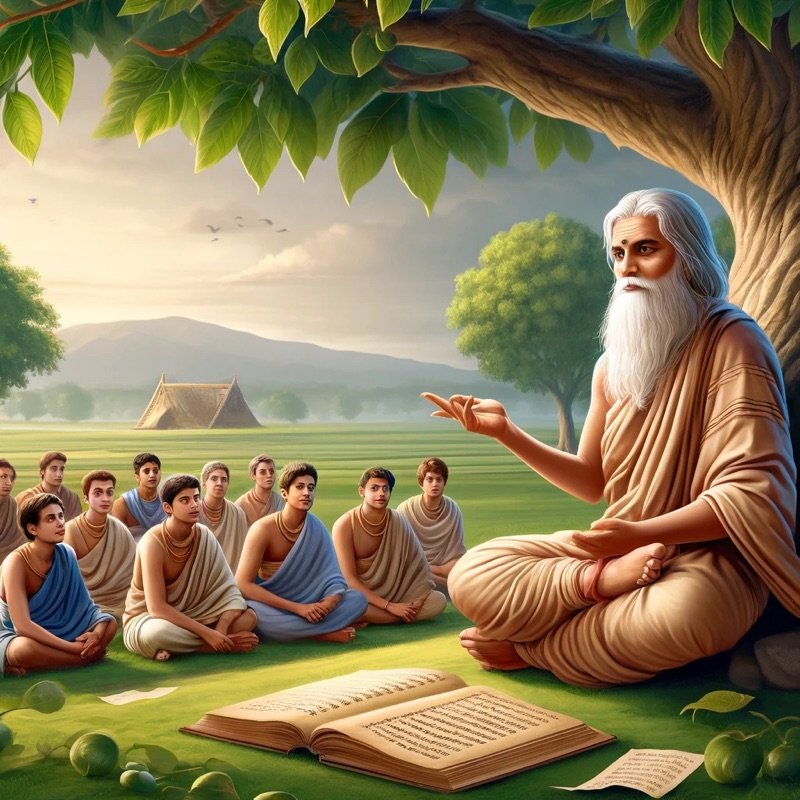
Given these limitations, it becomes clear why the guru-shishya parampara remains not merely a cultural preference but a structural necessity. Indian classical music is, at its core, an oral-aural tradition: knowledge passes through sustained listening, imitation, correction, and internalisation over years of close contact between teacher and student.
The guru does not simply transmit compositions; they transmit a way of hearing. When Bade Ghulam Ali Khan taught his disciples, or when Semmangudi Srinivasa Iyer shaped a generation of Carnatic vocalists, what they conveyed was an entire aesthetic sensibility — the weight of a particular phrase, the emotional temperature of a pause, the right moment to accelerate into a taan or pull back into stillness. No notation, however sophisticated, can encode this.
This is not to diminish the value of written notation. Bhatkhande's work was revolutionary precisely because it rescued hundreds of compositions from obscurity and made raga knowledge accessible beyond the closed doors of hereditary musicians. Notation serves brilliantly as a mnemonic scaffold, a reference tool, and a means of preservation. Scholars today rely on published notations to study compositional structures, trace historical evolution, and compare regional variants of bandishes and kritis.
But the rasika who wishes to truly understand a raga must go beyond the page. They must listen — to concert recordings, to the slow unfolding of an alap at dawn, to the way a master musician breathes life into a phrase that looks unremarkable on paper. The notation points the way; the tradition carries you there.
In an age of digital archives, machine learning transcription, and global access to recordings, the relationship between notation and oral transmission is evolving. Yet the fundamental truth remains: Indian classical music lives in the space between the notes — in the gamakas, the silences, the improvisatory leaps of imagination — and that space will always require a living human tradition to traverse.