
In This Article
The Hereditary Foundations of Indian Classical Music
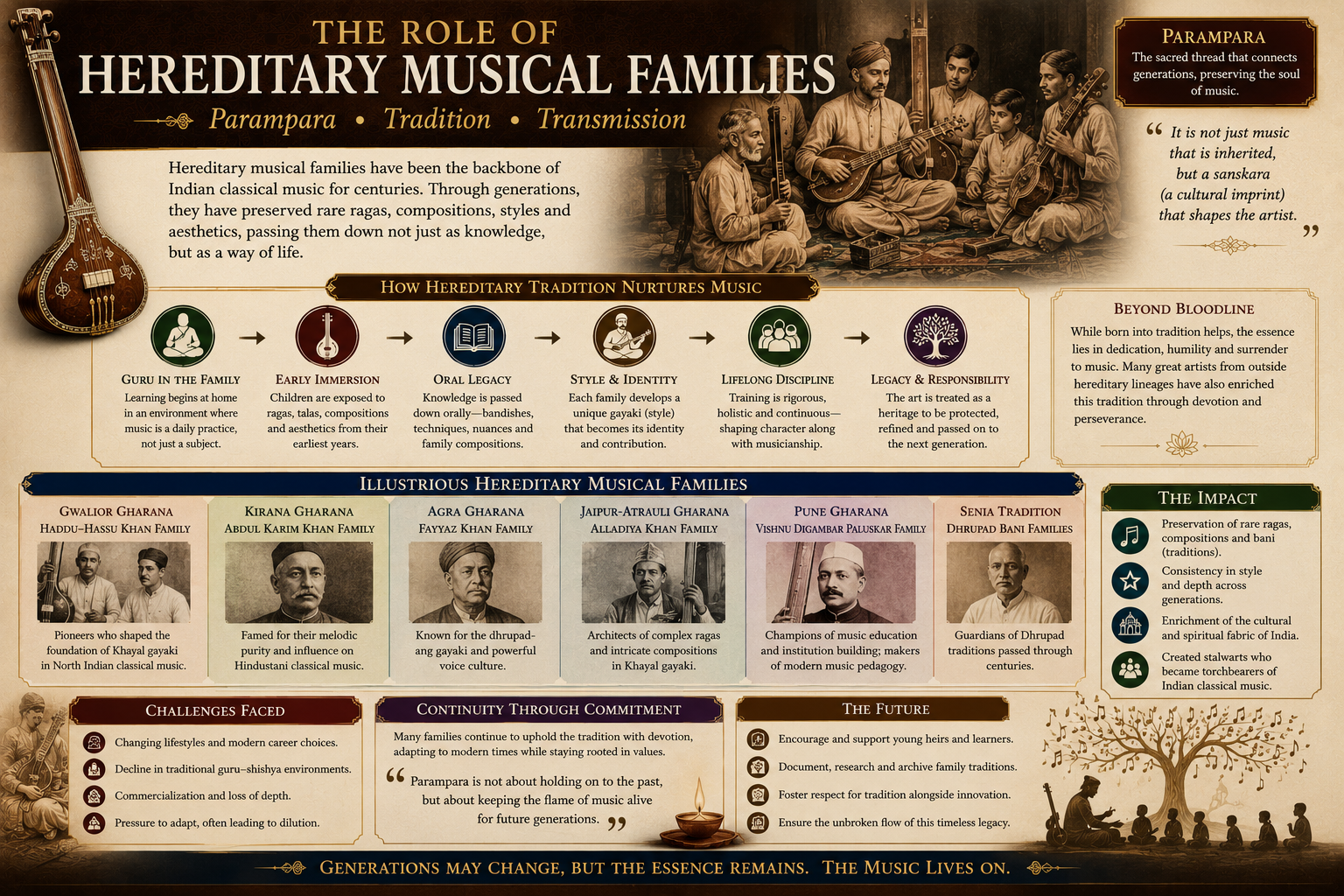
For centuries, Indian classical music was not merely an art form one chose to pursue; it was a birthright, a sacred inheritance passed from parent to child across generations. The very architecture of both Hindustani and Karnatik traditions rested upon the family unit as the primary institution of musical learning, preservation, and innovation. Understanding these hereditary structures is essential to comprehending how the music we hear today came to exist in its present form.
In the Hindustani tradition, the concept of the gharana—derived from the Hindi-Urdu word ghar (house)—emerged as the dominant organisational framework from roughly the 18th century onwards. Each gharana represented a distinct stylistic school anchored in a founding family lineage. The Gwalior gharana, widely considered the oldest among vocal gharanas, traces its origins to Nath Maharaj and was consolidated by figures such as Hassu Khan, Haddu Khan, and Nathu Khan in the mid-19th century. The Agra gharana, known for its emphasis on layakari and nom-tom alaap, descended from Ghagge Khudabaksh. The Kirana gharana, celebrated for its meditative, swara-focused approach, was shaped by Abdul Karim Khan (1872–1937) and Abdul Wahid Khan (1871–1949). In instrumental music, the Senia gharana claimed direct descent from Tansen himself, the legendary musician at Emperor Akbar's court in the 16th century, through his sons and sons-in-law.
In the Karnatik tradition of South India, hereditary musicianship was organised along somewhat different social lines. The isai vellalar community—a Tamil term meaning "musical cultivators"—comprised families whose identity was inseparable from their musical and dance practice. Alongside them, certain brahmin families maintained parallel lineages of musical learning. The great Thanjavur Quartet—Chinnayya, Ponnayya, Sivanandam, and Vadivelu—active in the early 19th century at the Maratha court of Thanjavur, exemplified how familial collaboration produced monumental contributions to both music and dance. Similarly, the legacy of Tyagaraja (1767–1847) was carried forward by his disciples and their family lines, creating what scholars sometimes call sampradayas or banis (stylistic traditions) analogous to northern gharanas.
Guru-Shishya Parampara: Methods of Knowledge Transmission
The hereditary system relied upon an intensely intimate mode of transmission. Children born into musical families began absorbing music almost from infancy—hearing their parents practise, falling asleep to the sound of ragas appropriate to the late hours, and gradually being drawn into structured training from as young as five or six years of age.
The pedagogy was overwhelmingly oral. Compositions—whether Hindustani bandishes, dhrupad compositions, or Karnatik kritis and varnams—were transmitted voice to voice, hand to hand, without written notation. This was deliberate: the subtleties of gamaka (ornamentation), microtonal inflections, rhythmic nuance, and the emotional architecture of a raga could not be adequately captured in any notational system. As the legendary sarangi master Ram Narayan once reflected, the only way to truly learn was to live in the presence of one's guru, absorbing the music through constant, immersive exposure.
"The music lives in the air of the house. You do not learn it; you breathe it in."
— A sentiment attributed to several hereditary musicians across traditions
Within this system, certain compositions were treated as family heirlooms—khandani cheezein in Hindustani parlance—guarded carefully and revealed only to trusted inheritors. A gharana's identity rested substantially on its repertoire of rare bandishes, specific raga treatments, and proprietary techniques. The Dagar family, torchbearers of dhrupad singing, maintained compositions believed to date back several centuries, transmitting them exclusively within the family for generations. In the south, the Semmangudi lineage—following the great Semmangudi Srinivasa Iyer (1908–2003)—preserved particular approaches to manodharma (improvisation) and kriti rendition that marked their students distinctly.
The system also extended to instrument-making. Families of veena makers in Thanjavur, mridangam craftsmen in Tanjore and Kumbakonam, and sitar and sarod builders in Miraj sustained specialised knowledge that was itself a form of musical inheritance.
Challenges, Exclusions, and the Shadow Side
For all its richness, the hereditary system carried significant structural problems that must be acknowledged honestly.
- Exclusivity and secrecy: The guarding of repertoire, while preserving certain traditions, also meant that vast bodies of musical knowledge were lost when family lines ended without heirs or when descendants chose other professions. When the great Bade Ghulam Ali Khan (1902–1968) of the Patiala-Kasur gharana passed away, concerns immediately arose about the preservation of his distinctive gayaki.
- Caste and community barriers: Access to musical training was heavily circumscribed by birth. The isai vellalar community, despite being the custodians of much of South India's performing arts heritage, occupied an ambiguous social position—respected for their art yet stigmatised by caste hierarchies. The devadasi tradition, in which women from particular communities were dedicated to temples and trained in music and dance, produced extraordinary artists such as Veena Dhanammal (1867–1938) of Madras, whose austere, deeply authentic style of veena playing and padams remains legendary. Yet the social reforms of the early 20th century, while rightly addressing exploitative aspects of the devadasi system, also resulted in the marginalisation of these hereditary artists and the near-extinction of their art forms.
- Gender dynamics: Women in hereditary musical families often faced paradoxical situations. In some communities, such as the devadasi and tawaif traditions, women were the primary carriers of musical knowledge—yet they were socially stigmatised. The great Kesarbai Kerkar (1892–1977), Mogubai Kurdikar (1904–2001), and Siddheshwari Devi (1908–1977) all navigated these complex social waters. In other families, women's musical abilities were cultivated but they were discouraged from public performance.
- Pressure on inheritors: Not every child born into a musical family possessed the temperament or talent for a life in music. The expectation of carrying forward a family legacy could be crushing, and the annals of Indian music contain quiet stories of sons and daughters who struggled under the weight of a famous surname.
Modern Transformations and the Enduring Legacy
The 20th century brought seismic changes to the hereditary system. The decline of princely court patronage after Indian independence in 1947 removed the economic foundation that had sustained many musical families. The establishment of institutional frameworks—Bhatkhande Music Institute (founded in Lucknow, 1926), the Music Academy, Madras (founded 1928), and ITC Sangeet Research Academy (founded in Calcutta, 1977)—began democratising access to classical music training. All India Radio, from the 1930s onwards, brought gharana music into millions of homes, simultaneously widening the audience and weakening the exclusivity that had characterised hereditary transmission.
Today, the picture is complex and layered. Several hereditary lineages continue to thrive: the Dagar family remains central to dhrupad; Kaushiki Chakraborty carries forward the Patiala gharana legacy of her father, Ajoy Chakraborty; in the south, Bombay Jayashri and T.M. Krishna represent lineages of learning (if not always biological descent) that connect to earlier masters. The Iyer and Iyengar families of Karnatik music—dynasties like that of the great Ariyakudi Ramanuja Iyengar (1890–1967), who revolutionised the concert format—continue to shape the tradition through their descendants and disciples.
Yet the boundaries between hereditary and non-hereditary musicians have blurred considerably. Many of today's finest artists come from non-musical families, having sought out masters through institutional or personal connections. Conversely, several scions of illustrious musical families have chosen careers outside music entirely.
What endures, however, is the fundamental insight at the heart of the hereditary system: that Indian classical music is not merely a collection of techniques and compositions, but a way of being that requires total immersion. Whether that immersion occurs in a family home in Kolkata, a gurukul in Pune, or a music college in Chennai, the principle remains. The hereditary families gave Indian classical music its depth, its diversity of styles, and its astonishing continuity across centuries. Their legacy is not merely historical—it is the living foundation upon which every contemporary artist, knowingly or not, continues to build.