
In This Article
Historical Foundations: Thanjavur as the Seat of Carnatic Music
No city in South India can claim a more central role in the development of Carnatic music than Thanjavur (anglicised as Tanjore). While the roots of the art form stretch back to ancient Tamil and Sanskrit traditions, it was during the reign of the Thanjavur Nayaks (1532–1673) and, more decisively, the Thanjavur Maratha dynasty (1674–1855) that the region became the crucible in which modern Carnatic music was forged. The Nayak rulers, originally governors under the Vijayanagara Empire, were generous patrons of the arts, establishing a courtly ecosystem where music, dance, and literature could flourish side by side.
When the Maratha king Venkoji (Ekoji I), half-brother of Chhatrapati Shivaji, established Maratha rule in Thanjavur in 1674, a remarkable period of cultural synthesis began. The Maratha rulers—particularly Shahaji II (r. 1684–1712), Tulaja I (r. 1728–1736), Pratap Singh (r. 1739–1763), and the celebrated Serfoji II (r. 1798–1832)—were themselves accomplished musicians and scholars. Shahaji II composed operas (yakshaganas) in multiple languages, while Tulaja I authored the landmark musicological treatise Sangita Saramrita, which codified raga and tala systems that remain foundational to Carnatic theory.
Under this extraordinary patronage, Thanjavur attracted musicians, dancers, and scholars from across the subcontinent. The city's temples—above all the magnificent Brihadeeswara Temple—served as institutional anchors for musical performance, with the devadasi tradition and temple odhuvars (Tamil hymn singers) adding further layers to the musical culture. The Saraswathi Mahal Library, expanded significantly under Serfoji II, preserved thousands of musical manuscripts, ensuring the intellectual continuity of the tradition.
The Musical Trinity and the Thanjavur Composer Tradition
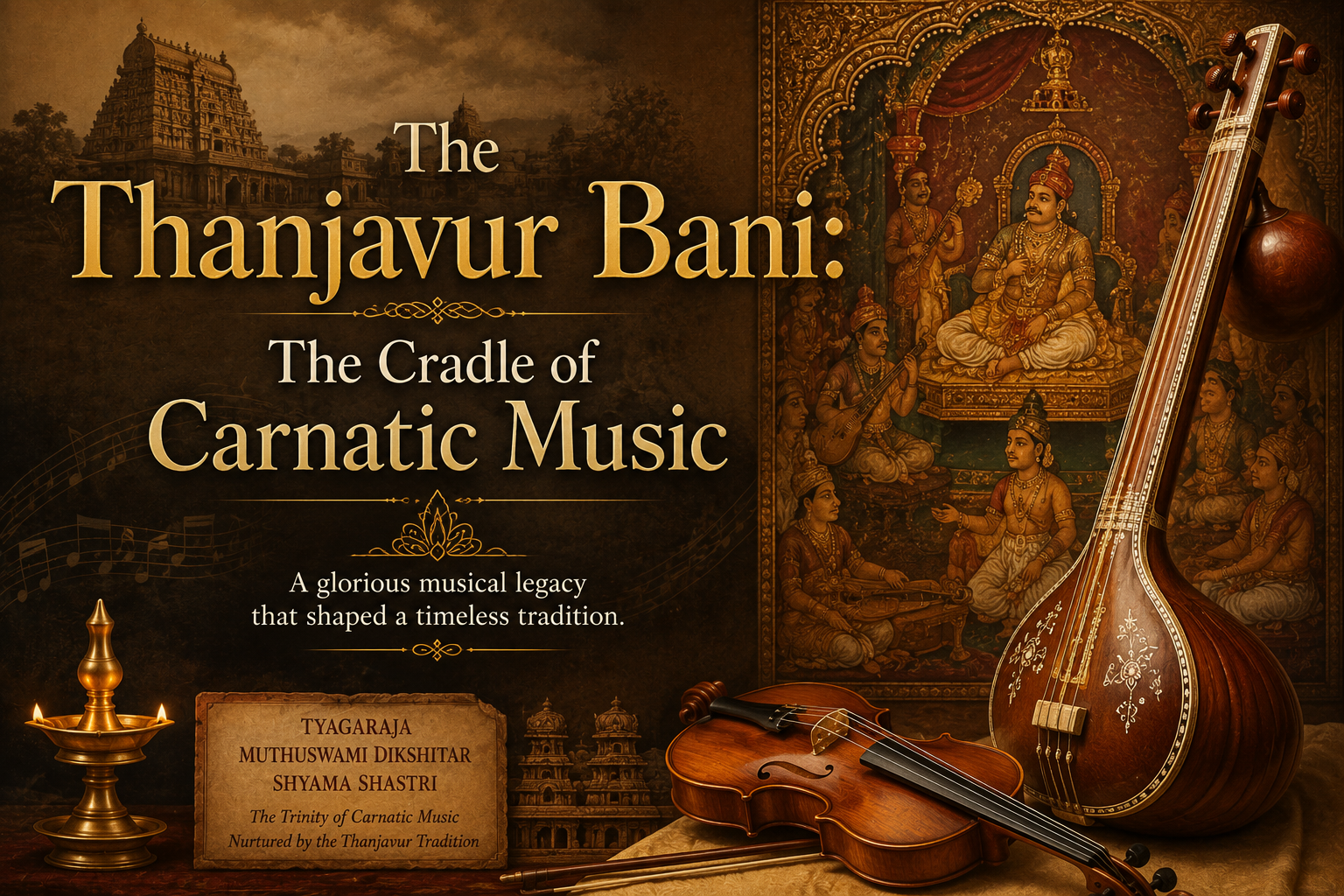
The crowning glory of the Thanjavur bani is the emergence of the Musical Trinity (Sangita Mummoorti)—Tyagaraja (1767–1847), Muthuswami Dikshitar (1775–1835), and Syama Sastri (1762–1827)—all born within a few years of each other in the Thanjavur region. Together, they defined the compositional vocabulary of Carnatic music in ways that remain unmatched.
- Tyagaraja, born in Tiruvarur and raised in Tiruvaiyaru, composed hundreds of kritis in Telugu, establishing the kriti form as the centrepiece of Carnatic concerts. His Pancharatna Kritis—five masterpieces in Ghana ragas—are performed collectively every January at his aradhana in Tiruvaiyaru, an event that remains the single largest gathering of Carnatic musicians in the world.
- Muthuswami Dikshitar, born in Tiruvarur, composed primarily in Sanskrit, employing a majestic, slow-paced style influenced by Hindustani music and Vedic chanting. His compositions on temples across South India—particularly the Kamalamba Navavarna Kritis on the Goddess at Thiruvarur—are marvels of musical and literary architecture.
- Syama Sastri, also of Tiruvarur, composed fewer pieces but with extraordinary emotional depth and rhythmic sophistication. His swarajatis and kritis in ragas like Anandabhairavi and Todi remain touchstones of the repertoire.
Beyond the Trinity, the Thanjavur region produced an astonishing density of composers. Swati Tirunal Rama Varma (1813–1846), the Maharaja of Travancore, was deeply influenced by the Thanjavur school. The Thanjavur Quartet—Chinnayya, Ponnayya, Sivanandam, and Vadivelu—codified the Bharatanatyam margam (concert repertoire) in the early nineteenth century, composing varnams, padams, and javalis that remain standard fare for dancers and musicians alike. Later composers such as Patnam Subramania Iyer, Poochi Srinivasa Iyengar, and Maha Vaidyanatha Sivan continued to enrich the tradition well into the late nineteenth and early twentieth centuries.
"Thanjavur did not merely produce great musicians—it produced the very grammar by which Carnatic music is spoken."
Defining Characteristics of the Thanjavur Bani
The term bani (literally "voice" or "style") in Carnatic music refers to a regional or lineage-based approach to performance, encompassing vocal production, ornamentation, phrasing, rhythmic sensibility, and aesthetic priorities. The Thanjavur bani, while not a monolithic entity, possesses several recognisable traits that distinguish it from styles associated with other regions such as the Mysore or Travancore courts.
Emphasis on compositional fidelity: The Thanjavur tradition places enormous importance on the faithful rendition of kritis as received through guru-shishya parampara (teacher-student lineage). Minute details of sangatis (melodic variations within a composition), as taught by Tyagaraja and his direct disciples, are preserved with near-sacred reverence. This contrasts with more improvisatory schools where the composition may serve primarily as a springboard for manodharma (creative elaboration).
Melodic richness and gamaka sophistication: The Thanjavur vocal style is characterised by richly ornamented phrases, with gamakas (oscillations and graces) rendered with precision and depth. The influence of the Tiruvarur temple tradition, with its emphasis on devotional intensity, lends the style a warmth and emotional directness that is immediately recognisable.
Rhythmic vitality: The region's close association with mridangam and nattuvanar (dance master) traditions ensured that rhythmic sophistication was woven into the fabric of the bani. The great mridangam masters of Thanjavur—including Narayanswami Appa, Manpoondia Pillai, and later Palghat Mani Iyer (who absorbed much from Thanjavur lineages)—shaped a percussive aesthetic that prizes both mathematical complexity and musical taste.
Integration of music and dance: Unlike some other centres where music and dance evolved more separately, the Thanjavur bani reflects a deep interpenetration of the two arts. The Thanjavur Quartet's work ensured that musical compositions were conceived with choreographic possibilities in mind, and vice versa. This gave the bani a theatrical dimension and a particular sensitivity to sahitya (lyrical text) and abhinaya (expressive interpretation).
Temple-centred aesthetics: The Thanjavur style retains strong connections to temple worship. The odhuvars singing Tevaram hymns, the nagaswaram maestros performing at temple festivals, and the ritual contexts of utsava sampradaya (festival traditions) all contributed to a musical sensibility rooted in devotion and communal celebration rather than purely courtly refinement.
Legacy and Continuing Influence
The Thanjavur bani's influence on the broader Carnatic tradition cannot be overstated. When the centre of concert activity shifted to Madras (Chennai) in the early twentieth century—particularly with the founding of the Madras Music Academy in 1927 and the establishment of the annual December music season—it was the Thanjavur repertoire and aesthetic that formed the backbone of the emerging concert format.
The great vocalists who dominated the twentieth-century stage were overwhelmingly products of Thanjavur lineages. Ariyakudi Ramanuja Iyengar (1890–1967), widely credited with formalising the modern Carnatic concert (kutcheri) format, drew deeply from the Thanjavur tradition in constructing a programme that balanced composed pieces with improvisatory elements. Semmangudi Srinivasa Iyer (1908–2003), Musiri Subramania Iyer (1899–1975), and G. N. Balasubramaniam (1910–1965) all carried forward lineages traceable to Thanjavur-based gurukulams.
Instrumentalists, too, bear the Thanjavur imprint. The veena tradition of the region, exemplified by Veena Dhanammal (1867–1938) and her descendants, preserved a style of exquisite subtlety and restraint that many regard as the purest expression of the Thanjavur aesthetic. The nagaswaram tradition, with towering figures like Tiruvizhimizhalai Subramania Pillai and T. N. Rajarathinam Pillai (1898–1956), carried the temple-centred dimension of the bani into the concert hall with electrifying effect.
Today, the Thanjavur bani faces the challenge confronting all regional traditions in an age of globalisation and digital homogenisation. The December season in Chennai, while vibrant, tends to flatten regional distinctions. Yet dedicated musicians and institutions continue to preserve Thanjavur-specific repertoire and performance practices. The annual Tyagaraja Aradhana at Tiruvaiyaru, the Thiruvaiyaru Music Festival, and the work of organisations such as the Thanjavur Sangeetha Vidwat Samajam remain vital custodians of this heritage.
For the serious rasika, understanding the Thanjavur bani is not merely an exercise in musical history—it is an encounter with the very soul of Carnatic music. The compositions, the performance practices, and the aesthetic values that emerged from this remarkable delta region continue to shape every concert heard today, whether in a Chennai sabha or a concert hall in London or New York. Thanjavur's legacy is not a relic of the past; it is the living foundation upon which the entire edifice of Carnatic music stands.